Trust a more informed palate
Why Warm Sake Is Not the Sake You Gave Up On
Serving temperature changes what a sake shows and what a salty, warm dish asks of it. The right question is not cold versus warm but which grade, aroma and food texture are on the table.
Asserted
“Good sake is cold, and warm sake is what happens when somebody stopped caring.”
Corrected
Sake's temperature-dependent style differences meet tasting method's controlled comparison at the point where two temperatures reveal whether warmth opens texture or merely buries aroma.
What to do
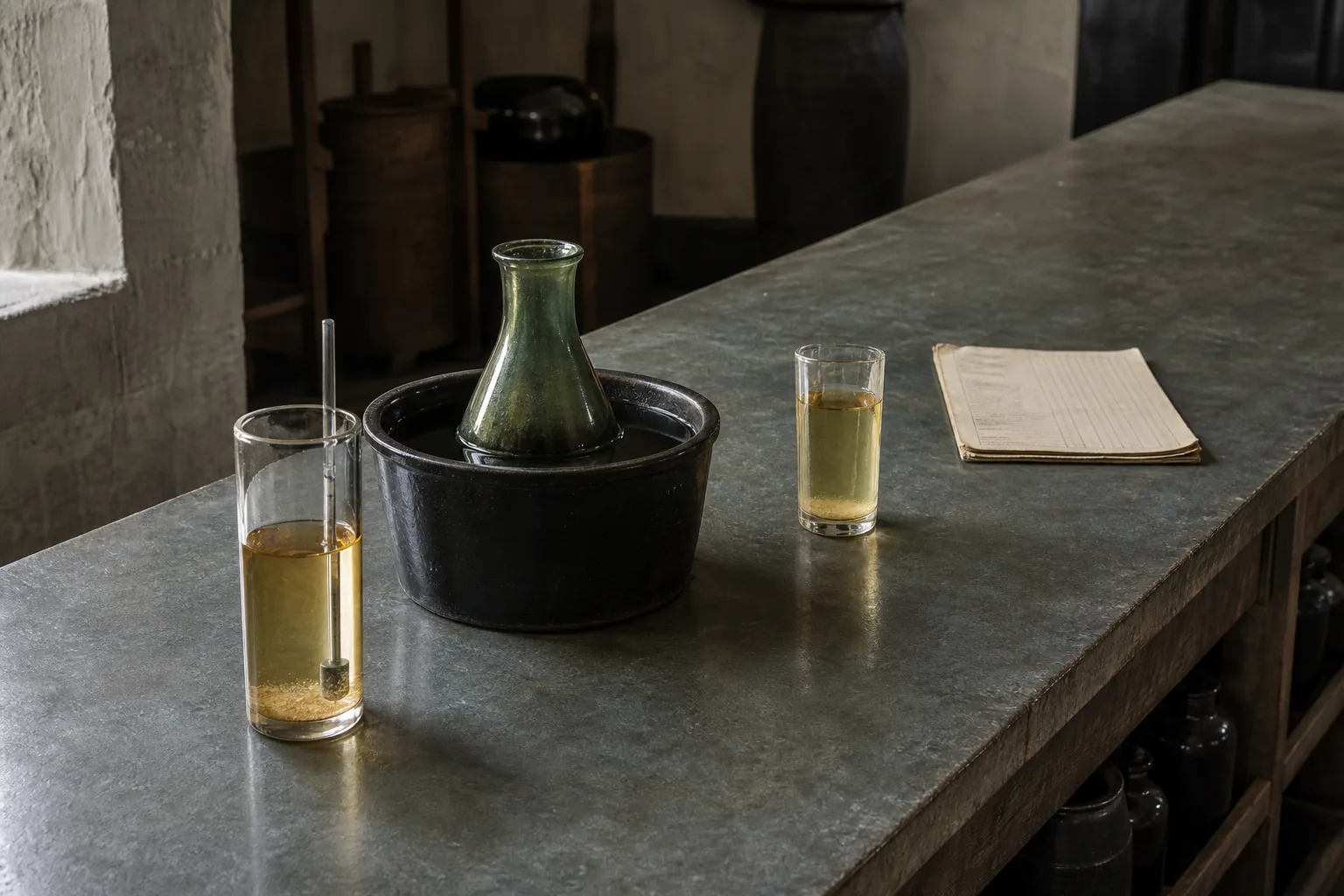
Pour two 45 to 60 mL samples of the same sake, one chilled and one gently warmed; choose the temperature that keeps aroma clear beside the actual dish.
Thomas had put every bottle in the refrigerator.
Not one bottle. Every bottle.
The shelf held beer, sparkling water, a jar of mustard, and a row of sake bottles lying down with the resigned look of people awaiting an administrative decision.
“Cold,” he said, seeing Clara look at them. “That’s how you know it is good.”
“How?”
“It is good enough to serve cold.”
This had the circular security of a locked room.
Clara removed one bottle with the calm of a person correcting furniture.
“That one can be warm.”
“No,” Thomas said. “Warm sake is what happens when somebody stopped caring.”
The rice hadn’t become bad because it was no longer cold.
And the refrigerator has never once tasted anything.
Because cold, room temperature and warm sake are not three grades of effort.
They’re three service conditions for the same liquid. Chilled runs roughly 8 to 15 °C. Room temperature runs 15 to 25 °C.
Warmed runs 40 to 50 °C, with the traditional starting point nearer 42 to 45 °C.
Those aren’t commandments written on a small mountain. They are useful places to begin a comparison.
Is Good Sake Always Served Cold?
Thomas’s rule is attractive because it has one setting.
It also gives the refrigerator considerable authority over a subject it has not studied.
A grade on the label doesn’t settle your temperature question.
Honjōzō, ginjō and daiginjō describe how much of the rice grain is left after polishing, and the direction of that number surprises people.
A 60% polishing ratio means 60% of the original weight remains.
It does not mean 60% has been scraped away, however much the bottle design might prefer that misunderstanding.
More polishing does change the substrate.
The outer layers hold fats, minerals and proteins, so a higher polish tends toward a lighter, more delicate result.
That tells you something about the material. It does not tell Thomas what his dinner wants.
Two bottles that clear the same threshold can still differ in rice, koji, yeast, finishing and declared alcohol.
The category is an entry point. It’s not a thermostat.
“So daiginjō is cold,” Thomas said.
“That was not what she said.”
This was technically true, although nobody had asked the narrator.
Junmai is not an instruction to heat anything either.
It tells you that no brewing alcohol was added, which can affect extraction and balance. It says nothing at all about warm or cold.
Genshu works the same way. It tells you no water was added before bottling, so the bottle carries its own higher declared strength.
That’s a fact about the liquid, not a temperature superstition.
How Serving Temperature Changes Sake
Cold service suppresses subtle expression and makes texture seem denser.
Warming makes the liquid seem lighter and brings cereal-like aroma forward.
Which is already enough to ruin the idea that warmth is just cold with poorer manners.
The mechanism is less mystical than the menus make it sound. Warming volatilizes alcohol and the low-boiling aroma compounds along with it.
At a useful point, that releases an aroma, or lets a warm salty dish and the sake’s texture meet in the middle.
Go too far and the alcohol masks the delicate aroma instead. The result isn’t “more expressive.” It is a small room full of ethanol.
Sweetness also registers more strongly near body temperature.
That doesn’t make a warm sake objectively sweeter, and it certainly doesn’t authorize a speech about how the rice has become comforting.
It means your perception moves with the service condition, while the measured values in the bottle stay exactly where they were.
The sweetness number on a technical sheet is a density-based value, not a tiny digital judge of deliciousness.
Two sakes carrying the same sugar can read very differently when their acidity differs.
Thomas watched Clara set a small pan of hot salted broth beside the bottle.
“That seems suspiciously like dinner.”
“It is dinner.”
The dish matters, because it changes the question.
A chilled sake may hold a fine floral aroma beautifully in a quiet glass.
Beside a warm, salty dish, a gently warmed pour may make its texture more useful without losing that clarity.
Or it may bury the very aroma you bought the bottle to show.
You don’t get to know in advance because the word premium has been printed in a restrained typeface.
Which Sake Styles Benefit From Gentle Warming?
There is no legal class called “the sort Thomas neglected in college.”
There are production and stability facts, which are less colorful and much more usefully rude to shortcuts.
Koji converts the rice starch into fermentable sugars while yeast converts those sugars to alcohol, both at once, in the same mash.
Nothing in that machinery selects a serving temperature. It does remind you that “rice wine” is concealing a great deal of apparatus.
The temperature words are worth separating, though, because a casual conversation will pile them into one warm syllable.
Fermentation temperature, pasteurization temperature, storage instruction and serving temperature are four different events. Only the last one is yours.
Pasteurization is a treatment condition, not a suggestion that you serve the sake as soup.
Namazake skips it entirely, which makes the bottle less stable and gives cold service a practical reason rather than a fashionable one.
So ginjō and nama are sensible first candidates for the cold trial. They are not prisoners of it.
Nigori and sparkling sake need even less swagger.
Fermenting nigori froths more than clear sparkling sake, wants several hours of chilling, and shouldn’t be shaken before opening.
Heat a carbonated bottle and you lose the gas.
This is not an opportunity for flexibility. It is an opportunity to keep the ceiling dry.
“So which one gets warmed?” Thomas asked.
“The one that survives being tasted.”
Clara had a talent for making a method sound like a threat.
How to Compare Sake at Two Temperatures
What you want is a paired comparison, not a performance.
The question runs one direction only.
Beside this finished dish, does gentle warmth open the texture while keeping the aroma clear, or does it mask the aroma?
Write that down before you pour. Otherwise Thomas will declare victory the moment a warm glass makes him briefly cheerful.
Pour two 45 to 60 ml samples of the same sake into the same kind of glass. Equal volume is the discipline that matters.
Record the bottle, the glass, the pour, the order and the measured temperature.
Chill one to the low band, or to whatever the bottle specifies. Warm the other gently, starting near the traditional point.
Do not compare a freshly opened cold pour against a warm remainder that has been breathing on the counter.
That’s a trial of temperature, time, oxygen and your own patience, and it will answer nothing cleanly.
Set the glass against a neutral, well-lit background. Note clarity, color and any visible gas or deposit before you swirl.
Take a short still sniff. Then swirl gently, let the surface settle, and sniff again.
Keep aroma intensity apart from aroma character. “More” and “different” are not synonyms, though they are frequently photographed together.
Then take the same small sip from each glass.
Record sweetness, acidity, alcohol impression, body, flavor intensity, texture and finish before you reach for the words better or serious.
Formal tasting grids separate appearance, nose, palate, finish and quality for exactly this reason.
A broad word like rich should not be allowed to perform every job in the room.
Now eat the actual warm, salty dish. Go back to each temperature and record what happened.
Does the chilled sample keep its aroma and turn dense and detached? Does the warm one bring cereal character and a more useful texture?
Has the alcohol become conspicuous?
The conclusion belongs to this bottle, this glass, these temperatures and this dish.
It is a service choice, not a constitutional amendment.
Thomas tasted the chilled sake, then the warm one, then the broth.
“The second one is warmer,” he said.
“Yes.”
“But it is also different.”
“Yes.”
He looked faintly betrayed, as though cold had promised more than it could deliver.
The refrigerator had preserved the bottle. The warmth had made an argument.
Neither had made the rice worse.
Put it into practice
- A rice-polishing ratio states the rice remaining, while special-designation thresholds describe eligibility rather than a temperature rule.
- Chilled, room-temperature, and warmed service occupy distinct published temperature bands, and ginjō or namazake have more specific starting points.
- Warming volatilizes alcohol and low-boiling aroma compounds, while cold service can suppress subtle expression and make texture seem denser.
- A fair two-temperature comparison holds sake, pour volume, glass, order, and recorded service temperature constant except for the temperature being tested.
- Appearance, nose, palate, and finish should be recorded before a preference conclusion, with aroma intensity separated from aroma character.
- A hot, salty dish can change the useful serving decision, so the chosen temperature is tested beside the finished dish rather than chosen from a category name.
Asked across the table
- Is good sake supposed to be served cold?
- No. Association guidance groups chilled service at 8 to 15 °C, room-temperature service at 15 to 25 °C, and warmed service at 40 to 50 °C. Those bands describe different ways the same sake can present itself, not a hierarchy of care. The useful choice depends on the bottling's aroma and texture, its finishing state, and the actual food beside it.
- What does warming sake actually change?
- Warming makes alcohol and low-boiling aroma constituents more volatile. It can make the liquid seem lighter and push cereal-like aroma forward, while excessive heat can let alcohol mask delicate aroma. Cold service can suppress some subtle expression and make texture seem denser. Temperature therefore changes perception of the same bottled liquid; it does not change its ABV, SMV, acidity, or category.
- What temperature is a sensible place to start for warm sake?
- Traditional warm sake is suggested around 42 to 45 °C by the National Research Institute of Brewing. Association guidance defines the broader warmed band as 40 to 50 °C. Those figures are starting points for a service trial, not an instruction that every sake should be heated. A temperature should be recorded with the bottle and dish, because a warmer result can uncover texture or obscure delicate aroma.
- Should ginjo sake always stay cold?
- Ginjō is suggested around 8 to 10 °C by the National Research Institute of Brewing, because delicate aroma can be more vulnerable to excessive warming. That is a starting test, not a permanent ban on another temperature. Ginjō identifies a special-designation threshold of 60% or less rice remaining; it does not itself prove that every bottling performs best cold.
- Does a lower rice-polishing number mean a sake is better?
- No. Rice-polishing ratio states the share of original brown-rice weight that remains. A 60% declaration means 60% remains, not 60% has been removed. Higher polishing tends toward a lighter, more delicate result because outer layers contain fats, minerals, and proteins, but the number does not settle quality, aroma, koji behaviour, finishing state, food pairing, or serving temperature.
- What are the rice-polishing rules for honjozo, ginjo, and daiginjo?
- The special-designation thresholds are 70% or less rice remaining for honjōzō, 60% or less for ginjō, and 50% or less for daiginjō. These are eligibility thresholds, not a quality ladder or a service-temperature code. Two 50% releases can differ through rice, koji, yeast, water adjustment, aroma, and finishing, so they still require a bottle-specific tasting decision.
- Is junmai automatically the kind of sake that should be warm?
- No. Junmai states that the sake has no added jōzō alcohol; it does not state a required serving temperature. Eligible non-junmai special-designation sake may use neutral alcohol below 10% of polished-rice weight, while junmai excludes it. That distinction concerns alcohol-addition history. Aroma, texture, stability state, and the dish determine whether a particular junmai is more convincing chilled, at room temperature, or warmed.
- What does genshu mean on a sake label?
- Genshu means that sake has not been water-adjusted before bottling. It does not mean that no alcohol was added during production, so a junmai genshu and a non-junmai genshu can both be undiluted. Stored sake around 20% ABV is commonly diluted to roughly 15% ABV before shipment, but a genshu serving decision relies on the declared ABV of that specific bottle.
- Can namazake be warmed like ordinary sake?
- Namazake receives no heat treatment and is less stable than standard sake, so a cold service and freshness rationale matter before any warming experiment. Ginjō and namazake are suggested around 8 to 10 °C as a starting point. By contrast, hi-ire around 65 °C is a pasteurization treatment that inactivates enzymes and prevents re-fermentation; it is not a serving instruction.
- How can two sake temperatures be compared fairly at home?
- A fair comparison uses the same sake, equal pours, the same glass, and measured temperatures at each service point. Two 45 to 60 mL samples provide a practical home trial; a strict equal-pour comparison uses the same 60 mL pour. The tasting question is written first, and the only intended variable is temperature rather than glass shape, melted ice, dilution, or air exposure.
- What should be written down in a sake temperature trial?
- The record identifies the bottle, sample code, service condition, temperature, glass, pour volume, order, and dish. Appearance is recorded before swirling; the nose is assessed once still and once after a gentle swirl; palate fields include sweetness, acidity, alcohol impression, body, flavor intensity, and texture; finish is recorded before a conclusion. Aroma intensity and aroma character remain separate observations.
- Why should the final temperature be tested with the actual food?
- A temperature comparison answers a contextual service question, not a universal quality ranking. The useful trial places both samples beside the finished warm, salty dish and records whether aroma remains clear, texture becomes more or less useful, and alcohol becomes more conspicuous. The choice is qualified to that bottle, temperature, dish, glass, and tasting condition rather than claimed as a rule for all sake.