Choose what works
Why Truffle Oil Is Not a Small Truffle
A truffle oil may be useful and still be a different ingredient from a fresh truffle. Aroma source, declared truffle content and timing decide what the dish is getting.
Asserted
“Truffle oil is the practical version of truffle, only less expensive.”
Corrected
Truffles' volatile and labeling evidence meets luxury foods' grading and price signals where expensive-looking flavor can be delivered by declared aroma rather than the named fresh specimen.
What to do
Use fresh truffle as a last-minute shaving over a warm dish; use flavored oil by the drop, only after reading whether added aroma and actual truffle percentage are declared.
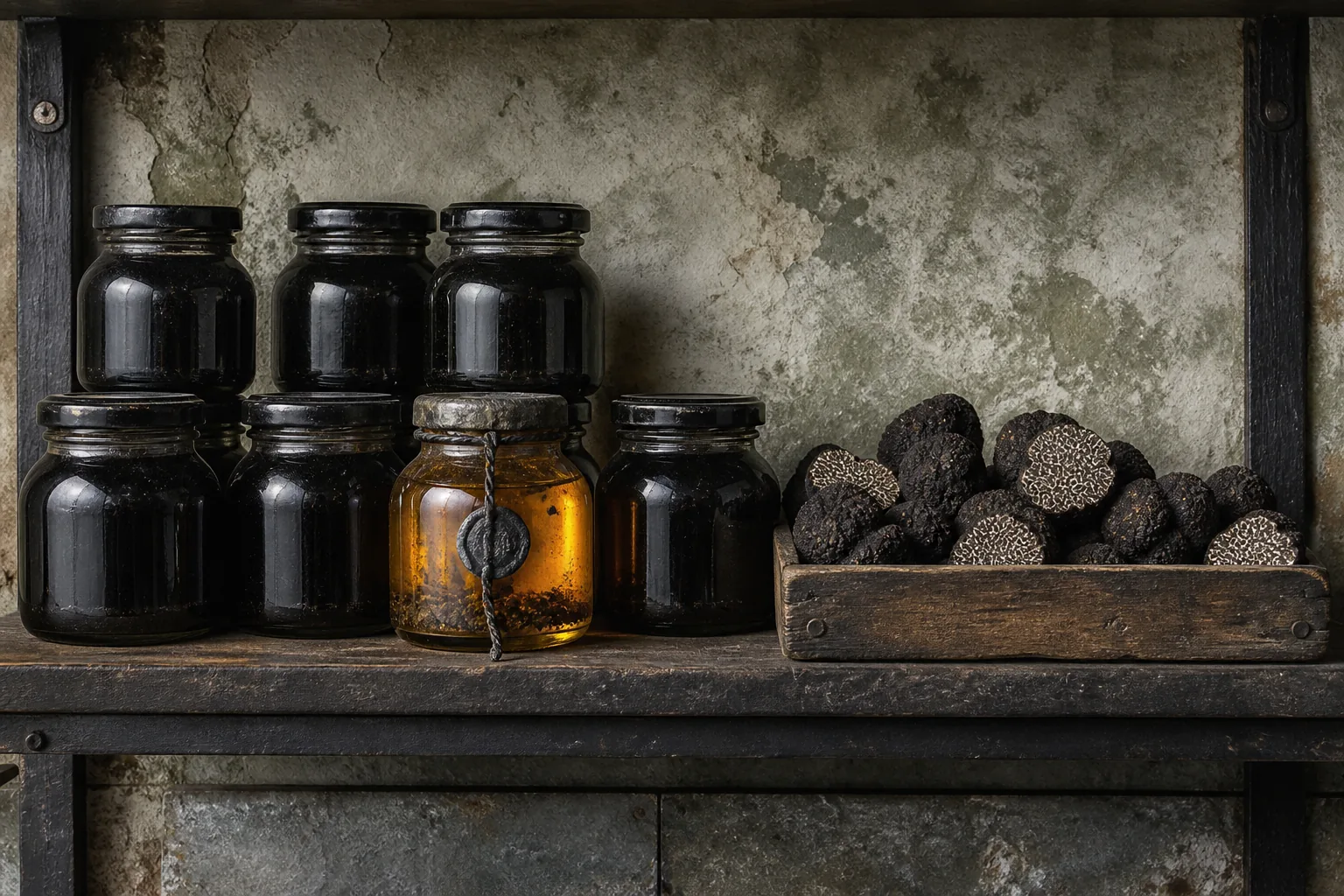
Thomas had bought a bottle with a black label, a gold neck, and the air of a minor European monarchy.
“Truffle,” he said, pouring it over the eggs.
Clara took the bottle and turned it around.
“Oil,” she said.
“Truffle oil.”
“That is two words.”
The kitchen went briefly quiet.
The eggs were warm. The oil was extremely aromatic. It had entered the room before anyone else had finished sitting down.
Thomas inhaled.
“It smells like truffle.”
“It smells of something called truffle.”
This seemed pedantic, which is how useful distinctions usually enter a meal.
He had been promised truffle, and the bottle had made a truffle-shaped noise. Surely that settled the matter.
It did not.
Because a fresh truffle and a bottle of truffle oil can both be excellent at dinner while making completely different claims about aroma, material, time and evidence.
The oil doesn’t have to be fraudulent to be a different ingredient.
It only has to stop pretending it is a small truffle that has learned to pour.
Is Truffle Oil the Same as Fresh Truffle?
No.
A fresh truffle is a fruiting body.
It has a species, a harvest date, a lot record, a condition when it reached you, and an aroma that starts changing the moment it comes out of the ground.
Truffle oil is processed.
It has a carrier oil, an ingredient statement, and an aroma source that may or may not be fresh truffle material.
Calling both of them “truffle” is a useful beginning. It isn’t the end of the sentence.
Fresh truffle aroma is also not one noble vapor rising from the earth to improve your risotto.
Researchers tracking a black truffle over less than a fortnight identified hundreds of volatile compounds in it, and found that storage, temperature, heat and contact with salt all moved the profile significantly.
That’s an inconveniently large number of ways for a truffle to stop being the truffle Thomas imagined while he was still looking for the grater.
Which is why fresh needs a time and a condition attached to it.
It isn’t a decorative adjective that becomes truer when printed in serif type.
A whole specimen, a frozen product, a paste and an oil are four different states, and they shouldn’t be made to compete on an abstract ladder called luxury.
Thomas picked up the bottle again.
“So it is not real?”
“It is real oil.”
This was not the answer he had hoped would arrive with breakfast.
The comparison you want isn’t real against fake.
It is immediate complexity against storage, portioning and reach.
Fresh truffle is a last-minute aromatic finish.
Oil distributes a recognizable flavor through a cold dish, a dressing, or a plate that has to behave the same way on Tuesday as it did on Friday.
The distinction is practical before it is philosophical, though philosophy does enjoy a free lunch.
Where Truffle Aroma in Oil Comes From
The ingredient list decides this, and it is on the back for a reason.
Fixing truffle aroma directly into a vegetable oil is genuinely difficult, because the compounds you want are volatile and unstable.
So the pronounced, stable note in most bottles arrives by a declared flavoring route instead.
That doesn’t make it a villain in a cape.
It means the aroma and the truffle are two separate facts, and the label has to tell you about both.
Plenty of products carry a small declared percentage of real truffle alongside added aroma.
One percent is not no truffle.
It also isn’t permission to let the front label do all the talking while the ingredient list waits on the back wearing a small hat.
Which is why intensity at the nose is a terrible purchasing test.
A freshly grated truffle, an oil made by extraction and an oil with added flavoring may all smell forceful at you.
None of that establishes the same species, origin, freshness or composition.
So ask blunt questions. What truffle material is declared? At what percentage? Is a species named? Is added flavoring declared?
What is the base oil?
Clara turned the bottle over.
“It says aroma.”
Thomas looked offended by the word, as though it had been caught behaving above its station.
“Aroma is not an accusation,” she said.
It isn’t.
You may want precisely that reliable, repeatable effect.
The trouble starts only when “truffle” is allowed to smuggle in a claim that the sensation came entirely from a named fresh specimen.
Ingredients are allowed to be useful. Labels are required to say which usefulness you bought.
Why Fresh Truffle Must Be Timed Differently
Shave fresh truffle over the warm dish after the heat has stopped.
The point isn’t ceremony, although people have done remarkable things with a small metal shaver and a dim dining room.
The point is that you are releasing the aroma at the plate, rather than asking it to survive the entire cooking process as though it had signed a contract.
Storage is part of the ingredient, and this is where most of the disappointment lives.
Under controlled cold storage with a managed package atmosphere, a black truffle can hold good aroma for around four weeks and a summer truffle for rather less.
Those are results under chosen conditions. They are not a retail blessing placed on every box with a ribbon.
Temperature, package atmosphere, handling, freezing, blanching, salt and one break in the cold chain all change what a later comparison means.
“Refrigerated” is a mood. A time-and-temperature record is evidence.
If you want fresh-truffle aroma at service, what you need is the shortest documented route you can get and a fast evaluation the moment it arrives.
Thomas produced a fresh truffle from a paper bag with the caution of a man unveiling a meteorite.
“This one, then?”
“After the heat.”
“And the oil?”
“Not instead.”
Fresh shaving and flavored oil can sit on the same table. They cannot be swapped for each other.
The first gives you a time-sensitive aromatic finish from a specimen. The second gives you a stable, portionable product effect.
Pour the oil into the pan early because it is “truffle” and you have confused its name with its job.
Shave the fresh truffle early because there is heat present and you have confused ceremony with chemistry.
Both errors are very expensive ways to make a kitchen smell decisive.
How to Read a Truffle Product Label
Read the back before you admire the front.
Write down the food name, the sold form, the ingredient list, the carrier oil, the truffle percentage if it is given, the flavoring declaration, the species, the lot identifier, the supplier, the claimed region and the date.
None of that is bureaucratic decoration. It separates a fresh-material claim from a processed-product claim, and a product-specific statement from a bottle-shaped anecdote.
Species claims need evidence in proportion to the claim.
DNA methods can distinguish species and detect a cheaper truffle mixed into an expensive one at low levels, in the matrix they were validated on.
That’s a method result. It is not a sensory threshold, and it is not a spell that authenticates every oil in a restaurant cupboard.
Whole specimens, chopped products, sauces and oils all present different analytical problems.
Price does not repair any of this.
The gap between what a white truffle and a black truffle fetch per kilo is exactly why substitution is tempting.
It cannot tell you what is in your bottle. A luxury price signal is a receipt with aspirations.
Paperwork doesn’t become persuasive by acquiring a wax seal, either.
A supplier invoice proves a commercial transfer. A producer certificate may support a scheme claim.
A laboratory report supports the sample it tested by the method it used.
Each has a job. None of them turns into a sensory award because the food was expensive.
For a processed product, the ingredient declaration is your starting document.
For provenance-led fresh service, it is the short chain from source to kitchen, with species, location, date and temperature.
Less seductive than a black box and a handwritten tag. Also the only route by which “fresh truffle” becomes more than an ambitious phrase.
Even the season can’t do the work alone. Collection windows tell you when a claim is plausible in that place.
They do not tell you that this particular truffle is mature, fresh or honestly identified. The lot record tells you what arrived.
Thomas read the ingredients in silence.
“So the oil stays?”
“Under supervision.”
He put one drop on a corner of the egg, then shaved the fresh truffle over the rest after the pan had gone quiet.
The oil was useful. The truffle was useful.
Neither had become the other, which was fortunate.
One can ask only so much of a bottle.
Put it into practice
- Fresh truffle aroma is time-sensitive and changes with storage treatment, temperature, heat, and salt contact.
- A flavored truffle oil and a fresh truffle are different product forms with different sensory and provenance claims.
- Added aroma, declared truffle percentage, stated species, carrier oil, and lot information must be read separately on a truffle product label.
- A high price does not establish a truffle's species, freshness, origin, or aroma source.
- Fresh truffle is shaved at service over a warm dish, while oil is used sparingly as a separately labeled finishing ingredient.
- Laboratory detection results are method- and matrix-specific and do not automatically authenticate an oil bottle.
Asked across the table
- Is truffle oil basically the same thing as a fresh truffle?
- No. Fresh truffle is a whole fruiting body with a time-sensitive, multi-compound aroma. Truffle oil is a processed product whose aroma may come from extraction, added flavor, declared truffle material, or a combination of these. Oil can be useful for stable distribution and portioning, but it cannot make the same freshness, species, or origin claim as a fresh specimen.
- If a truffle oil smells very strong, does it contain much truffle?
- Not necessarily. Aroma intensity does not state the amount or source of truffle material. The truffle factsheet describes products containing 1% fresh truffle alongside added aroma, and identifies 2,4-dithiapentane as a flavoring compound used in such products. A strong smell therefore requires an ingredient list, truffle percentage, species statement, and flavor declaration before it supports a larger claim.
- What is 2,4-dithiapentane doing in truffle oil?
- 2,4-dithiapentane is identified in the truffle factsheet as a flavoring compound used in processed truffle products. Its presence can supply a recognizable truffle-like note in oil even when direct fixation of unstable truffle odor compounds in vegetable oil is difficult. It describes an aroma route, not proof that the oil's flavor comes only from a named fresh truffle species.
- Why is fresh truffle shaved on after the heat is off?
- Fresh truffle aroma is highly time-sensitive, and research on T. melanosporum finds significant aroma effects from storage treatment, temperature, heat, and salt contact. Shaving a fresh truffle over a warm finished dish keeps its service role distinct from a cooked sauce or preserved product. The dish receives the aroma at the moment it is intended to be smelled rather than treating heat as a neutral holding condition.
- Does storage really change a truffle that quickly?
- Yes. A 12-day T. melanosporum experiment identified 695 volatile compounds and found that storage treatment and temperature changed the aroma profile. A T. aestivum study also observed important volatile and bacterial shifts over 9 days at room temperature. Freshness therefore needs a date, storage condition, and product state; a species name alone does not describe the aroma reaching the plate.
- What should a truffle oil label actually say?
- A useful truffle-product label states the actual truffle percentage when present, the carrier oil or base, the flavor declaration, and the species when declared. A lot identifier, supplier, product form, claimed region, and date records strengthen a provenance claim. “Truffle intensity” or “premium” does not identify whether the aroma comes from fresh truffle, extraction, or added flavor.
- Does an expensive truffle oil prove it uses a better truffle?
- No. Price records a transaction, not species, freshness, origin, maturity, or aroma source. An authentication study cited historical ranges of €3,000 to 5,000 per kg for T. magnatum and €700 to 1,200 per kg for T. melanosporum, but those figures are dated context rather than current quotations. Even a high price cannot replace a declared ingredient list and lot evidence.
- Can a laboratory test prove what is in a bottle of truffle oil?
- A laboratory result can support only the material, preparation, target, and method it actually tests. One PCR study used 117 fruiting bodies across seven target species and detected Asian black truffle in a T. melanosporum matrix at 0.5%. That analytical sensitivity is not a sensory threshold, a legal rule, or an automatic authentication method for a different matrix such as oil.
- Can packaging make a fresh truffle stay fresh for weeks?
- Under selected modified-atmosphere conditions, one study reported good aroma and flavor scores through 28 days for T. melanosporum and 21 days for T. aestivum. The study measured 4, 10, and 23 °C and selected packaging that produced 15% carbon dioxide and 7% oxygen at 4 °C. Those results are experiment-specific, not a retail guarantee for every package.
- When is truffle oil the sensible choice?
- Flavored truffle oil is a sensible choice when a dish needs a stable, recognizable note, easy distribution, and repeatable portioning, especially in a cold preparation. Fresh truffle is the appropriate choice when the dish needs an immediate aromatic finish and the claim concerns a fresh, identified specimen. The two choices solve different service and evidence problems rather than occupying one price ladder.
- Does a seasonal truffle name prove that the truffle is fresh?
- No. A season is a legal-logistical availability axis, while maturity and post-harvest condition are separate. Piemonte's published calendar lists T. magnatum from 1 October to 31 January, T. melanosporum from 15 December to 15 March, and T. borchii from 15 January to 30 April. Those local windows do not establish an individual specimen's harvest date, handling, or aroma.