Buy with confidence
Why Old Wine Is Not Automatically Historic Wine
Age can make a bottle scarce without making every attached story true. Historical trade, appellation formation and a physical bottle record have to agree before nostalgia becomes provenance.
Asserted
“It is old, so the history on the label must be real.”
Corrected
Wine history's evidence chain and appellations' conditional name rules meet when a historic-looking label is tested against the name, protection, and records actually available in its claimed period.
What to do
Before buying a historic bottle, compare the label's appellation and producer claim with its period, then retain catalogue, photos and seller record rather than relying on bottle age alone.
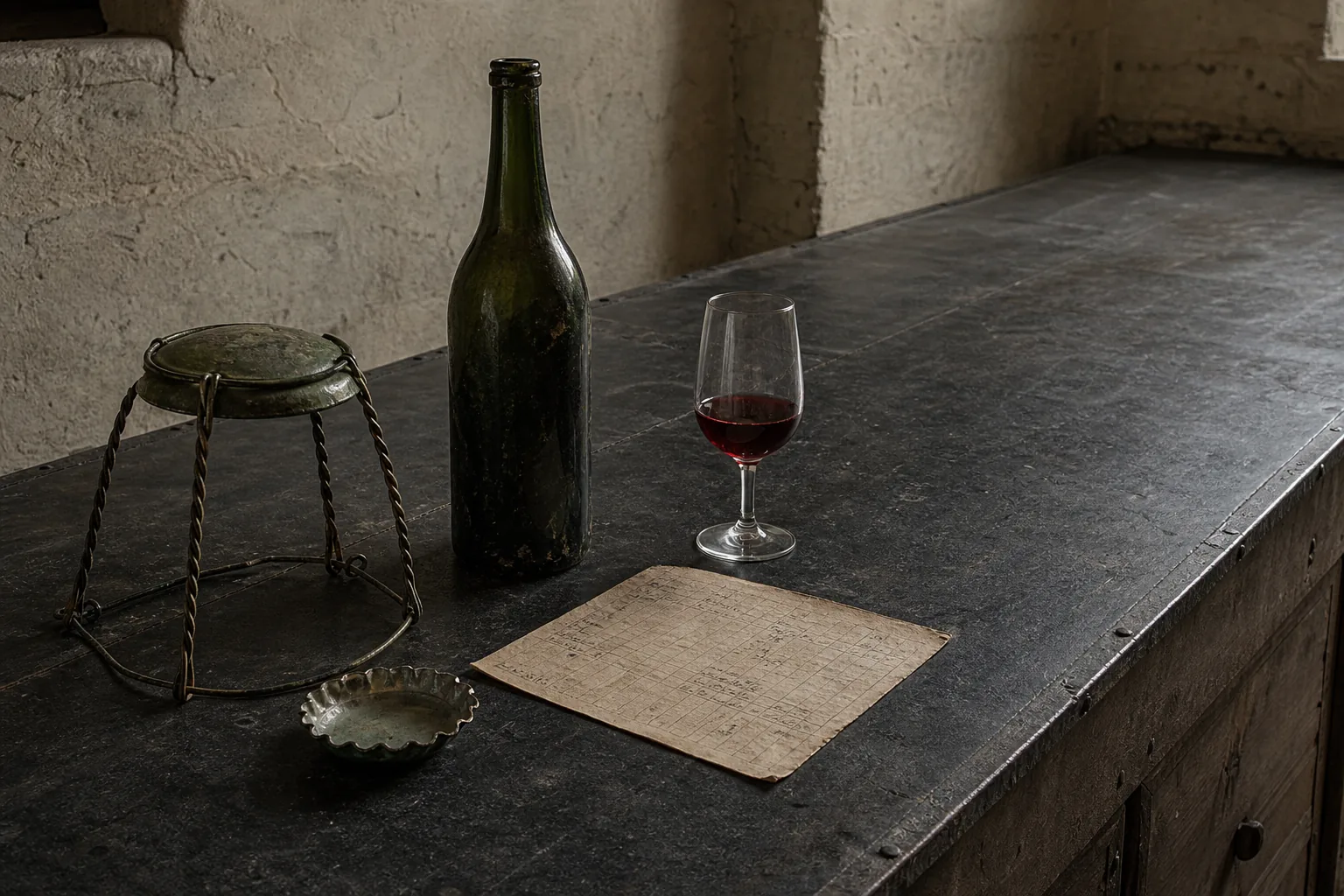
Thomas had bought a bottle with dust on it.
The dust was substantial.
It lay in the shoulders and around the capsule with the patient authority of something that had been there before anyone’s opinion mattered.
“Provenance,” he said.
“Dust,” said Clara.
“Historic dust.”
This seemed to Thomas a distinction worth having.
The label named an old-looking place. It also claimed an old-looking category.
The paper had foxed at the edges in a way that made time appear to have taken a personal interest.
“It says it is from before the appellation existed,” Clara said.
“That makes it earlier.”
“Yes.”
“Historic.”
“No.”
Because age and history aren’t rival descriptions of the same bottle.
One is a date. The other is an argument.
How Do You Check a Historic Wine Claim?
The first question isn’t whether the bottle looks old.
It does.
There are old books that look old too, which has not prevented some of them from acquiring an entirely modern paragraph at a strategically convenient moment.
Start with what you can actually observe. The bottle. The label. The closure.
The stated producer, the stated place, and the record by which it reached you.
Then work out what each of those can establish on its own.
A bottle establishes a physical object. A catalogue preserves what a seller represented. A label establishes that certain words appear on it.
None of them, alone, gives you the story.
Wine history runs on a chain: observation, identification, context, then inference.
The strongest chain names an actor, a dated action, and a mechanism connecting that action to production or exchange.
An amphora proves movement only with its setting and the evidence around it. A customs account records what an authority chose to assess.
A law says what was required, not what every merchant cheerfully did after lunch.
This isn’t pedantry for people who own magnifying glasses.
Archaeologists arguing about Greek wine moving through Phoenician ports build the case from transport amphorae plus the structures around them plus the evidence of taxation and inspection.
The amphorae didn’t announce the conclusion from the ground.
Your bottle doesn’t become more communicative because it spent longer in a cellar.
Records also survive unevenly.
Informal exchange leaves less trace than customs collection. A grand label outlasts the paperwork that would have made it interesting.
So the conclusion has to match the evidence. “Old bottle with an old-looking label” is a beginning.
It is not proof of estate history, protected origin, unbroken custody, or anything else that has grown conveniently expensive.
The point isn’t to make old wine joyless. It is already trying quite hard in that direction.
The point is to stop a scarce object from being promoted, by its own wrinkles, to a complete archive.
Thomas held the bottle nearer the window.
“The label has a date.”
“The label has printing,” Clara said.
When Did This Appellation Name Exist?
Now ask the question printed words dislike.
When, exactly, could this name and this category be used in the form your label claims?
An appellation isn’t a flattering adjective that falls from the sky onto a hillside.
It is a conditional right of use, and rights of use have start dates.
So a historical-looking label needs two timelines.
One is the period the bottle claims.
The other is the period in which that exact place name, category, wording and control mark were actually available to anybody.
A wine region can be very old while a particular protected term is recent.
A producer can be very old while the promise on its label is newer than the wine.
Those aren’t paradoxes. They are filing problems, which is worse.
And no typeface will supply the date for you.
You need the relevant regulation or the archive. Until you have it, “historic appellation” is an attractive sentence containing an unanswered question.
This matters more than it sounds, because what a name promises varies by system.
Some place names bind only origin and finishing. Others bind grapes, yield, harvest, processing, aging, bottling and label terms.
A claim that a bottle sits “under appellation rules” therefore doesn’t tell you which rules, or whether they existed when the label says they did.
Thomas turned the bottle around.
“It has a seal.”
“From when?”
He developed the expression of a man asked to provide documentation for a ghost.
Why an Old Bottle Is Not Automatic Provenance
Trade made names, marks, measurements and accountable cargo economically useful long before anybody printed a modern label.
Medieval English customs on wine imports left records of routes, duties, officers and taxable events. Those records make the trade visible.
They don’t tell you what a particular diner thought of a claret on a Tuesday.
That limitation is the useful part.
Historical wine tends to be sold with an atmosphere of continuous prestige. Vineyard, merchant, ship, cellar, bottle, glass.
In reality each link needs its own evidence. A port changes a wine’s margin and its paperwork.
A duty makes one route useful and another inconvenient.
A surviving bottle shows you survival. It cannot fill the missing transactions with fog and then call the fog continuity.
“But it tastes old,” Thomas said.
“That is a different question.”
He tasted it again. The bottle did not assist.
What Records Should Match a Historical Label?
For an old bottle, what you keep is humbler than a control plan and considerably more useful than a mood.
Keep the catalogue description. Photograph both labels, the capsule and the closure.
Keep the seller’s record, and any document naming the producer, the period, the place and the prior transaction.
Then compare each claim against the name and rule structure that were actually available then.
Sometimes the record will be incomplete. Incompleteness isn’t guilt. It’s a limit, and you are allowed to say so.
Don’t let an impressive-looking analysis replace that chain, either.
Chemistry will tell you useful things about the liquid in the bottle.
A tasting panel will tell a controller whether specified sensory conditions are met.
Neither one can name the vineyard.
The right order is almost offensively practical. Establish the category and the period. Preserve the object’s record.
Then decide what conclusion the joined evidence can actually bear.
Not theatrical. Which is precisely why it works.
The practical version fits in a sentence: check that the name on the label could legally exist in the year the label claims, and keep the seller’s record that got it to you.
Everything else is atmosphere, and atmosphere is what you are being charged for.
Thomas put the bottle back on the table.
“So the dust is authentic.”
“Probably.”
“And the story?”
“Still needs a date.”
The dust remained exactly what it had been.
Old, real, and entirely unwilling to testify.
Put it into practice
- A physical bottle establishes an observation, not every claim printed on or attached to it.
- A historic wine claim needs a dated evidence chain linking object, maker, place, and mechanism.
- Protected origin names are conditional rights of use rather than proof of quality or ownership.
- Customs and trade records establish routes, duties and taxable events without recording what an individual bottle contained.
- A chain of custody requires each holder to have received the same physical container and to have recorded the transfer.
- A passing analysis or tasting does not independently prove vineyard origin.
- A historical label must be checked against the name and protection available in its claimed period.
Asked across the table
- Does an old bottle prove that the story on its label is true?
- No. An old bottle establishes that a physical object exists and may help establish its date, condition, maker, or context. It does not independently prove every historical statement attached to the label. A defensible claim joins observation, identification, context, and inference: the bottle, its stated name, the period in which that name could be used, and records connecting the object to a producer or transaction.
- What should match before a historic wine claim is believed?
- The bottle's physical features, the claimed producer, the stated place name, the proposed date, and the available transaction record should agree. A catalogue entry, clear photographs of front and back labels, closure and capsule details, and a seller record preserve the evidence available for later checking. A discrepancy does not automatically prove deception, but it prevents age alone from becoming authentication.
- Why does the date of an appellation name matter on an old label?
- A protected wine name is a conditional right of use under the relevant rules, not a decorative synonym for an old place. The name, category, and protection need to have existed in the form claimed during the bottle's period. A later regulatory category or protection cannot authenticate an earlier label merely because the vineyard area or local reputation existed before the rule.
- Does a period-correct label prove the wine inside is what it claims?
- No. A name that could legally exist in the claimed year removes one objection; it does not establish that this liquid came from that producer in that year. Period-correctness is a necessary condition, not a sufficient one. The bottle, the closure, the fill, the seller record and the transaction history each carry a separate part of the claim, and none of them is settled by the label alone.
- What does a customs or trade record actually establish about an old wine?
- It establishes what an authority chose to assess: a route, a duty, an officer, a taxable event, and often a quantity and a date. That makes the trade visible and datable. It does not record what any individual bottle contained, how it was received, or what a drinker thought of it. Trade records are strong evidence of movement and weak evidence of contents.
- Why is an unbroken ownership story not the same as provenance?
- Because a story travels more easily than an object. Provenance requires that each holder received the same physical container from an identifiable source and recorded the handoff. A smooth narrative in the passive voice, with no transfer records, photographs or invoices behind it, describes a belief rather than a chain of custody. Gaps should be recorded as gaps.
- Does an old-looking label indicate an old bottle?
- Not on its own. Foxing, fading and period typography are observations about paper and ink, and they can be produced, replaced or applied later. A label establishes that certain words appear on a bottle. Connecting those words to a production date needs the regulatory or archival record for the name, plus a bottle-specific history.
- Can tasting an old wine prove where its grapes came from?
- No. A tasting result describes the liquid in one glass under one set of conditions. Vineyard origin depends on records, inspection and the documented connection between an eligible source and an identified production lot. A wine can taste entirely consistent with a claimed origin and still not be from it, and an unimpressive old bottle is not evidence of fraud.
- What should be photographed and kept when acquiring an old bottle?
- The front and back labels, the capsule and closure, any markings on the glass, the fill level, the seller's description as published, the invoice, and the shipping and storage record. Photographs taken at the point of transfer make later comparison possible. Recording a field as unknown is more useful than supplying a detail under pressure.
- How much can an incomplete record be relied on?
- It can support the claims it actually covers and no others. An incomplete record is common in historical material, because informal exchange leaves less trace than taxed exchange and paperwork is lost more readily than glass. Incompleteness is a limit on what may be concluded, not evidence of deception, and stating the limit is part of the claim.
- Why does scarcity make a historical claim harder rather than easier to check?
- Because a scarce object attracts a valuable story, and the story becomes the thing that circulates. Repetition across catalogues, listings and articles can look like corroboration while resting on a single unsupported description. Three sources repeating one claim are not three confirmations, and price is a fact about a transaction rather than about the wine.
- What should a buyer keep after purchasing an old bottle?
- A buyer should keep the catalogue description, clear photographs, seller record, and any documents that identify the claimed producer, date, origin, and prior transaction. Those items do not create provenance by themselves, but they preserve the observation and context needed to test it later. The bottle should remain linked to those records rather than being asked to carry the entire story alone.