Know what you’re choosing
Why Natural Wine Is Not a Production Method
Natural wine can signal a set of intentions while leaving key decisions about fermentation, sulfur, filtration and stability unresolved. The bottle needs a process, not a mood.
Asserted
“It says natural, so I know how it was made and what will be in the bottle.”
Corrected
Wine styles' category limits meet winemaking's measured process choices where a natural-wine claim cannot disclose the fermentation, stabilization, and addition decisions that determine a bottle's condition.
What to do
Ask the producer or retailer about fermentation, sulfur, and filtration before buying; buy one bottle first and chill it to the producer's stated serving range before judging the style.
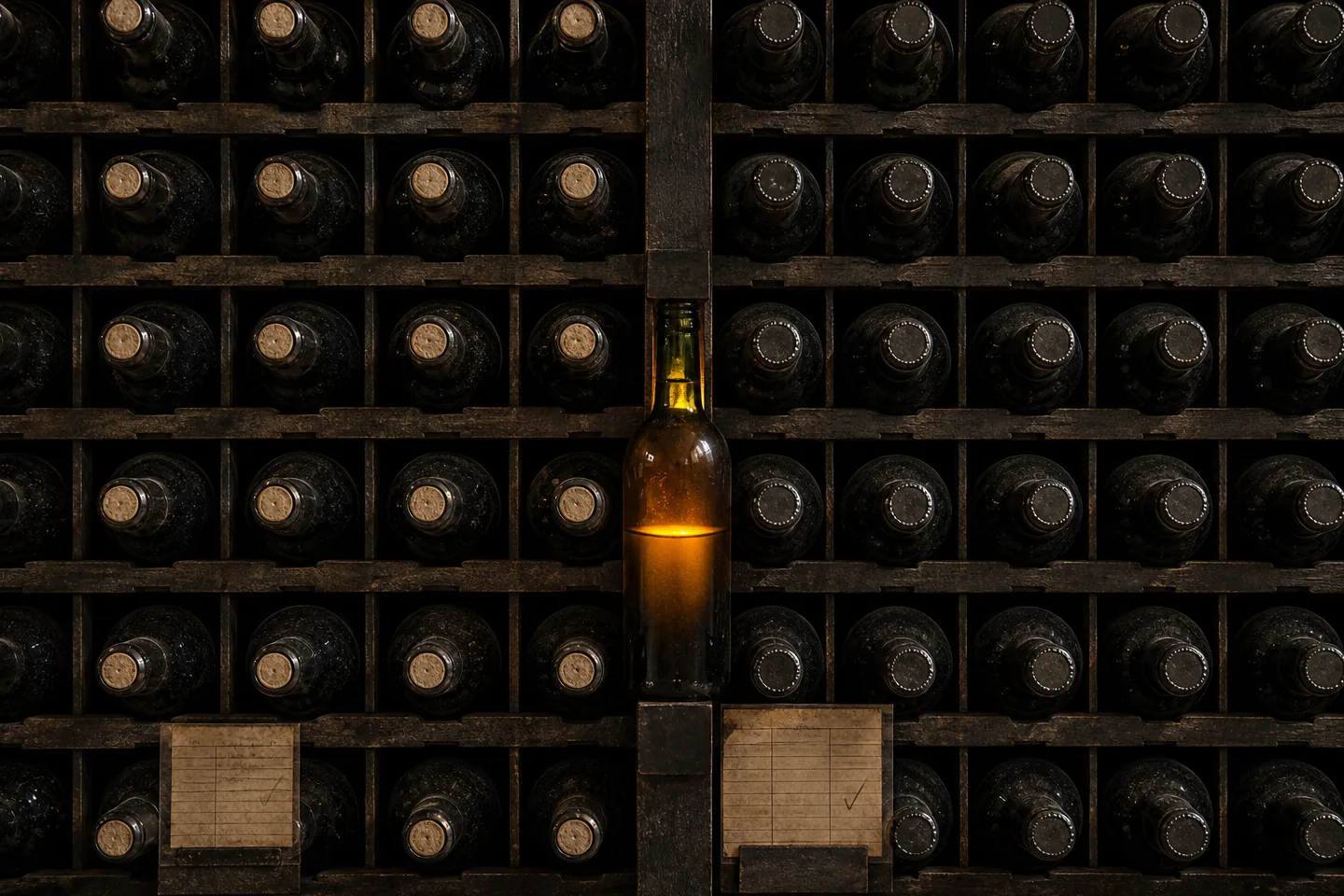
Thomas had found the word natural on a shelf tag and stopped reading.
This had felt efficient.
The tag was cream colored. The bottle had a bird on it that appeared to have declined employment.
There was no foil capsule, which Thomas treated as evidence from a tribunal.
“No chemicals,” he said.
Clara read the back label.
“Which ones?”
Thomas held it up. “It says natural.”
This was, in its way, an answer. It just did not answer anything useful.
The shop was quiet except for a refrigerator fan working through its personal disappointment.
Thomas had come in for something uncomplicated. He now possessed a word with no visible screws.
“It means minimal intervention,” he said.
“How minimal?”
Thomas examined the bird again. The bird declined to quantify itself.
Nothing on that shelf was going to answer for it either.
What Does Natural Wine Actually Tell You?
Natural wine is not a color, a flavor or a completed production record.
It is a claim about restricted practice, plus whatever evidence somebody has offered for it.
It can tell you that a producer intends to limit additions, filtration or corrective treatment.
Without further disclosure it cannot tell you which fermentation route was used, what went in, whether malolactic conversion was wanted, or how the finished bottle was made secure.
The word has acquired the bearing of a small moral weather system. That is not helpful.
Wine is grapes, microbes, vessels, oxygen, temperature, time and a quantity of paperwork capable of ruining a terrace.
The question is not whether anybody behaved naturally. It is what happened to this lot.
“Ask for the sheet,” Clara said.
“There is a sheet?”
“There should be.”
A useful record keeps the exact printed wording, the named scheme, any organic or biodynamic certification, the harvest claim, the yeast source, the additions, the fining, the filtration and the declared sulfur dioxide.
It carries the vintage and the lot as well.
And it keeps its sources apart.
A producer technical sheet, a laboratory certificate, a back label, an importer questionnaire, a regulatory register and a tasting note are not interchangeable.
They are different kinds of evidence, which is less lyrical than a hand-drawn moon and considerably more helpful.
The distinction sorts into three words.
A laboratory or instrument result is measured. A primary production or certification record is documented. An unverified seller or producer statement is reported.
A retailer’s description copied from another retailer stays reported, however many websites repeat it. Your bottle does not become more knowable through chorus.
“So natural means nothing?” Thomas said.
“It means ask the next question.”
That is not a dismissal. It is the beginning of an answer.
A natural claim is informative when it names the rules it follows and puts the production facts beside them.
Without those, it is a direction of travel.
The bottle still has to arrive somewhere.
Why Natural Is Not a Production Method
The trouble starts when a category is asked to do the work of a protocol.
A production method says what happens, when, and what has to be checked before the next operation.
“Natural” doesn’t tell you whether the grapes were direct pressed, whether a red fermented on skins, whether the cellar used chosen yeast or a managed spontaneous start, or whether malolactic conversion was planned.
It is a roof sign. It is not the wiring.
There are actual rule sets, and their differences matter to you.
One retailer’s published natural-wine criteria bar fining, bar added yeast, bar reverse osmosis and several additions, allow only minimal filtration, and cap total sulfur dioxide at 70 parts per million.
The same document also says the retailer is not a certification body. That is a surprisingly important sentence.
A shop’s screen does not become an independent certificate by acquiring a PDF.
An independent scheme lands on the same 70 ppm cap and then diverges on filtration, permitting coarse filtration while barring one particular medium.
So two bodies can agree exactly on sulfur and still give you different answers to “was this filtered?” The number is real.
The shortcut is not.
Thomas looked relieved.
“So it has 70.”
“No. It may have a rule.”
A cap is not an analysis of your bottle. Don’t let a sulfur claim be smuggled out of a category word.
What you want is the declared sulfur dioxide, the scheme, the version of the scheme, and where you are buying.
A wine can pass one retail screen and fail another.
It can also be carefully made and simply lack the documentation a particular natural claim requires.
That difference is not philosophical. It is provenance.
Nor does natural settle the yeast question.
A cellar may inoculate a chosen strain, inoculate after a cold soak, or run a managed spontaneous start. Those are production observations, not auras.
On the lot sheet the route sits beside the tank, the timing, the intake numbers and the cap work.
Explain it later without that chain and you have a memory of “the normal thing.”
The normal thing has caused a great deal of administrative grief.
Which Winemaking Choices Affect Stability
Fermentation is a set of decisions, and the decisions stay inconveniently physical.
Temperature, maceration time and cap work act together.
A short hot ferment with vigorous pump-overs is not the same wine as a long cool one under a submerged cap.
“Minimal” doesn’t tell you which of those happened. It barely tells you that somebody owned a barrel.
“But if it ferments by itself?” Thomas said.
“It still has to finish.”
Exactly.
A managed spontaneous start is not the abandonment of management.
It is a fermentation route that still needs measurement, decisions and a plan for the wine afterwards.
The alternative to a plan is not nature. It’s a return.
Malolactic conversion makes this unusually clear.
Where it’s intended, the wine has to sit inside a fairly narrow envelope of temperature, pH, free sulfur dioxide and alcohol before the bacteria will finish the job.
Each of those adds stress, and averaging them into a reassuring slogan doesn’t remove any of it.
Where it isn’t intended, the work doesn’t vanish.
The cellar has to keep the wine away from conditions that support bacteria, establish protective sulfur dioxide for that wine’s chemistry, and verify microbial security before bottling.
“No malolactic” is an active preservation program. Possibly the least romantic sentence in wine, and still true.
Filtration is another word that has been made to sound like a betrayal.
A filtration specification aims at something: haze reduction, yeast removal, bacterial security, final polish.
It should state the target, the method, the rating, the prefiltration, the flow, the pressure and an integrity check where one applies.
A filter rating with no microbial target is a purchasing detail wearing a lab coat.
Minimal filtration raises your spoilage risk in the bottle. Well-chosen filtration needn’t harm the wine at all.
That’s the unglamorous trade. Cloudiness isn’t proof of care, and clarity isn’t proof of vandalism.
Turbidity can come from suspended solids, a deliberate choice, age or tartrates. The wine deserves a question before it receives a backstory.
“So the cloudy one might be filtered?”
“It might be cloudy.”
This seemed harsh but scientifically tidy.
How to Ask a Useful Question at the Shop
Be specific enough to embarrass a shelf tag without embarrassing the person behind the counter.
Ask three things: what supports the natural claim, what the fermentation route was, and whether the wine is fined or filtered and for what.
Then ask whether each answer is measured, documented or reported.
You don’t need to demand a dissertation while holding a bottle with a ceramic mushroom on it. But a concrete answer changes the purchase.
“Minimal intervention” becomes a stated practice. “Unfiltered” becomes a filtration decision. “Natural” becomes an aspiration with a file attached.
Producers settle their own questions the same unsentimental way.
A treatment gets tested on small samples, in a dose series, against an untreated control, before anyone scales it.
A bench trial isn’t an insult to conviction. It’s how a cellar stops conviction becoming several thousand liters of regret.
“They did all that for this?” Thomas asked.
“Someone did, or should have.”
So buy one bottle first.
Ask the retailer or the producer about fermentation, sulfur and filtration. Chill it to the stated serving range before you judge it.
Note the vintage, the lot, the source and the date of the claim, if the answer matters enough for you to repeat it.
None of that demands your bottle become a spreadsheet.
It admits that it already is one, in the dark.
Thomas put the bottle back on the shelf.
“I will ask about the process,” he said.
“Before buying it?”
He considered the bird, the cream tag, and the entire brief and costly history of his confidence.
“That would be more efficient.”
Natural is a direction.
The bottle is the itinerary.
Put it into practice
- Natural wine is a claim that needs a named scheme and supporting production disclosures, not a sensory yes-or-no category.
- SAQ and the Natural Wine Authority both state a 70 ppm total-SO2 cap, but their filtration rules are not identical.
- Fermentation route, yeast source, additions, fining, filtration, and sulfur dioxide must be recorded separately to describe a bottle's process.
- Minimal filtration can raise bottle-spoilage risk, while appropriately selected filtration need not harm quality.
- A no-MLF choice requires active microbial protection rather than simply omitting a bacterial inoculation.
- Measured, documented, and reported claims carry different levels of evidence and should retain vintage, lot, source, and retrieval date.
Asked across the table
- Does natural wine mean the wine has no sulfur?
- No. A natural-wine claim does not by itself state that no sulfur dioxide is present or added. SAQ's published criteria and the Natural Wine Authority's scheme each state a total-SO2 cap of 70 ppm, but a cap is not an absence. The bottle needs a producer or retailer disclosure of its sulfur practice, the scheme used, vintage, and lot before the claim can describe the actual wine.
- What does natural wine actually tell a buyer?
- Natural wine can signal a producer intention to restrict interventions, additions, filtration, or corrective treatments. It does not, by itself, provide a complete production record. A useful record gives the exact claim wording, named scheme, yeast source, additions, fining and filtration practice, declared sulfur dioxide, vintage, lot, and any organic or biodynamic certification supplied. Each field answers a different question about the bottle.
- Are all natural wines unfiltered?
- No. The filtration rule depends on the named scheme and the documented bottle. SAQ's criteria call for minimal filtration and no fining, while the Natural Wine Authority permits coarse filtration under its own rules. A cloudy appearance does not prove minimal intervention, because turbidity can have several causes. Filtration should be disclosed as a process choice rather than inferred from the word natural or the wine's appearance.
- Why would filtration matter in a natural wine?
- Filtration can be specified for haze reduction, yeast removal, bacterial security, or final polish. A minimal-filtration choice can raise the risk of bottle spoilage, while appropriately selected filtration need not harm quality. The useful question is therefore not whether a wine is filtered in the abstract, but what target the filtration serves, whether prefiltration and integrity checks are used, and how microbial security is established before bottling.
- Can a natural wine still use added yeast?
- A natural-wine label alone does not settle the yeast source. SAQ's published criteria include no added yeast, but every claim needs its named scheme and production record. The record should state whether the fermentation has a chosen yeast, a managed spontaneous start, or another declared route. Yeast source is a fermentation decision; it should not be guessed from a natural-wine shelf tag or a cloudy bottle.
- What should be asked about fermentation before buying a natural wine?
- A buyer can ask whether the wine is made from a chosen yeast or a managed spontaneous start, whether fermentation occurs with skins or after pressing, and whether malolactic conversion is intended. The producer record should also identify the vintage, lot, vessel where supplied, and any additions. These questions separate a broad natural claim from the fermentation choices that affect extraction, aroma, microbial condition, and later stability.
- Does no malolactic fermentation mean nothing was done to the wine?
- No. When malolactic conversion is unwanted, the wine must be separated from conditions that support bacteria, receive protective sulfur dioxide according to its chemistry and regulation, and be checked for microbial security before bottling. No MLF is an active preservation program, not merely the absence of a bacterial inoculation. The label natural does not reveal whether this program occurred or whether conversion was intended.
- What numbers matter if malolactic fermentation is planned?
- OSU's operational table gives a conservative malolactic-conversion envelope of 18 to 22 °C, free SO2 below 5 mg/L, pH 3.20 to 3.50, alcohol below 13.5%, and malic acid below 30 to 50 mg/L at completion. These values are not a universal recipe because strain and wine conditions differ. They show why a broad style label cannot replace measurements and a lot-specific fermentation plan.
- How can a buyer tell whether a natural-wine claim is well supported?
- The buyer can distinguish measured, documented, and reported information. Measured information is a laboratory or instrument result. Documented information comes from a primary production or certification record. Reported information is an unverified seller or producer statement. A strong record retains the source, stable URL or file, retrieval date, vintage, lot, and responsible person or organization rather than copying a catalogue description across retailers.
- Is natural wine a guarantee that the bottle will be stable?
- No. Restricting additions, filtration, and corrective treatments can place more weight on fruit hygiene, fermentation management, bottling decisions, and storage. Neither minimal intervention nor clearer filtration automatically makes a wine sound or faulty. Stability depends on the documented process and release checks, including the actual microbial objective, sulfur-dioxide management where used, and the wine's intended distribution conditions.
- Why does the lot and vintage matter on a natural-wine record?
- A style claim does not freeze a wine's composition or production choices across releases. Residual sugar, alcohol, total acidity, pH, fermentation history, and bottling condition can change with a new vintage or lot. Keeping both identifiers with a producer technical sheet, laboratory certificate, back label, importer questionnaire, certification record, or tasting note makes the claim traceable to the particular bottle rather than to a general reputation.
- What is the safest first way to try an unfamiliar natural wine?
- A buyer can ask the producer or retailer for the fermentation, sulfur-dioxide, and filtration record, then buy one bottle before committing to more. The bottle should be chilled to the producer's stated serving range before its style is judged, because service condition affects sensory assessment. The method does not guarantee a preferred result; it prevents a broad category word from standing in for the bottle's actual process and condition.