Choose what works
Why Decanting Does Not Repair a Fault
Air can change a wine's presentation, but it cannot turn cork taint, oxidation or volatile acidity into a style choice. Diagnosis has to come before the handsome vessel.
Asserted
“It smells odd, so let it breathe until it gets over itself.”
Corrected
Wine faults' causes and thresholds meet wine service's opening and decanting procedure where oxygen is an intervention for a sound wine, not a remedy for a microbial or closure-derived defect.
What to do
Pour a 30 mL diagnostic sample before decanting; if the fault persists across glasses, stop serving it and retain the bottle, closure and receipt for a return.
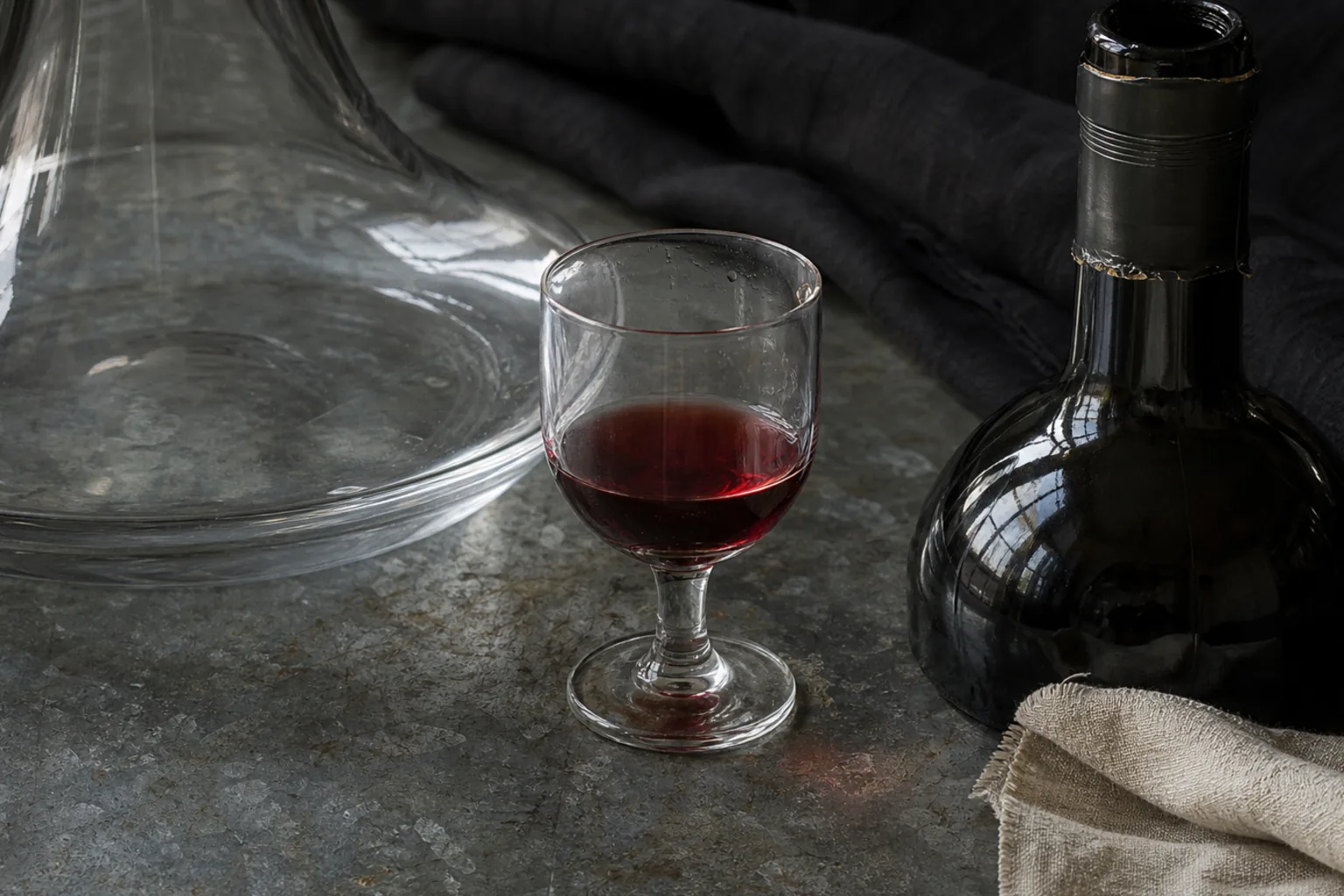
Thomas brought out the decanter with professional sorrow.
It was broad at the bottom, narrow at the neck, and clean enough to suggest that something important had died near it.
“This will help,” he said.
Clara smelled the newly opened wine.
“What fault do you believe air removes?”
Thomas looked at the decanter. This was not the question he had prepared for.
The bottle smelled strange. That much was agreed.
Thomas had translated strange into needs to open, because that turns an awkward bottle into a project and permits the use of a handsome vessel.
The alternative was that the wine was wrong.
Nobody likes that alternative. It arrives without a task.
“It is a little shut down,” he said.
“Or?”
“A little corked.”
“Those are not the same sentence.”
They are not even the same kind of sentence.
Can Decanting Fix a Faulty Wine?
No.
Decanting changes how a sound wine presents itself. It separates wine from sediment.
It gives a sound young structured red some oxygen and makes the aroma easier to read.
It cannot make a taint stop being a taint. It cannot reverse oxidation. It can’t subtract the compounds behind volatile acidity.
A decanter is glassware. Keep its ambitions proportionate.
Before it comes out, pour yourself a 30 ml diagnostic sample.
Use a clean, odor-free glass, not the nearest one that held a candle last winter.
A small pour in a large bowl has plenty of headspace to disclose itself, which is the whole point of pouring a small one.
Then write down what you have: the bottle, the closure, the fill level, the date and time you opened it, the serving temperature, and how long it has been open.
That sounds like bureaucracy until you need it, and then it doesn’t.
The same wine at 18 °C releases a different aroma balance than it does at 10 °C, and a fault note without a temperature is an opinion with the evidence removed.
Thomas held the decanter over the glass with the air of a surgeon interrupted during an important flourish.
“So I do nothing?”
“You smell it first.”
Your first job is to separate a wine that is closed, reductive or simply too cold from a wine with a persistent problem.
Air matters to the first group. It does not do a thing for the second.
The difficulty is that opening the bottle and immediately running a large oxygen experiment destroys the comparison.
You can’t say what the wine was doing before you intervened if your intervention was the first observation.
For a sound young structured red, start the decanter at fifteen to thirty minutes and re-taste every ten or fifteen.
A quiet transfer, a brisk swirl and a high-turbulence aerator can all take the same elapsed time and deliver very different amounts of oxygen.
This is not a hierarchy of manliness.
More open is not automatically better. Stop when the aroma clarity and the balance peak.
So the decanter has two legitimate jobs.
Sediment removal is one.
Stand the bottle upright long enough for the deposit to settle, then transfer slowly and stop when it reaches the neck.
Aeration is the other.
Neither of them is microbial rehabilitation, and neither ever was.
Which Wine Problems Air Can and Cannot Change
Air can change how a reduction aroma expresses itself.
It can also uncover a fault that fruit, cold or a freshly opened bottle had briefly covered.
Which is why a changed second glass is evidence, not absolution.
A reduction note may well shift after exposure. That’s still not a license to treat every unpleasant smell as a shy personality.
Cork taint has a different decision profile entirely. It stays perceptible after enormous dilution, and it survives distillation into spirits.
There is no decanter geometry that negotiates with that.
It may present as musty or wet cardboard, and it may simply flatten the fruit rather than announce itself with a small bell.
A natural cork isn’t proof either way. Neither is a prolonged vigil beside a swan-necked vessel a treatment.
Oxidation has a poor relationship with hope.
It combines lost freshness with an added bruised, aldehydic character, and a wine already showing it should skip broad-surface aeration altogether.
Pour a test sample instead.
Some wines are meant to develop nutty, sherry-like character.
A fresh aromatic white does not become an oxidative style because Thomas has phrased it generously.
Volatile acidity, meanwhile, is not a synonym for vinegar. Acetic acid gives you the vinegar impression. Ethyl acetate gives you solvent lift.
Sugar can mask both. Ethyl acetate can intensify what you notice. Neither of them leaves because you poured the wine into something wider.
Thomas took the second glass.
It had changed, though not in the direction he had called improvement.
“It smells more like the problem,” he said.
“Yes.”
This seemed unnecessarily literal.
How to Recognize Cork Taint and Oxidation
Start with what you observed, not with the diagnosis.
Musty, wet cardboard, bruised apple, rotten egg and nail-polish remover are sensory descriptions. They aren’t laboratory confirmations of anything.
Wine language has enough costume jewelry already. It does not need to borrow a chromatogram’s name without its evidence.
Thresholds are worth knowing about in principle and worth not reciting at dinner.
Detection and rejection are separate: one is whether you can tell something is there, the other is whether it stops you drinking it.
Different people cross both at different points, in different wines.
Matrix moves the line too.
The same compound needs a far higher concentration to be noticed in a heavily oaked red than in a neutral one.
Fruit, oak, sugar, alcohol, acidity, tannin and age all mask or expose it.
That explains why two people disagree about a bottle.
It isn’t an amnesty for a wine that tastes bad in the glass actually being served.
“Could it be the glass?” Thomas asked.
“Now that is a useful question.”
Check the glass for detergent residue, trapped water, chips, lipstick or a stray smell. Then pour a second sample into a clean one.
If the smell follows the wine across glasses, it has at least stopped being the glass’s personal business.
If you have a second bottle, compare them at the same temperature under the same conditions.
One bottle is a one-bottle observation, and closure-linked taints are distributed unevenly.
When Should You Return a Bottle?
Return is a service decision. It isn’t a courtroom verdict.
The fast question is whether the bottle is sound enough to serve.
The long questions, about lot quality and prevention and analytical cause, need different evidence and a patience nobody ordered with dinner.
There are legal limits on volatile acidity, and they don’t overrule your nose.
A wine can sit comfortably below a legal ceiling and still disappoint a panel.
A sensory-clean bottle can still need documentation in a regulated market.
Legal, analytical, sensory and bottle-consistency questions should not be poured into one glass and called quality.
If the fault persists across the diagnostic glass and a second clean glass, stop serving it.
Keep the bottle, the closure and the receipt.
Keep the label information, the opening conditions, the temperature, the descriptors you actually used, and any comparison you made.
A photograph of the label and closure turns a disappointed impression into a checkable record.
So does writing “unknown” where you don’t know, which is more useful than a lot number you’ve invented under pressure.
Thomas set down the second glass.
“The decanter has done what it can,” he said.
It hadn’t done much. This was, in the circumstances, a respectable performance.
Clara put the stopper beside the bottle, not in it.
“So it is not recovering.”
“It is not ill in a way glassware can treat.”
The decanter stayed bright and empty between them, entirely innocent.
The wine hadn’t become worse because it was named correctly.
It had merely lost the costume.
Put it into practice
- A 30 mL diagnostic sample separates first assessment from decanting and should be checked in a clean glass.
- Decanting has separate jobs: sediment removal or controlled aeration of a sound wine.
- TCA, oxidation and volatile acidity require sensory description and context rather than a decanter as a default remedy.
- Thresholds depend on compound, unit and wine matrix; detection, rejection and legal limits are different claims.
- Temperature and clean, odor-free glassware can change what reaches the nose and must be recorded in a fault assessment.
- A persistent suspected fault should be documented with the bottle identity, closure, opening conditions and comparison evidence before return.
Asked across the table
- Can decanting fix a corked bottle?
- No. Cork-type taint is an external taint, and its sensory effect generally remains perceptible even after significant dilution. Decanting may alter the wine's presentation, but it does not remove the taint. A suspected bottle should be assessed in a clean glass, described as an observation such as musty or wet-cardboard, and retained with its closure and identifying information for comparison or return.
- What should happen before a wine is decanted?
- A small diagnostic sample should be poured into a clean, odor-free glass before any decanting decision. The bottle's closure, fill level, opening time, serving temperature and initial aroma should be recorded when a fault is suspected. This distinguishes a wine that is merely closed, reductive or too cold from a bottle with a persistent taint, oxidation character or volatile-acidity problem.
- How much wine is enough for a diagnostic pour?
- The supplied working instruction is a 30 mL diagnostic sample before decanting. Wine-service procedure otherwise specifies a 25 to 50 mL assessment sample for a newly opened bottle. The sample is smelled and tasted in clean glassware before broad-surface oxygen exposure changes the presentation. A second glass helps separate a glass problem from a bottle problem.
- What is decanting actually for?
- Decanting has two different jobs. For sediment removal, a bottle is rested upright, opened and transferred slowly while sediment is left behind. For aeration, a sound young structured wine is transferred to expose it to oxygen and then re-tasted. These jobs are not a general treatment for defects; a fragile wine or one already showing oxidation ordinarily receives a test sample instead of broad-surface aeration.
- How long should a sound young red stay in a decanter?
- A young, structured still wine can start with 15 to 30 minutes in a decanter and be re-tasted every 10 to 15 minutes. The purpose is to find aroma clarity and balance, not to fulfill a fixed clock. A 750 mL bottle needs at least a 1 L decanter to avoid crowding, while a broader 1.5 L vessel creates more headspace and can speed development.
- How can cork taint be recognized without a laboratory?
- A suspected cork-type taint is recorded first as a sensory observation, often musty or wet-cardboard with reduced fruit, rather than as laboratory-confirmed TCA. AWRI cites a 2.1 ng/L consumer detection threshold and a 3.1 ng/L consumer rejection threshold for TCA, but both values are study endpoints, not legal limits. A natural cork alone does not confirm the diagnosis.
- Can oxidation be improved by letting wine breathe?
- Air can change how oxidation is expressed, but it does not reverse bottle development. Oxidation combines lost freshness with added aldehydic notes, and acetaldehyde has a reported 100 to 125 mg/L sensory range in the relevant fault material. Wine already showing oxidation ordinarily bypasses broad-surface aeration. A small sample in an appropriate glass is the safer assessment before any service decision.
- Is volatile acidity just vinegar?
- No. Volatile acidity is not synonymous with acetic acid because ethyl acetate can materially change the sensory result. AWRI gives red-wine thresholds of 0.74 g/L for acetic acid and 0.16 g/L for ethyl acetate; sugar can mask and ethyl acetate can intensify the impression. A useful sensory record describes both vinegar-like character and solvent lift rather than calling a wine simply high VA.
- Does a volatile-acidity legal limit prove a wine tastes fine?
- No. The OIV states a volatile-acidity maximum of 20 milliequivalents/L, or 1.2 g/L expressed as acetic acid, with exceptions for some old wines of particular elaboration. That is a legal and analytical comparison, not a sensory guarantee. A wine below the limit can still disappoint a panel, while a sensory assessment also needs the wine matrix and ethyl-acetate contribution.
- Why do two people disagree about whether a wine is faulty?
- Fault perception depends on the particular wine matrix, the threshold endpoint and the assessor. Oak, fruit concentration, residual sugar, alcohol, acidity, tannin and bottle age can mask or expose a compound. A TCA detection threshold, a rejection threshold and a legal maximum answer different questions. Agreement improves when both tasters use clean glasses, record temperature and compare the same bottle under stated conditions.
- What evidence should be kept when returning a faulty bottle?
- The retained record should identify the bottle or lot, closure, fill level, opening date and time, serving temperature, time exposed after opening, and the observed aroma or flavor. Labels, closure photographs, comparison notes and any available analytical or panel evidence make a later judgment checkable. The supplied return instruction also retains the bottle, closure and receipt rather than discarding the evidence after service stops.