Know what you’re choosing
Why Coffee Tasting Notes Are Not a Shopping List
Blueberry, chocolate and jasmine on a coffee bag are descriptors, not ingredients somebody misplaced in the roastery. Processing and roast can make the same word mean very different things.
Asserted
“If it says blueberry, it should taste like somebody put blueberries in it.”
Corrected
Coffee's processing and roast variables meet tasting terminology's descriptor system at the point where a named aroma is a comparative sensory observation rather than a literal additive.
What to do
Cup two coffees blind in equal 150 to 200 mL preparations, then reveal the notes after recording aroma and flavor; use the label as a comparison prompt, not a verdict.
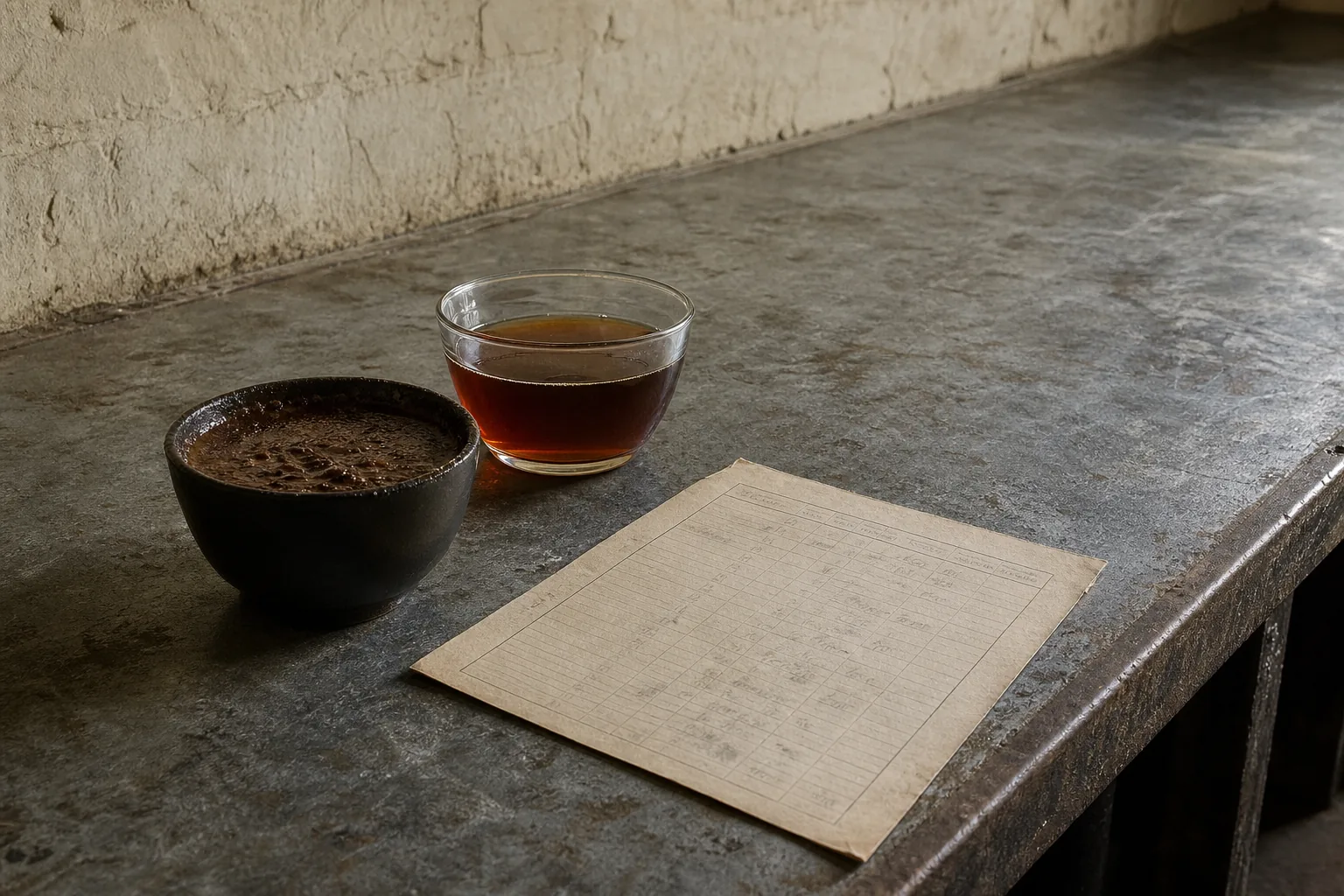
Thomas had opened the coffee bag and was looking inside it with care.
“Blueberry,” he said.
“Yes,” said Clara.
“There are no blueberries.”
Clara looked into the bag. It contained coffee.
This was apparently the grievance.
Thomas held the label up to the light, as though the fruit might have been printed on the reverse. Blueberry, jasmine, milk chocolate.
The coffee was brown, dry, and entirely unhelpful.
“They have listed three things,” he said. “None of them is here.”
“It’s a tasting note.”
“Then why does it read like a shopping list?”
This was difficult to dismiss.
Coffee language has spent decades arranging ordinary food nouns in expensive type and hoping nobody asks who bought the flowers.
Clara made two cups.
“Smell this,” she said.
Thomas did.
“Coffee.”
“Good. Now say what kind.”
That request is the entire discipline, and it is harder than the label makes it look.
What Do Coffee Tasting Notes Actually Mean?
A tasting note is a comparison, not an inventory.
Blueberry means somebody found an aroma reminiscent of blueberry.
It does not mean a roaster mislaid fruit in the cooling tray and then made a remarkably calm decision about it.
That seems pedantic until the word starts doing work.
Your cup can reach you through six separate channels: how it looks, what you smell before drinking, what you smell from your mouth while drinking, basic taste, mouth-feel, and the sharp trigeminal sensations that aren’t taste at all.
Saying a coffee has a blueberry-like aroma before the sip, or a cocoa-like impression after swallowing, is more useful than calling the whole event “flavor” and letting acidity, aroma, warmth and drying texture share one name tag.
What you smell before the sip and what reaches you from the mouth afterwards are different measurements.
A note can live strongly in one and barely appear in the other.
This isn’t coffee trying to be difficult. It is simply not a fruit salad with a lid.
The trade keeps other distinctions apart too, and you should as well.
A description, a preference, a physical measurement and a story about origin are four things.
They are not one very impressive score wearing several hats.
Shared vocabulary helps, but it doesn’t turn a word into a measurement.
An aroma wheel gives you a route from broad families toward familiar references.
It helps you move from fruit to berry to blueberry without claiming the route ends at a laboratory bench.
The wheel supplies possibilities. You supply the observation.
Intensity needs the same humility.
A panel may use low, medium and high, or mark a line scale with named anchors at each end.
Neither result converts quietly into a critic’s number, a molecular concentration, or a legal ruling on whether blueberry has occurred.
It means that in a stated cup under stated conditions, an assessor found a comparison more or less forceful.
Considerably less cinematic than a revelation. Also how a note stays useful after the bag has stopped being new.
Thomas smelled the first cup again.
“It does smell a little like something.”
“That is the whole job.”
“Not a very secure job.”
No. But more secure than the blueberry theory, which had required a roastery to maintain a secret fruit department.
Why Blueberry Is Not an Ingredient
Descriptors work by resemblance, and they sit in a hierarchy. Fruit is broad. Berry is narrower. Blueberry is narrower still.
Getting more specific is only useful when you can honestly support it.
A bag that says blueberry is making a sensory comparison. It is not establishing that blueberry has become the coffee’s botanical identity.
Which is also why a descriptor is not a laboratory result.
You have three different levels of evidence in play. One person perceives a descriptor.
A panel records how often a reference appears and how strongly. A laboratory reports a compound, with its method, units, matrix and date.
They are neighbors. They are not synonyms who have agreed to share a coat.
The chemical version is the most tempting, because it looks as though it ends the conversation.
It doesn’t.
A concentration and a detection threshold stay attached to the matrix and the method that produced them, and concentration alone is not sensory importance.
The cup is a mixture. You are a person. Neither of you has signed an agreement to behave like a spreadsheet.
Nor does a label claim unanimity.
A preference rating records what people liked under a protocol. It doesn’t prove that you must like, or even find, the same note.
If four cuppers disagree, that spread is part of the result.
It isn’t an administrative error to be corrected with more confidence.
Thomas tasted the first cup, then the second.
“The second one is darker,” he said.
“That is a color.”
“It is also an opinion.”
This was promising. He had stopped looking for produce.
How Processing and Roast Change Coffee Aroma
The same word can reach you by different routes, because coffee is not one material for very long.
Natural, honey, washed and wet-hulled are process labels.
Each one contains decisions about cherry ripeness, depulping, water, mucilage, fermentation vessel, oxygen, drying surface, turning, temperature and final moisture.
“Natural” is the beginning of a record. It is not the whole alibi.
Whole-fruit natural drying takes weeks. Washed drying takes days.
The longer route isn’t automatically more developed, more fruity, or more anything pleasant.
It is more time in which weather, airflow, microbial activity and turning discipline can change the lot.
Honey processing needs close drying management while the mucilage is still there.
That’s a great deal of responsibility for a word that sounds as though it should arrive in a small bear-shaped bottle.
Roast adds another layer.
First crack happens somewhere in a broad temperature band, and where exactly depends on the bean and the machine.
It’s useful inside one roaster with one probe. It is not a universal target carried down a mountain on a stone tablet.
Batch scale explains a lot of the confusion.
A profile that worked on a one-kilo sample roaster does not transfer to a production machine, because the mass changes how heat moves.
Color and roast loss let you compare batches. Two coffees can still reach similar color and loss through completely different heat histories.
So don’t ask which roast makes blueberry, as though the roaster had a button marked orchard.
Ask what one controlled roast change does to this green lot in this preparation.
Thomas read the first label again.
“So blueberry could mean different blueberry.”
“It could mean a different comparison.”
He looked at the bag with the particular disappointment of a man denied both fruit and certainty.
How to Taste Coffee Notes Without Suggestion Taking Over
The remedy is mercifully small.
Prepare two coffees blind, in equal 150 to 200 ml servings, with the preparation held comparable.
Record what arrives before you see any labels. Dry fragrance. Aroma in the nose. Aroma from the mouth. Basic taste. Mouth-feel. Finish.
Then reveal the notes and use them as prompts, not as verdicts issued by a small square of cardboard.
Blind and randomized matters because a label tells your nose what it is due to find.
A coffee can be descriptively floral and still score lower on liking in a particular market. That isn’t a contradiction.
Description and preference answer different questions.
Write down the timing too.
An impression on the first smell is not the same as one that arrives twenty seconds later.
Attack, mid-palate, finish gives you a three-stage record without pretending your mouth has become a railway timetable.
Temperature, water, grind, filter, serving order, and whether you knew what you were drinking all belong to the context.
If you want to measure, keep strength and extraction separate.
Dissolved solids tell you the concentration in your cup. Extraction yield tells you what share of the dry coffee actually dissolved.
The same strength can occur at different yields and different ratios, with different results in the mouth.
A brewing chart is a coordinate system. It is not a small court delivering a sentence on blueberry.
Thomas took the labels away from the cups.
“The first one smells more like blueberry,” he said.
“Before or after tasting?”
“Before. The second tastes more like cocoa after.”
Clara nodded.
“So it was not a shopping list.”
“No.”
“It was a map.”
“A very imprecise map.”
That, at last, was correct.
A tasting note doesn’t tell you what went into the coffee.
It tells you where your cup may resemble something you already know, under conditions somebody should have named.
The blueberries had not been hiding.
They had been directions.
Put it into practice
- Natural, honey, washed, and wet-hulled processing routes differ in fruit handling, water demand, drying risk, and control burden.
- Roast development must be compared within one roaster and probe setup because first-crack temperature and endpoint readings are not transferable targets.
- A tasting descriptor records a sensory resemblance and must be kept separate from a measured chemical claim or literal ingredient claim.
- A useful tasting record separates orthonasal aroma, retronasal aroma, basic taste, mouth-feel, and temporal change.
- Blind, randomized comparison reduces label-led expectation and lets the note serve as a later comparison prompt.
- Brew strength and extraction yield are separate measurements, represented on the SCA chart by TDS and extraction axes.
Asked across the table
- Do coffee roasters put blueberries in blueberry coffee?
- No. A blueberry note is a sensory descriptor: it says that an aroma or flavor resembles a blueberry reference to the taster. It does not report an ingredient added at the roastery. A defensible coffee record also identifies the preparation and sensory channel, because an aroma smelled before sipping and an impression perceived after swallowing are not necessarily the same observation.
- What does a coffee tasting note actually describe?
- A tasting note describes a perceived resemblance, not a chemical inventory or a recipe. It becomes more useful when it records whether the impression is dry fragrance, orthonasal aroma, retronasal aroma, taste, mouth-feel, or finish; its intensity; and the preparation context. The same descriptor can be broad, such as fruit, or specific, such as blueberry, without becoming a literal ingredient claim.
- Why can two coffees both say blueberry but taste different?
- The word blueberry can be attached to different coffees, preparations, and roast states, so it is a comparison reference rather than a fixed flavor measurement. Processing route, fruit condition, water exposure, drying, roast development, strength, extraction, and serving conditions all change the cup. A label without those conditions is lower-resolution information, not a promise of identical sensory experience.
- Does natural processing always make coffee taste fruitier than washed processing?
- No. Natural, honey, washed, and wet-hulled processing should be compared by fruit condition, water need, drying capacity, weather exposure, labor, and the desired sensory range. Whole-fruit natural drying is reported at 10 to 25 days and washed drying at 5 to 10 days after the stated fermentation stage, but duration alone does not determine a cup character.
- What does wet-hulled mean for a coffee record?
- Wet-hulled describes a processing route whose material stage must be stated. A processing review reports hulling a wet-hulled lot at 30 to 35% moisture, while traded green coffee is much drier. The label alone omits ripeness selection, water exposure, vessel, oxygen condition, drying surface, turning, temperature, and the later moisture measurement that make the route interpretable.
- Does a light roast guarantee more origin flavor?
- No. Roast comparison requires endpoint color, roast loss, curve shape, time to key events, and cup results in the intended preparation. The useful question is whether thermal development makes a coffee soluble and balanced without vegetal, baked, smoky, or ashy faults. A color name alone does not identify the actual internal development or predict a particular descriptor.
- Is first crack a temperature target for every coffee roaster?
- No. First crack is commonly reported around 170 to 200 °C, but the observed temperature depends on bean and equipment conditions. It is a repeatable event marker within one roaster and probe setup, not a universal calibration. A 205 °C endpoint on one machine can represent different bean development from the same displayed number on another machine.
- What is the difference between aroma, flavor and finish in coffee?
- Aroma can be recorded before sipping as orthonasal perception and after swallowing as retronasal perception. Flavor is not a substitute word for every sensation: basic taste, mouth-feel, and trigeminal sensation are separate modalities. Finish records what persists or changes after the main palate impression. Recording the channel and timing keeps acidity, aroma, and drying texture from being treated as one thing.
- Should a coffee label be read before tasting?
- A blind, randomized comparison gives a cleaner first observation because the taster records aroma and flavor before the label supplies a target. The label can then be revealed as a comparison prompt. This does not make the label useless; it separates descriptive observation from expectation and preserves disagreement as evidence instead of forcing every taster to find the advertised reference.
- How can two cups have the same strength but extract differently?
- Strength is the concentration in the cup, commonly expressed as total dissolved solids, while extraction yield is the fraction of dry coffee that dissolves. The SCA Brewing Control Chart displays 0.90 to 1.80% TDS and 14 to 26% extraction yield as separate axes. Water, grind, and contact time can therefore produce similar apparent strength with different extraction and sensory results.
- What makes a coffee tasting descriptor credible?
- A credible descriptor states its evidence level. An individual taster can report a perceived blueberry-like aroma; a panel can report how often and how intensely assessors use that reference; a laboratory can measure a named analyte with method, units, and matrix. These are three different evidence levels. A sensory analogy should not be promoted into a chemical finding without analysis.
- How should two coffees be compared at home?
- Two coffees can be prepared blind in equal 150 to 200 mL servings and recorded before their labels are revealed. Each record should separate dry fragrance, aroma before sipping, flavor after sipping, basic taste, mouth-feel, and finish. The label then serves as a comparison prompt rather than a verdict. The 150 to 200 mL serving instruction is a practical editorial protocol, not an SCA standard.