Buy with confidence
Why a Caviar Tin Is Not Proof of Caviar
A luxurious tin, a Russian-looking name and a high price can all be compatible with the wrong species. Identity begins with the species record and ends, where needed, in a testable chain.
Asserted
“It came in a proper tin and cost a great deal, so it is obviously what it says.”
Corrected
Caviar's species and CITES distinctions meet authentication's claim-to-record flow where a tin supports a seller's story but does not independently identify the roe.
What to do
For any high-value tin, retain the label, lot, seller and species claim; buy only the quantity that will be served promptly and escalate an unsupported species claim before purchase.
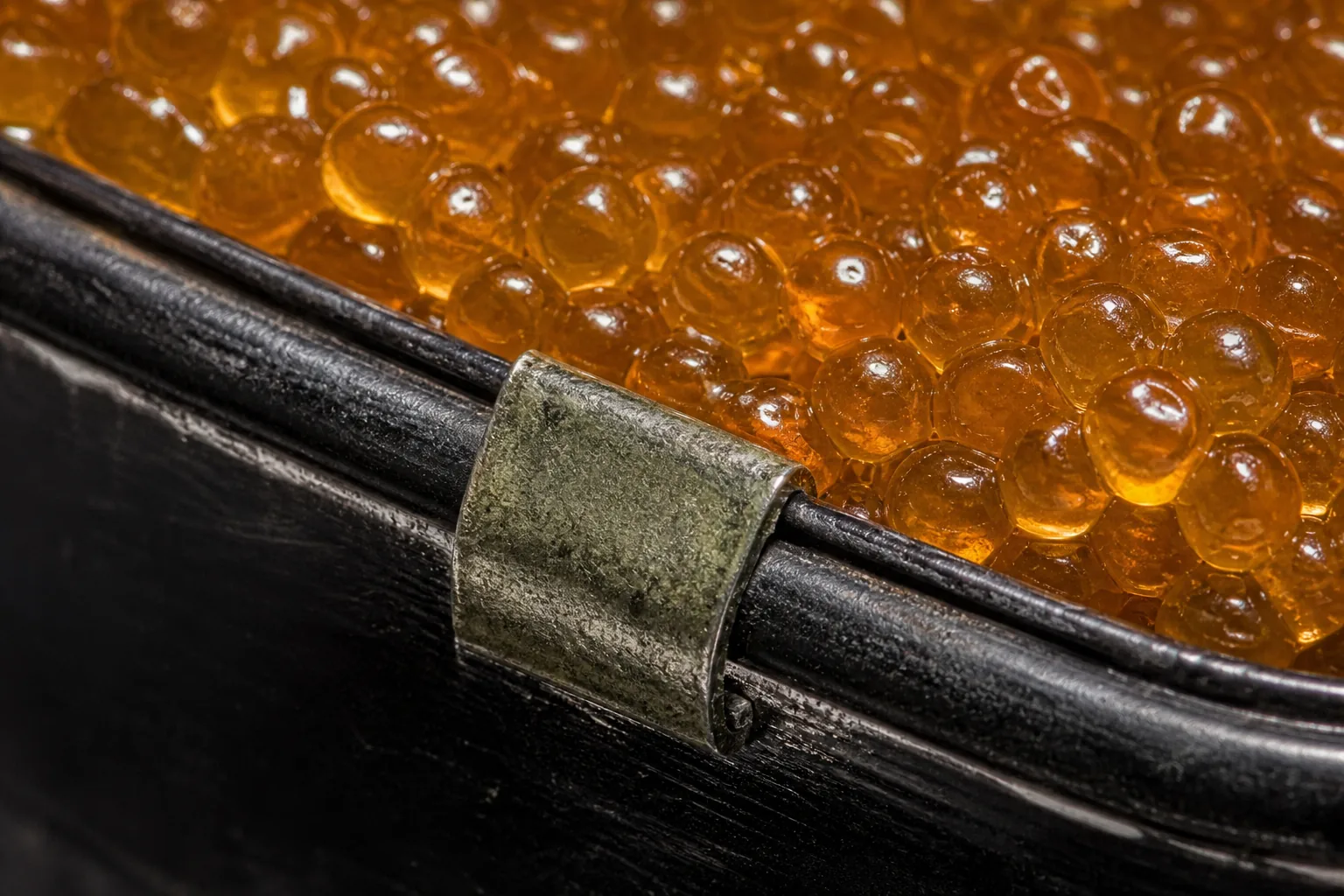
Thomas had bought the tin because it was beautiful.
It was blue-black, low and circular, with gold type so restrained it appeared to have been briefed by a diplomat.
A name in Cyrillic-looking lettering moved around the lid.
The price had been significant enough to make him set it down twice, then pick it up with greater conviction.
“It’s obviously caviar,” he said.
Clara looked at the tin.
“What species?”
Thomas looked at it again. The tin had not become less handsome. It had merely declined to answer.
“Ossetra.”
“That was not the question.”
And the tin is never going to be the answer.
Because it can be a real tin, sold by a real shop, carrying a real-looking name, and still leave the central claim unresolved.
The central claim is biological. Which sturgeon produced these eggs?
Everything else is nearby. Some of it is useful. None of it is a substitute.
How Can You Tell What Caviar You Are Buying?
Start with the fish, not the adjectives.
The international standard gives each sturgeon a compact three-letter code. HUS is beluga. GUE is Russian sturgeon. PER is Persian. STE is stellate.
BAE is Siberian. TRA is white sturgeon. RUT is sterlet. Kaluga is DAU.
The names have the poise of minor European railways. The distinction is real.
A species code identifies a biological member.
It is not a flavor note, a price tier, or a small tattoo of excellence on the egg.
“Ossetra is a species,” Thomas said.
“Sometimes it is two,” said Clara.
That is exactly the trap.
Ossetra is permitted for both the Russian and the Persian sturgeon, so it is a useful commercial word and an incomplete species record.
If your seller can’t say which of the two you’re buying, you have been handed a category with the important part missing.
The Russian-looking name on the lid supplies atmosphere. Atmosphere has never been admitted as a witness.
Hybrids need even less romance and more careful transcription.
Different systems write the parentage in different orders, so you cannot decode it from a retail name with the confidence of a man reading tea leaves.
Copy the governing record. Say which convention it uses. Keep it.
Thomas turned the tin over.
“It says malossol.”
“How much salt?”
This was not, he felt, a generous way to receive a beautiful word.
Why a Tin and a Price Do Not Prove Species
Malossol means little salt.
It does not mean beluga, wild, rare, best, legal, or secretly approved by someone in a fur hat.
Conforming sturgeon caviar sits at 3 to 5 grams of salt per 100 grams of finished product.
A brand using the word should give you an actual value or a stated method.
The word alone is a direction, not a calibrated global grade.
Salt does real work. It changes preservation, salinity and texture.
It does not identify the fish. A lightly salted lot and a saltier one are different propositions in the mouth and on the shelf.
Neither number proves a species, a wild source, or a seller’s private “reserve” grade.
Food people do enjoy a grade word.
Reserve is especially popular, because it sounds as though the product has been standing quietly behind a velvet rope.
Unless the seller gives you its rubric, it isn’t comparable between brands.
Larger, more even grains may be a genuine preference of yours.
They do not become a species test by having been arranged attractively in metal.
The tin can’t settle condition either.
What you actually inspect is separate grains, intact and tender skins, reasonably even color, and no broken eggs, free fluid, fat or membranes.
Hard skins and membranes that tear during separation are defects.
An unopened photograph shows you color and perhaps damage. It cannot establish taste, salt, microbial safety or biological identity.
The lid is not invited to testify.
“But it cost a great deal.”
“That establishes a price,” said Clara.
Thomas examined this response for a loophole. There wasn’t one.
Price is a fact about a transaction. Weight is a fact about a container.
A small gift tin, a family tin and a food-service container may share one lot and still give you completely different problems of time-to-use and exposure after opening.
Net weight rules set a conformity floor. They are not a certificate of magnificence.
Egg condition is a lot observation. Species is a fish identity. Packaging is a claim container.
Do not let those three columns marry each other.
What CITES and Lot Records Add
Now the unglamorous part becomes the useful part.
A CITES label can carry the species, the source, a country code, a harvest year, the processing plant and a lot number.
The year identifies the harvest or quota year. Not the moment a waiter brought the tin to your table looking pleased with itself.
The lot is the hinge.
It should let the company retrieve when, where and from whom it acquired the caviar in that container.
A processing plant packs roe into a primary container in the country of origin.
A repackaging plant receives caviar and puts it into new containers.
So a retail jar can carry a later plant record without anything having happened to the fish’s origin.
That isn’t suspicious. It is paperwork behaving like paperwork.
A non-reusable label is one you cannot remove undamaged or move to another container, which makes it better physical support than a charming description copied off a menu.
It still doesn’t turn the label into a laboratory.
The strongest ordinary comparison available to you is lot against lot.
The physical tin and its label, matching importer or plant records, and a declared storage trail.
Thomas found a code around the rim.
“There,” he said. “A number.”
“Can it retrieve anything?”
The code became briefly less triumphant.
A lot code is a traceability key, not a quality score.
An invoice says a buyer bought a named product from a named seller on a date.
It does not prove the seller received the correct species.
And three catalogues repeating the same unsupported description do not give you three confirmations. They give you a small committee of echoes.
That is circular provenance, and it happens whenever the claim travels more easily than the object.
A three-owner history means something only if each owner received the same physical container from a reliable source and wrote down the handoff.
At every transfer, photograph the label, the seal, the markings, the lot, the invoice, the shipping record and the storage record.
A smooth story in the passive voice is not a chain of custody. It is a story with good tailoring.
Cold-chain records belong in the same file, because handling isn’t a mood.
Caviar wants a tight, cold band for packaging, storage and retail, and colder still for wholesale transport. A logger supports a shipment.
A shop thermometer supports one observed point. The label supplies an instruction.
None of them should be promoted into evidence it doesn’t carry.
When Should a Buyer Ask for Verification?
Before you buy, when the species claim matters and the record can’t support it.
This is less theatrical than cutting the seal at the table and declaring an emergency, which is fortunate for everyone nearby.
Keep the label, the lot, the seller’s claim, the invoice, the photographs and the storage information.
Ask the producer, importer or plant whether the identifiers join up.
Compare the claim, the object and the record as three separate things.
“And if they don’t?” Thomas said.
“Then it is not obviously anything,” said Clara.
If biological identity matters beyond the paper trail, DNA is your next layer.
Market surveys have recovered sequences from nearly every lot they sampled and found mislabeling at a rate high enough to justify asking.
That is a reason to check. It is not a reason to treat every tin as guilty by association.
It is also narrower evidence than it sounds.
One genetic marker doesn’t always separate closely related sturgeon, and some markers report only the maternal line.
So “DNA proved it” is frequently a sentence with its shoes untied.
Make the report say what it distinguished: species, hybrid identity, or lineage only.
A test can be powerful and still answer a narrower question than you were hoping.
Verification costs money, takes time, and has limits.
Which is why you don’t begin by treating every serving as a forensic exhibit.
You begin by buying only what you will serve promptly, keeping the label and the records, and escalating an unsupported high-value species claim before the money moves.
Farmed against wild is a provenance choice too, not a tasting score.
What is legal depends on the jurisdiction, the documents, the quota and the source status.
Thomas set the tin beside the plates.
“So we are not opening it?”
“We are serving it,” Clara said. “We are not making it testify.”
The label, the lot, the seller and the species claim had gone into the drawer.
The roe could now be roe. It did not need to be a story, an alibi, or a small black puck of inherited certainty.
A tin can carry a claim a long way.
It cannot carry it all the way home.
Put it into practice
- Scientific species and the Codex three-letter code identify the fish more precisely than a prestige name.
- Malossol describes a low-salt processing direction and does not certify species, origin or grade.
- A CITES caviar label links species, source, country, harvest year, plant and lot, but its presence is not a flavor or grade guarantee.
- A lot and its transfer records can support provenance only when they are linked to the same physical container rather than copied from an earlier description.
- A non-reusable label, matching records and documented cold chain provide stronger support than a tin, price or menu claim alone.
- DNA can provide biological evidence, but its method must state whether it resolves species, hybrid identity or only maternal lineage.
- Caviar condition, salt, net weight and storage temperature are separate product questions from species identity.
Asked across the table
- What species is actually in a tin called Ossetra?
- Ossetra is not one unambiguous biological identity. Codex CXS 291-2010 permits the name for Russian sturgeon, Acipenser gueldenstaedtii, coded GUE, and Persian sturgeon, Acipenser persicus, coded PER. A reliable description therefore states the scientific species or the applicable code, rather than treating the prestige name alone as a complete species record.
- Does a proper caviar tin prove what is inside?
- No. A tin and its label are evidence of a seller's asserted identity, not independent proof of the biological identity of the roe. Stronger support links the physical container and its non-reusable label to matching species, source, plant, lot and transfer records. A disputed species claim may require laboratory evidence that states exactly what its DNA method can resolve.
- What information should a CITES caviar label carry?
- Relevant CITES label fields include the species, source, a two-letter country code, a four-digit harvest year, processing-plant information and a lot identifier. The lot should allow the company to retrieve when, where and from whom it acquired the caviar in that container. These fields support traceability; they do not by themselves establish flavor, grade or condition.
- Is malossol a grade of luxury caviar?
- No. Malossol is a processing and marketing term meaning little salt, not a free-standing certification of species, wild origin or elite grade. An older FAO description gives a traditional four-to-six-percent salting range, while Codex CXS 291-2010 sets three to five grams per 100 grams for conforming sturgeon caviar. A useful claim gives the actual salt result or stated method.
- Can a CITES code tell whether caviar will taste good?
- No. A CITES code and label fields identify parts of a trade and traceability claim. Taste and condition depend on a separate lot assessment: grain separation, membrane integrity, free fluid, odor, flavor, salt, handling and storage. Codex allows a wide color range, so darkness, color uniformity or a dramatic country name does not convert a traceability code into a sensory grade.
- What makes a caviar provenance story circular?
- A provenance story becomes circular when later sellers repeat an earlier unsupported description as though each repetition were independent confirmation. A three-owner history is useful only when each owner receives the same physical container from a reliable source and records the handoff. Invoices, photographs, lot identifiers, shipping records and storage records must link to the actual object, not merely to its advertised name.
- Can DNA settle a disputed caviar species claim?
- DNA is evidence about biological identity, but the method and its limit matter. A PLOS market study used cytb, D-loop and cox1 sequences and found that one marker did not always resolve closely related assignments. A laboratory result should therefore state whether it distinguishes species, hybrid identity or only maternal lineage, rather than being reported loosely as proof of every part of the product claim.
- What does a lot number actually prove?
- A lot number is a traceability key, not a quality score or a guarantee of authenticity. It can allow a company to retrieve when, where and from whom it acquired the caviar in a particular container. The number becomes stronger evidence when it matches the label, processing or repackaging record, seller record and physical container without an unexplained break in the chain.
- Does expensive caviar have to be wild?
- No. Farmed and wild describe provenance and supply-chain claims, not a single sensory hierarchy. Either source can involve more than one sturgeon species, and legality depends on jurisdiction, CITES documents, quotas and source status. A fully identified, traceable farmed lot can support its identity more convincingly than a claimed wild lot with only a menu description or luxury packaging.
- What temperature records matter for caviar?
- Codex CXS 291-2010 specifies plus two to plus four degrees Celsius for packaging, storage and retail, and zero to minus four degrees Celsius for wholesale storage and transport. Those values are conditions to be maintained, not proof that a particular shipment met them. A logger supports a shipment record; a display thermometer records only one point in time.
- Is a larger caviar tin better value or better quality?
- No. A 30-gram gift tin, a 125-gram family tin and a one-kilogram food-service container may contain caviar from the same lot, but they create different use and holding risks after opening. Weight is not a quality axis. A useful comparison records net mass, price per gram, declared weight, expected prompt service and the condition of the opened product.
- What should happen when the species claim cannot be supported?
- The unsupported claim should be escalated before purchase or service rather than repaired with confident language. The label, lot, seller description, invoice, photographs and storage record should be preserved, then compared with producer, importer or plant records. If biological identity is material and records do not resolve it, a suitable laboratory method can be considered without overstating what that method proves.