Know what you’re choosing
Why Brandy Is Not Just Wine With the Volume Turned Up
Distillation and aging do not simply intensify wine; they select and reshape it. A cognac, an armagnac and a generic grape spirit therefore cannot be chosen by proof alone.
Asserted
“Brandy is wine, but louder, so any bottle will do in the same role.”
Corrected
Brandy's pot-versus-column and aging distinctions meet spirits' legal category and proof conventions at the point where a spirit's base material does not determine its finished structure by itself.
What to do
For a mixed drink start with 30 to 45 mL; for tasting pour 20 to 30 mL and choose by declared style and age rather than proof alone.
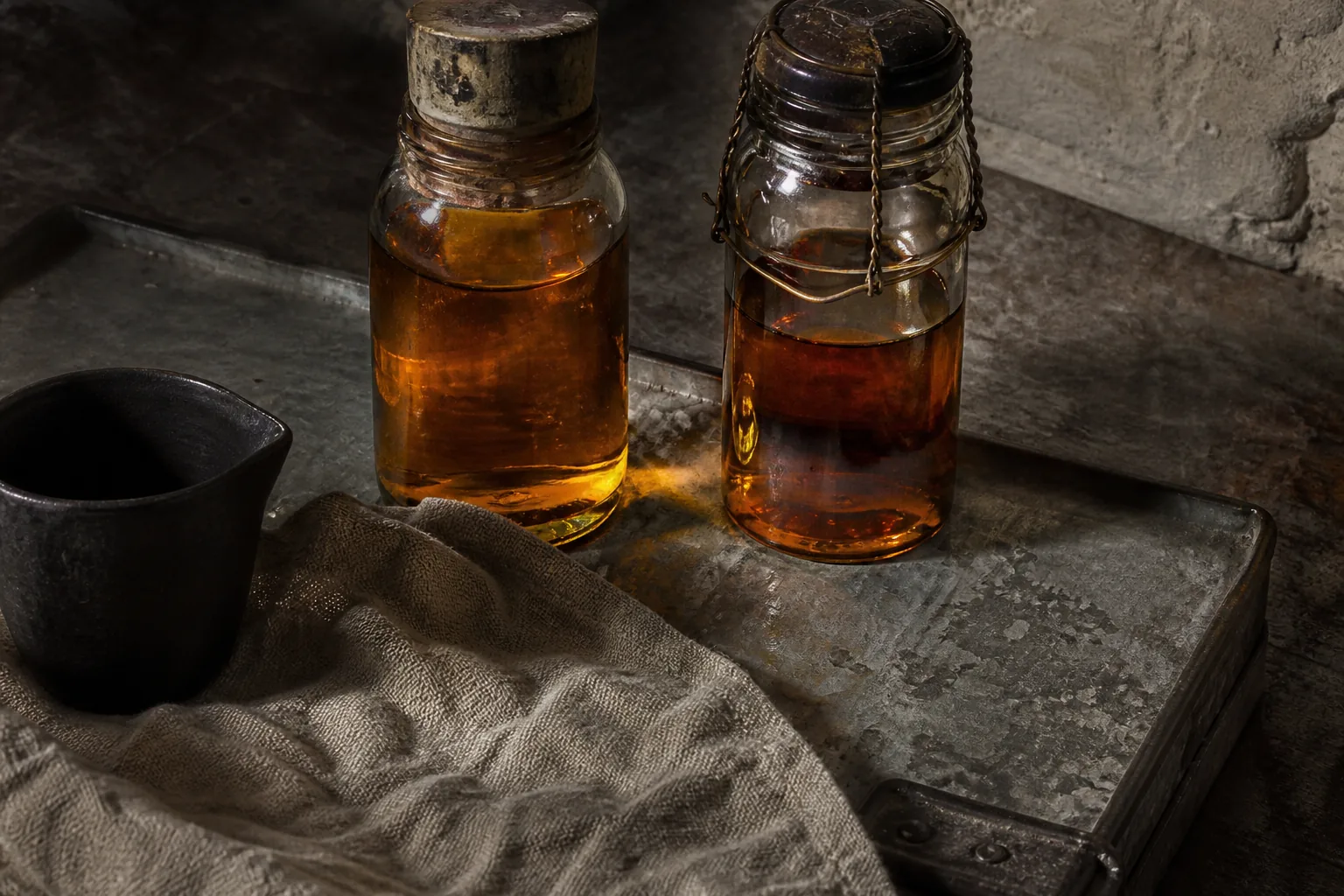
Thomas was holding the snifter by its bowl.
This was partly because it looked convincing and partly because the room was cold.
The brandy inside had gone warm at once, with the quick, private authority of a small radiator.
“Wine after dark,” he said.
Clara looked at the bottle.
“Which still made it?”
Thomas lowered the glass slightly.
“The bottle made it.”
This was not, strictly speaking, a production method.
“It is wine,” he said. “But louder.”
“At what stage?”
Thomas considered the amber liquid. It had the color of a complicated answer and proved nothing much by itself.
“After it becomes brandy.”
Which is the stage where it stops being wine at all.
Because brandy can begin with wine and still behave nothing like wine in the ways that matter to you at a shelf.
Distillation does not put the original liquid through a megaphone.
It selects part of it, separates it from the rest, and hands what’s left to wood, time, water, blending and a label with several opportunities to become evasive.
The source is real. Your conclusion is premature.
How Is Brandy Different From Wine?
Wine is fermented. Brandy is distilled.
That sentence is so short it encourages misconduct.
Distilling from fermented fruit juice, mash, wine or residue gets you brandy, and the family then divides again. Fruit brandy. Lees brandy.
Pomace or marc brandy. Residue brandy. Dried-fruit brandy. Neutral brandy.
It is not a single setting marked “grape, but concentrated.”
A wine spirit starts with wine. A grape-marc spirit starts with pressed solids. A fruit spirit starts with fermented fruit.
All three can reach you clear or amber, in a handsome bottle or a bottle designed by somebody’s nephew.
The color doesn’t settle the source, and the source doesn’t settle anything else.
Thomas examined the label more closely.
“So grape is not enough.”
“It is a beginning.”
Fruit spirit is distilled at a lower strength specifically to keep the fruit’s character, and it has to be sold above a stated minimum.
That’s a legal route with fruit identity at the middle of it.
Cognac is a different route altogether: a protected grape wine spirit with a delimited origin and oak maturation.
A pear eau-de-vie and a Cognac may both appear after your dinner. So may an invoice. That isn’t a useful basis for comparison.
Cognac’s provenance is specific without turning into a tasting note.
It has six named crus. Fine Champagne means the blend came from the two best of them, with at least half from Grande Champagne.
That is a blend-composition claim.
It is not sparkling Champagne, it isn’t a single cru, and it isn’t a legal promise of velvet with a finish of inherited furniture.
Geography gives you traceability. It is not a flavor vending machine.
What Pot and Column Distillation Change
“Fine,” Thomas said. “But distillation makes it stronger.”
“It also makes it less like the wine.”
This seemed, to Thomas, needlessly technical for a drink he had hoped merely to admire.
Cognac runs a prescribed double batch route.
The wine is distilled once into a low-strength spirit, then run a second time, with the cut decisions made during that second pass.
What comes off has a legal ceiling on its strength.
That figure describes new spirit. It doesn’t tell you what your finished bottle will be.
Armagnac usually reaches you by another route entirely.
Almost all of it comes off a continuous still, where incoming wine and rising vapor meet across a sustained plate system rather than arriving in discrete charges.
It leaves the apparatus in a lower and wider band than Cognac does. Again: exit strength.
Not a declaration of bottled proof, tenderness or moral seriousness.
Thomas took this in.
“So the column is not the cheap one.”
“That is not what it says.”
A continuous route supports uninterrupted seasonal operation. A batch route makes every charge and every cut its own record.
Those are operational differences, not a folk ranking of industrial against artisanal. A pot still isn’t automatically a beret.
A column still is not automatically an office block.
Distillation is selection.
It decides what carries forward from the fermented material and at what strength it leaves the apparatus.
Then somebody matures, blends, reduces and bottles it.
Which is why two bottles both called grape brandy, both brown, both showing a familiar number on the label, can share almost nothing beyond their first premise.
So the comparison worth making isn’t pot against column as a morality play.
It’s batch against continuous. Wine against marc. New-spirit strength against bottling strength.
A recorded cellar history against a label that would prefer everyone to relax.
Why Cognac and Armagnac Are Not Interchangeable
Thomas was now reading the age word with the concentration normally reserved for rail timetables.
“This one says XO. That means old.”
“It means a floor.”
For Cognac, the floors run two years for VS, four for VSOP, ten for XO and fourteen for XXO, and the age is that of the youngest component in the blend.
Your XO may well contain much older material.
The word does not calculate the average, disclose the oldest cask, or send you a reliable telegram from the cellar.
Armagnac uses several of the same words with different minimums, and its XO sits considerably lower than Cognac’s.
The shared vocabulary is the trap. An XO isn’t a universal time unit with a French accent.
Some bottles make a vintage claim instead.
A vintage Armagnac accepts the character of one harvest. A multi-age blend can be tuned toward a recurring house profile.
A date on a label is not an age statement, just as an XO isn’t a harvest year.
Keep the time in wood, the bottling date, the designation and the vintage in four separate drawers.
Less romantic than letting the label form a weather system around your glass.
Also how you avoid buying a category word instead of a bottle.
“But they are both forty percent,” Thomas said.
“One number is not a biography.”
Cognac has a minimum bottling strength. Armagnac may be reduced with water or bottled straight from the cask.
Strength is label arithmetic. It isn’t a quality metric, an oak record, or a sensible answer to what you should order.
Armagnac’s cellar practice makes the point physical.
Spirit goes into oak, transfers from new wood to older wood, and eventually into glass once the wood has given what was wanted.
So a spirit can have years passing in its life without all of them being active wood years.
Dark color cannot reverse-engineer that chronology for you.
Neither can a label adjective that sounds as though it was written in a library after rain.
How to Choose Brandy for Mixing or Sipping
Thomas set the snifter down and reached for a tumbler.
“So this is for sipping.”
“What are you making?”
“I had not planned that far ahead.”
For mixing, start at 30 to 45 ml. For tasting, pour 20 to 30.
Those are working measures, not category law, and they don’t turn brandy into a medicine administered under supervision.
The smaller pour just makes the useful question easier.
What has this particular bottle declared about its source, its still route, its age term, its barrel record and its bottled strength?
For a mixed drink, a younger declared style gives you a more direct grape or fruit role.
A more mature category brings a wood-shaped direction instead.
That’s a decision about the job, not a ladder where the higher number wins. Start from the role you need.
Lift, fruit, dryness, oak, or simply a base that won’t remove the roof from everything else.
For sipping, read the label in columns.
Is it wine spirit, marc spirit or fruit spirit? Is Cognac provenance actually being claimed, and is a cru named?
If it says Fine Champagne, does it mean the blend the term requires?
Is the age word a legal minimum, a vintage, or both being confused for the benefit of an inattentive Tuesday?
Clara poured Thomas a small measure in the smaller glass.
“That looks mean.”
“It looks measurable.”
A producer’s distillation record can identify the still, the run, the pure-alcohol figure and the measured strength.
A cellar record can say when the spirit went into wood, which vessel held it, when it moved and when it was bottled.
A shop description is useful for finding a bottle. It is not a cask chronology in a trench coat.
The phrase wine with the volume turned up was now lying on the table between them, somewhat damaged.
Thomas took a sip.
He did not say it tasted more alcoholic. He did not say it tasted older.
He said it tasted like itself, which was the first competent thing he had said about it.
Clara nodded.
Brandy begins where wine stops.
Put it into practice
- Grape brandy begins with a grape-derived material, but distillation and maturation determine more than finished strength.
- Cognac's prescribed double batch distillation and Armagnac's common continuous-still route are different production records, not quality rankings.
- Cognac and Armagnac exit-strength figures describe new spirit and cannot be treated as bottling proof.
- Cognac and Armagnac age words have different minimums and apply to the youngest component of a blend.
- A Cognac, a grape-marc spirit, and a fruit spirit make different source and label claims even when their color is similar.
- Proof doubles ABV in the United States, but bottling strength alone does not establish age, wood history, or drinking role.
- Mixing and sipping require different decisions: a declared style and age matter alongside strength.
Asked across the table
- Is brandy just distilled wine?
- No. A grape wine spirit begins with wine, but the finished brandy also reflects the still route, distillation strength, cut decisions, oak chronology, blending, reduction, and bottling strength. A grape-marc spirit begins with pressed grape solids instead, while fruit spirit can begin with fermented fruit or berries. The shared presence of grapes does not make these products interchangeable in a glass or on a label.
- What is the difference between Cognac and Armagnac distillation?
- Cognac uses a prescribed two-stage batch route: wine first becomes brouillis, then a second bonne chauffe produces the retained wine spirit after cut decisions. Armagnac reports that roughly 95% of production uses a continuous Armagnac still. Batch and continuous routes create different production records and operating patterns; neither route alone proves superior quality or a fixed flavor result.
- Does a higher proof mean a better brandy?
- No. In the United States, proof simply doubles ABV, so 40% vol. is 80 proof. Bottling strength records a final strength choice, not a barrel chronology, source material, still type, or age. Cognac must be sold at at least 40% vol., but two Cognacs at that strength can have sharply different wood histories and blends.
- Why do Cognac and Armagnac have different numbers after distillation?
- Cognac eau-de-vie may not exceed 72.4% vol. at 20°C after its double distillation. Armagnac's official account gives a 52 to 72% vol. exit range, traditionally around 52 to 60% vol. These are new-spirit process figures, not bottle strengths. Aging and any later water reduction can change the strength presented for sale.
- What does VSOP mean on Cognac and Armagnac?
- The same word does not carry the same age floor in both systems. Cognac VS requires 2 years, VSOP 4 years, XO 10 years, and XXO 14 years. Armagnac guidance gives VS 1 year, VSOP 4 years, XO or Napoléon 6 years, and Hors d'Âge 10 years. These terms describe minimum eligibility, not average age or guaranteed flavor.
- Does an age statement describe the whole bottle?
- For a blend, an age claim refers to the youngest eau-de-vie in the blend. An Armagnac stated as 15 years therefore has a minimum component age of 15 years; it is not a calculated average. Cognac's familiar designation floors work by the youngest-component rule as well. A label should be read as a maturity threshold, then alongside bottling date and any available cask record.
- Can color show how old a brandy is?
- No. Dark color does not prove old age or a particular cask history. Cognac and Armagnac can be reduced before bottling, and permitted coloring or sweetening is a separate legal and analytical field from dilution. Armagnac may also move from 400-liter oak pieces into glass storage once the desired wood extraction is reached, so calendar age and active wood time are not identical.
- Is a grape-marc spirit the same thing as Cognac?
- No. A wine spirit begins with wine, while grape-marc spirit begins with pressed grape solids. The EU grape-marc category allows no more than 25 kg of lees per 100 kg of marc and limits alcohol from lees to 35% of total alcohol. Cognac is a protected grape wine spirit with its own origin, production, aging, and sale-strength conditions.
- What does Fine Champagne mean on Cognac?
- Fine Champagne is a Cognac blend made only from Grande and Petite Champagne, with Grande Champagne accounting for at least 50% of the blend. It is neither a single cru nor sparkling Champagne. The phrase is a provenance-and-composition claim; it does not by itself predict a particular flavor, quality ranking, or amount of time in wood.
- How should brandy be chosen for a cocktail or a tasting?
- For a mixed drink, a 30 to 45 mL starting measure is supplied for practical testing; for tasting, a 20 to 30 mL pour is supplied. The bottle should then be chosen by declared style, source material, age term, and intended role rather than proof alone. Label and producer records establish the bottle-specific facts.
- What makes a spirit legally brandy in the United States?
- The broad U.S. brandy category is distilled from fermented fruit juice, mash, wine, or residue and must be distilled below 95% vol., or 190 proof. The rules then distinguish fruit, lees, pomace or marc, residue, dried-fruit, and neutral brandy types. A source description and a distillation ceiling therefore matter alongside the word brandy.
- Why cannot a clear fruit spirit be judged like an aged Cognac?
- EU fruit spirit must be distilled below 86% vol. to retain fruit-derived character and must be sold at at least 37.5% vol. A Cognac comparison instead concerns a protected, wood-aged grape-wine spirit; Cognac must be sold at at least 40% vol. Their color, strength, and after-dinner use can overlap, but their source material, production rules, and intended character do not supply the same decision.