Know what you’re choosing
Why Cellar Temperature Is Not a Vintage Chart
A cool cellar does not make every wine age beautifully; it merely stops storage from adding a second problem. Suitability for aging and conditions of storage are separate decisions.
Asserted
“If I store it properly, it will become a better wine eventually.”
Corrected
Cellaring's temperature, humidity and orientation controls meet wine aging's suitability limits where storage can preserve a bottle's potential but cannot manufacture the structure required to improve.
What to do
Hold long-term wine near 12 to 14°C with stable conditions, store bottles as closure requires, and buy no more than 6 bottles of an untried age-worthy wine before opening one benchmark bottle.
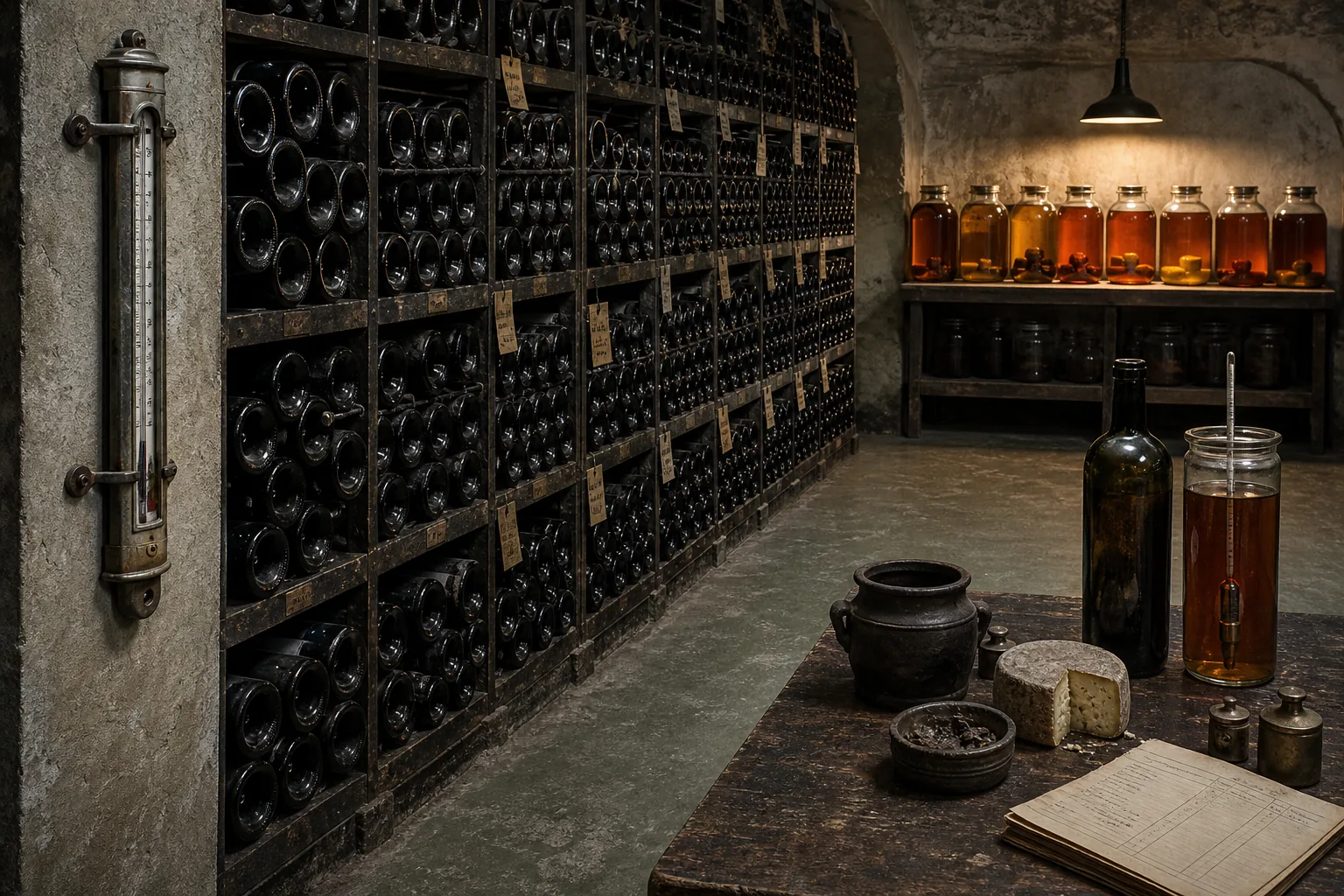
Thomas had bought a rack.
It had individual wooden cradles, a small digital thermometer, and the air of an appliance designed to correct a personality.
He had spent the afternoon loading it with bottles in the sort of silence usually reserved for museums and very expensive bicycles.
“There,” he said. “Now they become history.”
Clara looked at the rack.
“Which ones?”
Thomas looked at the rack too. This hadn’t occurred to him.
“The wines.”
“Which wines are meant to improve?”
The thermometer displayed 13 °C. It had no opinion about tannin.
And it was never going to have one.
Because a cellar and an aging curve are separate pieces of furniture.
The first controls what happens to your bottle while it waits.
The second describes what the wine was capable of doing in the first place.
Putting both ideas beside the same rack has caused a great deal of patient disappointment.
Will Proper Cellaring Make Any Wine Better?
No.
Proper cellaring stops improper storage from making a wine worse. That’s important, and less cinematic than you were hoping.
For long-term storage of anything serious, work at 12 to 14 °C and hold it there.
The number isn’t a séance. Stability matters far more than a heroic struggle to preserve one supposedly perfect digit on a small blue display.
What you want to record is the daily minimum, the daily maximum, and how long you spent outside the band.
A pleasant monthly average conceals warm spikes, which is exactly what averages do when you leave them unsupervised.
Put your sensors at the bottles. Warmest zone, coolest zone, most exposed zone.
Not beside the cooling unit’s return, where the machine is having its best day.
Temperature controls the rate of reaction and the burden on the package.
It doesn’t supply your wine with phenolics, acidity, sulfur dioxide or a coherent future. Storage preserves a possibility. It cannot issue one.
Thomas pressed the thermometer’s button twice.
“It gives the temperature in Fahrenheit too.”
“That is not a second qualification.”
What’s in the bottle matters before the cellar starts its quiet work.
The things that decide the outcome are pH, titratable acidity, sulfur dioxide, dissolved and headspace oxygen, phenolic composition, sugar where there is any, and the package.
A grape name isn’t an inventory. It’s a large label applied to several smaller uncertainties.
And a cool cellar cannot save a bottle from the limits of its own balance.
Your wine may go from youthful and disjointed to expressive and integrated, and then on toward fading fruit, oxidative notes and a thinning structure.
Its peak is a zone. It is not an appointment printed by the rack manufacturer.
Which Wines Actually Improve With Age?
The question isn’t which wines survive. Most sealed bottles manage that with very little assistance from prose.
The question is whether this particular wine has enough structure, enough reserve, and a desirable direction of change to reward you for waiting.
That answer comes from the starting wine and its package.
Two Cabernets can begin bottle life with different pigment-to-tannin balance, different pH, different sulfur dioxide, different closures and different oxygen exposure.
Time acts on what is actually in there. Not on what was printed in a large serif font.
“So the tannin sorts itself out,” Thomas said.
“Sometimes it changes.”
This seemed less reassuring than the original theory, which had been that time did the work while everyone else was asleep.
Bottle age is a set of reactions, not a maturation. Oxidation. Reduction. Esterification. Hydrolysis. Polymerization.
Fruit-forward esters decline, sometimes below the point where you can find them. Oxygen chemistry forms aldehydes. Sulfur compounds get lost, formed or unmasked.
Dried fruit, honey, tobacco, nutty, savory and earthy impressions arrive. They may be welcome, unwelcome, or merely unfamiliar to you.
The word tertiary does not cast a spell over any of it.
Sulfur dioxide is a protective reserve, not a quality score.
Once that reserve is spent, a stable cellar cannot put it back with calm determination and a tasteful hygrometer.
So the buying rule is deliberately unromantic.
Buy no more than six bottles of an untried wine somebody has told you will age, and open one before you buy any deeper.
Then build your drinking plan around what that bottle told you, rather than around a category’s reputation.
Six is a purchasing discipline, not a chemical law.
It’s still kinder than discovering a rack of expensive orphans after the enthusiasm has moved on.
Thomas looked at the bottles as though several had acquired paperwork.
“They are not orphans.”
“Not yet.”
What Temperature and Humidity Should a Cellar Hold?
Temperature is only one control. A good cellar isn’t a refrigerator that has learned to speak Latin.
For natural cork, hold the humidity somewhere around 65 to 70%.
Go below that and you start worrying about the cork drying at the exposed end and the seal following it.
Go above and you get condensation, mold, adhesive failure and ruined labels.
A brief departure is not a season. Which is why a log beats a single apologetic glance at a display.
A screw-capped bottle doesn’t need room humidity to keep anything elastic.
It can still have a label problem, a carton problem or a corrosion problem.
Wax can hide a capsule. It cannot persuade dampness to stop existing.
So run one workable environmental plan for the whole cellar, and let the closure decide what deserves your attention.
Thomas had put a small humidifier beside the rack.
“For the corks,” he said.
“How many corks?”
He checked. Several bottles did not have corks. This was becoming administrative.
Long-term storage also wants darkness, and it means it.
No daylight. No display lighting. Lights on only while somebody is in the room working.
The damage sits in the UV-A and violet band, and your glass is the main defense.
Clear glass lets a great deal of it through. Bluish-green much less. Dark amber almost none.
Dark glass is mitigation, not diplomatic immunity for a lit display. Clear-glass rosé, white, sparkling and delicate wines belong in cartons or shaded bins.
The cellar will look less like a boutique. It will look more like a place that understands electricity.
Vibration gets the same treatment. Nothing continuous and perceptible at the rack.
Controlled studies find more accelerated change at higher vibration levels over long periods, which is a reason to isolate compressors, laundry machines, pumps, traffic and repeated handling.
It is not an invitation to hold a bottle against a wall and estimate the reading by intuition.
How to Build a Cellar Without Buying Orphans
Store natural-cork bottles horizontally, or with the cork end slightly down.
That’s mostly about rack efficiency and stable handling.
A long glass-and-cork study found no orientation effect on oxygen transfer at all, so the horizontal rule is sensible and closure-specific, not a tiny religious war about gravity.
Screw caps, crown caps and some synthetics can go whichever way gives you the safest capacity and the easiest retrieval.
Large formats go low. Sparkling bottles need racks rated for their weight and shape.
Get the load rating in kilograms per shelf, because a magnum does not become a standard bottle by occupying a familiar-looking hole.
Thomas began moving bottles according to a plan he had not previously possessed.
“This one is for history,” he said, holding up a bottle.
“What is its identifier?”
He put it down.
Your cellar needs a bottle record as much as it needs a climate.
Every bottle or case gets a unique ID, its identity fields, format, where you bought it, when, where it physically sits, its status and any condition note.
A physical address like A-03-R04-B12 lets somebody else find the bottle without having to interpret “somewhere behind the good red.”
Every receipt, move, consumption, breakage and sale updates that record the same day.
Reconcile a small home collection against the shelves once a year.
Anything more active, shared or headed for resale needs checking more often, and after anyone has been in there.
This isn’t devotion to filing.
It’s what turns a rack into a drinking plan: which bottle is ready to test, which one is being held, which one has left the room, and which one has quietly become a question nobody can answer.
Thomas made a list.
It had fewer wines on it than the rack, because several were now designated for opening rather than waiting. He found this personally affronting.
“I thought the cellar was where wine went to become important.”
“It is where wine goes to be found.”
The thermometer went on holding 13 °C, immaculate and unhelpful.
Time is not a winemaker.
It is only the room in which the wine finds out what it was.
Put it into practice
- A 12 to 14 °C long-term cellar setpoint is useful because stable conditions prevent storage from adding damage, not because the number makes a wine age-worthy.
- Aging potential depends on starting pH, acidity, phenolic composition, sulfur dioxide, oxygen exposure, sugar where present, and package details rather than a grape name alone.
- Natural-cork collections use 65 to 70% RH as a working range, while screw-capped bottles do not need room humidity to keep cork elastic.
- Long-term storage targets 0 lux and avoids persistent vibration, because bottle color and a quiet room mitigate exposure without eliminating it.
- Natural-cork bottles are normally stored horizontally or slightly cork-down, while other closures are oriented for safe capacity and retrieval subject to producer guidance.
- Closure oxygen transmission can change a wine's sensory trajectory, but it does not create a universal ranking of cork, screw cap, or synthetic closure.
- A bottle list supports a drinking plan when every bottle has an identifier, location, status, and condition note, and when untried wines are tested with a benchmark bottle before deeper buying.
Asked across the table
- Does a cold cellar make every wine better with age?
- No. A cool, stable cellar prevents storage from adding heat, light, vibration, or humidity problems to a bottle, but it does not create aging potential. A wine's later development depends on its starting pH, acidity, phenolic composition, sulfur dioxide, oxygen exposure, sugar where present, and package details. A bottle without a favorable starting balance can simply lose fruit or concentration over time.
- What temperature should a wine cellar hold?
- For long-term fine-wine storage, a practical setpoint is 12 to 14 °C (54 to 57 °F). Stability matters more than chasing one supposedly perfect reading. Sensors belong where bottles live, including the warmest, coolest, and most exposed zones, and the record should show daily minimum, maximum, and time outside the agreed band. A monthly average can conceal harmful warm spikes.
- How does a collector tell whether a wine can improve with age?
- A collector starts with the wine's actual bottling condition and package rather than a grape name alone. Relevant factors include pH, titratable acidity, phenolic composition, free and total sulfur dioxide, dissolved and headspace oxygen, sugar where present, and closure. A controlled comparison of the same wine over time gives stronger evidence than an unrelated vertical tasting from different vintages.
- Does more tannin always mean a wine will age well?
- No. Tannin is one part of a changing system, not a guarantee. During bottle age, tannin concentration can fall as material transforms, binds, or precipitates, while its structure and interaction with saliva proteins also change. A wine can become less abrasive, but it can also lose concentration or retain hard drying phenolics if its starting balance is poor.
- What humidity does a natural-cork cellar need?
- A 65 to 70% RH range is a defensible starting point for a natural-cork collection. Sustained conditions below that range raise concern about drying at the exterior cork end and seal risk. Conditions above it shift the concern toward condensation, mold, adhesive failure, and damaged labels. Relative humidity is logged with temperature because the two readings affect one another.
- Do screw-capped bottles need to lie on their side?
- Not for the purpose of keeping a cork elastic. Standard natural-cork bottles are normally stored horizontally or slightly cork-down for conventional rack efficiency and stable handling. Screw caps, crown caps, and some synthetic closures can be stored in the orientation that provides the safest capacity and retrieval, subject to producer guidance. Closure type changes the storage priority.
- Should a cellar be completely dark?
- Normal long-term storage targets 0 lux: no daylight, no display illumination, and lights used only while someone works in the room. Light sensitivity is strongest in the 320 to 440 nm UV-A and violet band. Darker bottle glass reduces transmission but does not make display lighting harmless, so clear-glass and delicate wines belong in cartons or fully shaded bins.
- Does a screw cap stop a wine from aging?
- No. Closures create different oxygen-exposure trajectories rather than a simple quality hierarchy. Screw caps tend toward very low to low oxygen transmission and high consistency; technical cork has lower variability than natural cork; synthetics often occupy moderate to high ranges. Very low exposure can permit reductive attributes, while high exposure can move a bottle toward oxidation sooner.
- Why can two bottles of the same wine age differently?
- Two bottles can diverge because closure permeability varies and because heat history, fill level, seal failure, sulfur dioxide reserve, and starting wine condition also vary. Package differences can help explain unequal development in one case, but they do not prove the cause of a disappointing bottle. A mature bottle needs interpretation beside aroma, palate, color, fill level, and provenance.
- How should a collector test an unfamiliar wine before buying a case for the cellar?
- The supplied working discipline is to buy no more than 6 bottles of an untried wine claimed to be age-worthy, then open one benchmark bottle before buying more. The opening does not prove a universal drinking window, but it tests whether the wine's fruit, acidity, tannin, aroma, and balance justify deeper commitment to that particular cellar plan.
- What records make a cellar useful instead of decorative?
- Every saleable bottle or case has a unique identifier, identity fields, format, purchase source, acquisition date, physical location, status, and condition note. Each receipt, move, consumption, damage event, and sale changes the record on the day it occurs. A small home collection may be physically reconciled every 12 months; higher-risk collections need more frequent checks.