Understand the craft
Why a Stuck Fermentation Is Not a Nutrient Emergency
A slow ferment can have too little nitrogen, too much alcohol, damaged cells or several problems at once. Adding nutrient late without diagnosis may feed the wrong organism.
Asserted
“The ferment stopped, so it needs more nutrient immediately.”
Corrected
Winemaking's nutrient timing and operating ranges meet wine microbiology's stress ecology where a late nutrient addition cannot restore exhausted yeast but can leave substrate for spoilage.
What to do
Before any intervention, measure residual sugar, temperature, pH, alcohol, YAN and viable cells; do not add nutrient late merely because fermentation has slowed.
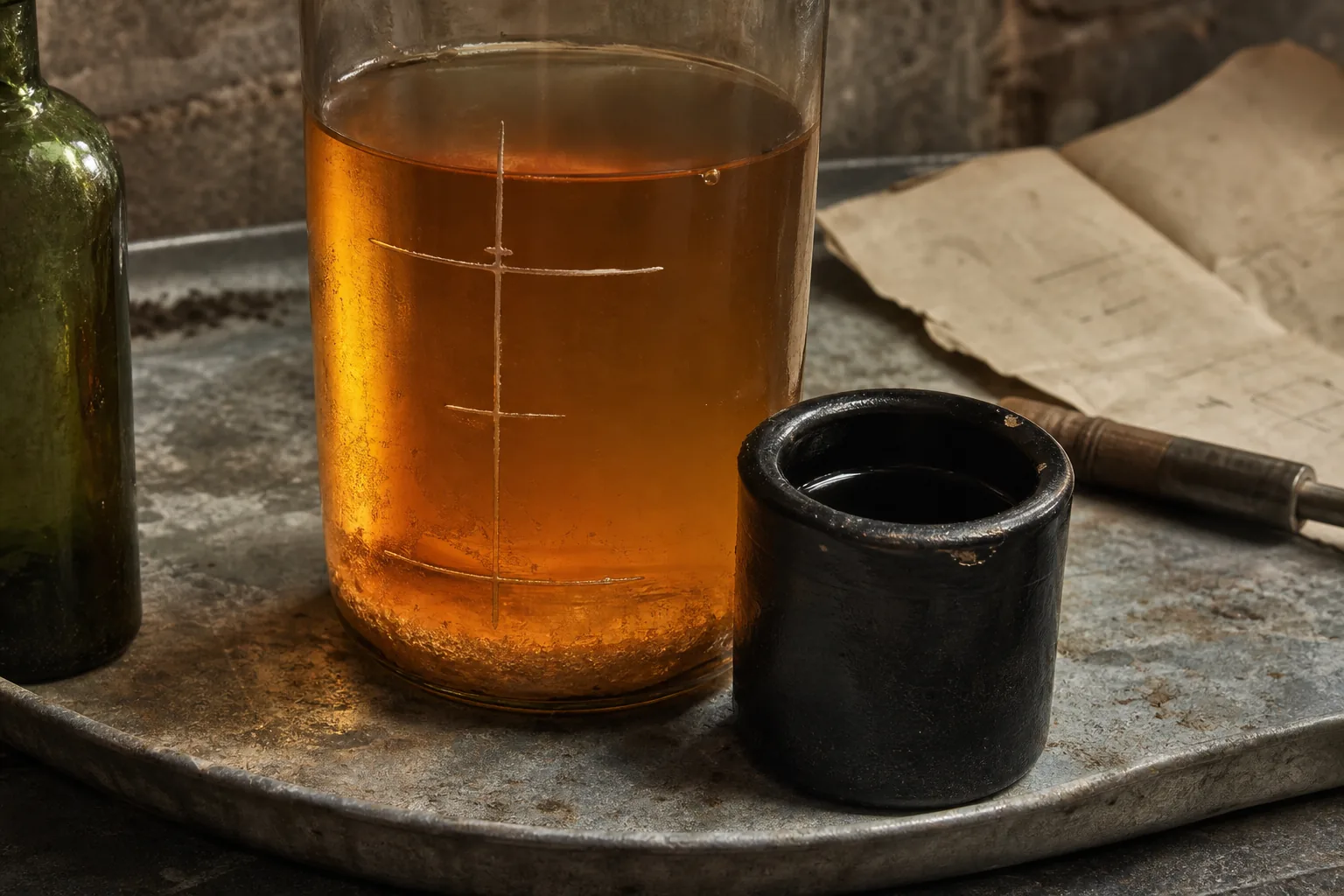
The ferment was not moving.
It had not stopped with drama. There was no tiny black flag in the tank.
There was a hydrometer on the bench, a notebook open beside it, and Thomas holding a packet of nutrient as though it had been issued by a higher authority.
“It needs feeding,” he said.
Clara looked at the hydrometer.
“What is limiting?”
“It is slow.”
“That is what it is doing.”
This seemed fussy, until you notice that a thermometer also reports what something is doing, and nobody responds to a fever by adding soup to the patient without asking further questions.
Not nobody. But the result is rarely celebrated in the technical literature.
Thomas had not yet located the temperature record.
He had not measured pH, alcohol, available nitrogen, viable cells, or how much of the remaining sugar was glucose and how much was fructose.
He had located the nutrient with extraordinary efficiency.
“It has sugar left,” he said.
“Yes.”
“And yeast need nutrient.”
“Sometimes.”
Sometimes is where the whole tank lives.
Because a stuck fermentation isn’t a hungry houseplant.
It is a population of cells in an acidic liquid that started sugary, turned alcoholic, and may now be cold, hot, nitrogen-poor, sulfur-stressed, damaged, or several of those at once.
Adding nutrient isn’t a diagnosis. It is one possible answer, arriving before the question.
What Causes a Stuck Fermentation?
Nitrogen matters. It supplies the material for proteins, enzymes and new cells.
Low available nitrogen goes with slow or incomplete fermentation, and with a greater chance of sulfide reduction.
Higher nitrogen raises the rate and the heat.
Push it too far with inorganic nitrogen and you’re left with residue in the wine and a raised ethyl acetate risk.
It is a curve, not a hymn to more.
Published low-risk targets sit somewhere around 150 mg/L of yeast assimilable nitrogen for whites and 100 mg/L for reds, with aromatic whites often wanting considerably more.
None of those is a packet instruction for a slow tank.
They are planning references, qualified by sugar, strain, temperature, aeration, and, in reds, whatever the skins release later.
Even the measurement is narrower than it sounds. It counts ammonia and amino nitrogen.
It doesn’t measure your vitamins, your lipid status, your oxygen history, or the remaining will to live inside an ethanol-stressed cell.
Wine has again declined to be a spreadsheet.
Thomas read the numbers in the notebook.
“So it might need nutrient.”
“It might.”
“That is what I said.”
“You said it was an emergency.”
The first trap is treating a nitrogen reading as a permanent verdict.
A healthy early population does not guarantee you a finish.
Growth is over in a day or two, and most of the sugar gets consumed afterwards, once growth has slowed and stress has accumulated.
The cells finishing your wine are doing a different job from the cells that started it.
And the stresses stack.
High initial sugar means osmotic pressure. Fermentation raises the ethanol and changes membrane permeability. Low pH adds acid stress. Cold cuts activity.
Serious heat damages yeast health outright. Sulfur dioxide and microbial metabolites join in.
None of these queue politely.
Which is why the same alcohol level can be perfectly tolerable in one warm, nutrient-rich must and unworkable in another that is cold, acidic and nitrogen-poor.
A slow ferment has causes, plural.
So the useful question isn’t “what does yeast eat?” It’s “what can these cells still do in here?”
Why Late Nutrient Can Make a Problem Worse
Nutrient has a place in the story, and it is early.
Additions belong at the start and around a third of the way through, because the window closes as ethanol rises.
A dose thrown in with almost no sugar left will raise your residual nutrient without restoring a healthy population. Those late cells aren’t seedlings.
They are survivors of a long and increasingly hostile administrative process.
Ammonium added while yeast can still build biomass may stimulate growth. Ammonium added to a near-stuck ferment may simply sit there.
That’s the unpleasant turn. A treatment intended for your yeast becomes food for something else.
The residual sugar has already created a niche.
Brettanomyces is strongly favored by it, and other yeasts and bacteria will use what’s available when oxygen, time and weak hurdles allow.
Spoilage does not happen because a molecule feels lonely. It needs a viable organism, a usable pathway and permissive conditions.
But an unconsumed nutrient addition is not a contribution to that situation anyone needed to make.
Thomas put the packet down.
“So the nutrient might feed the wrong organism.”
“It might.”
This was worse than being told no. It was being told perhaps, with paperwork.
The second trap is assuming the remaining sugar tells you what’s missing.
Wine yeast eats glucose preferentially, so the sugar left late in a troubled ferment is disproportionately fructose.
Fructose isn’t a villain.
It is just often the last one in the room, at the point where ethanol, depleted nutrient, acid stress and weak membranes have made the room very difficult.
That changes the plausible remedy.
A fructophilic restart strain may be exactly what you need. More nitrogen for the original, exhausted population may not be.
Both options are real. Neither one is selected by panic.
Which Measurements Diagnose a Slow Ferment?
The minimum equipment is a sample and a refusal to let the hydrometer run the meeting.
Confirm the glucose and the fructose separately. Measure temperature, pH, alcohol, volatile acidity, available nitrogen and viable cells.
The hydrometer can tell you the ferment hasn’t finished.
It can’t tell you whether your surviving yeast are hungry, poisoned, absent, or merely working slowly.
Cell viability is especially rude to wishful thinking.
Once viability drops below about 60 to 70%, you are looking at a toxic environment, not a shortage of inoculum.
Fresh yeast thrown into unchanged high alcohol, high volatile acidity or inhibitory sulfur dioxide will reproduce the original failure in newer packaging.
Your constraints are also coupled.
A pH target is useful for planning and useless as a repair. So is an alcohol figure, a temperature and a nitrogen number.
Read them together, rather than averaging them into a reassuring personality. Lower pH and higher alcohol stack their stress.
A nitrogen result taken before the skins soaked is a baseline, not a composition.
Temperature belongs in the same sentence, not in a decorative column of its own.
A cold ferment is slow because activity is reduced. A hot ferment is slow because health has been damaged.
The number is neither a virtue nor a vice until alcohol, pH, sugar and the state of the cells arrive beside it.
“So we measure all of it.”
“Before we intervene.”
“That takes time.”
“Less than a second failed restart.”
The sample went to work. The panic was asked to sit down.
Numbers don’t abolish judgment. They give it somewhere to stand.
Your nitrogen can be low. Your temperature can be wrong. Your alcohol can be high. Your viable cells can be insufficient.
Several of those can be true at once, which is why a universal threshold makes such determined nonsense of a real fermentation.
When Should You Restart Instead of Feed?
Restarting becomes the coherent move when the original population isn’t viable enough to resume, when the sugar left points at fructose, and when the wine isn’t still hostile to whatever you put in next.
A restart culture has to be built up to nutrient sufficiency before it meets alcoholic, acidic wine.
That is not the same as sprinkling nutrient into the stalled tank and waiting for morale to improve.
So the order matters.
Find out what the residual sugar actually is. Read alcohol, pH, temperature, volatile acidity, sulfur status, nitrogen and viable cells.
Then decide whether a missing resource can still change the original ferment, or whether a restart culture has a plausible path.
Less thrilling than a decisive scoop of powder. Also less likely to create a second problem with a purchase order attached.
And don’t turn regulatory limits into a rescue plan.
A permitted addition rate is not a needed addition rate. The cellar has a great many ways of confusing permission with explanation.
Thomas looked at the unopened nutrient packet.
“Yeast are not houseplants.”
“No.”
“That is an irritating distinction.”
It was, chiefly because houseplants have taught everyone that a droop means thirst and that water is nearby, innocent and generous.
Fermentation is less obliging.
The thing that looks like a shortage may be alcohol. Or acid. Or heat. Or cold.
Or a population that has reached the end of its useful life with fructose still on the ledger.
The packet stayed unopened. The sample did not.
That was not inaction.
It was the difference between feeding a problem and finding it.
Put it into practice
- YAN affects fermentation rate, completion and metabolic profile, but more nitrogen is not always better.
- Published low-risk nitrogen targets, near 150 mg/L for whites and 100 mg/L for reds, are planning references rather than a late-fermentation treatment dose.
- Yeast use nutrient differently during growth and stationary phase, when 50 to 80% of sugar consumption can occur.
- Yeast preferentially consume glucose, so late residual sugar is often disproportionately fructose-rich.
- Alcohol, temperature, pH, sugar pressure, sulfur dioxide and cell viability can stack into a slow or stuck ferment.
- Viability below 60 to 70% indicates a toxic environment in the AWRI rescue framework rather than a simple shortage of inoculum.
- Late nutrient can remain unconsumed and create an opportunity for spoilage organisms instead of restarting alcoholic fermentation.
- A restart decision follows measurement of the remaining sugar mix and wine environment, not a hydrometer reading alone.
Asked across the table
- Does a stuck ferment always mean the must needs more nutrient?
- No. Low YAN can slow or prevent completion, but alcohol, temperature, pH, initial sugar pressure, sulfur dioxide, volatile acidity and damaged cells can also limit fermentation. A slow ferment can contain several stresses at once. Nutrient is useful only when a usable nutrient shortage is actually limiting and when yeast can still use the addition.
- What should be measured before adding nutrient to a slow ferment?
- Residual glucose and fructose, temperature, pH, alcohol, volatile acidity, available nitrogen and viable cells should be assessed before an intervention. These results distinguish a missing resource from a toxic or stressful wine environment. A hydrometer result alone records density or sugar depletion; it does not establish why yeast activity has slowed.
- What does YAN tell a winemaker?
- YAN measures yeast-assimilable nitrogen: ammonia and primary amino-acid nitrogen available to yeast. The operational expression is YAN = 0.8225 × ammonia nitrogen plus alpha-amino nitrogen, reported as mg N/L. It helps plan fermentation nutrition, but it does not count every nutrient requirement or show whether late cells remain viable enough to use a new addition.
- What YAN level is useful for a 21 °Brix must?
- For a 21 °Brix must, OSU gives 120 to 220 mg/L YAN as a general range associated with good fermentation kinetics. It is a planning range, not an automatic correction dose. Higher-sugar musts and high-demand strains can need more, while fruit condition, temperature, strain and aeration determine whether that range suits a particular lot.
- Why does nutrient help early but not necessarily near the end?
- Yeast use nitrogen for proteins, enzymes and new biomass during growth, then face transport and metabolic stress later in stationary phase. OSU places nutrient additions early and around one-third fermentation because ethanol narrows the useful nutrient window. At 2 °Brix remaining, an addition can remain unconsumed without restoring a healthy yeast population.
- Why is the sugar left at the end often hard to ferment?
- Saccharomyces cerevisiae preferentially consumes glucose, so residual sugar late in a troubled ferment is often disproportionately fructose-rich. Fructose is not impossible to ferment, but it remains when yeast have already experienced nutrient depletion and rising ethanol. A restart culture with stronger fructose performance can therefore be relevant after the wine environment is diagnosed.
- What does yeast viability below 60 to 70% mean in a stuck ferment?
- In the AWRI rescue framework, yeast viability below 60 to 70% indicates a toxic environment rather than a simple shortage of inoculum. Adding fresh yeast or nutrient to unchanged high alcohol, high volatile acidity or inhibitory sulfur dioxide can fail for the same reason. The environment must be evaluated before a restart is treated as plausible.
- Can alcohol and temperature cause a ferment to stop even when YAN is adequate?
- Yes. High initial sugar creates osmotic pressure, and fermentation then raises ethanol, which changes yeast membrane behaviour. Cold reduces activity, temperatures above 35 °C can impair yeast health, and low pH adds acid stress. These constraints can combine, so an adequate YAN result does not guarantee that a stressed late population can finish.
- Can late nutrient make a stuck ferment worse?
- It can. Late ammonium or other nutrient may remain unconsumed when exhausted yeast cannot resume metabolism. Residual nutrient then becomes part of the wine's available substrate for spoilage organisms, while excessive inorganic nitrogen can increase ethyl acetate risk. The result is not that nutrient is inherently harmful, but that timing and diagnosis determine whether it has a useful target.
- When is a restart more sensible than feeding the original ferment?
- A restart becomes more relevant when analysis shows that the original population is not viable or that late residual sugar is fructose-rich, rather than merely nitrogen-limited. A restart culture needs adequate nutrition before entering alcoholic, acidic wine. The remaining alcohol, pH, temperature, sulfur dioxide, volatile acidity and viable-cell result determine whether such a culture has a workable environment.
- Why is residual sugar also a spoilage concern?
- Residual sugar creates a substrate niche for organisms able to use it. Brettanomyces growth is strongly favored by residual sugar, while other yeasts and some bacteria may also exploit available resources when oxygen, time and inadequate inhibitory hurdles permit it. Completing alcoholic fermentation therefore reduces an opportunity for later spoilage but does not guarantee microbial stability by itself.
- Are YAN targets the same for every wine?
- No. AWRI gives about 150 mg/L YAN for whites and 100 mg/L for reds as low-risk starting points, and Chardonnay in one guide is associated with 250 to 350 mg/L YAN for a cleaner, fruitier young-wine profile. These are conditional working references. Initial sugar, strain, temperature, aeration and nitrogen released from skins can change the useful target.