Know what you’re choosing
Why a Producer Name Does Not Explain the Price
A famous estate may be expensive because of quality, scarcity, allocation, reputation or all four. The price becomes legible only when the route from producer to buyer is visible.
Asserted
“It costs this much because the producer is famous, which explains everything.”
Corrected
Wine producers' ownership and reputation models meet wine trade's allocation and distribution flow when an estate name becomes a retail price through finite stock, intermediaries, and market access.
What to do
Before paying an allocation premium, compare the exact vintage, format and market route with two similarly styled producers; buy one bottle before committing to a case.
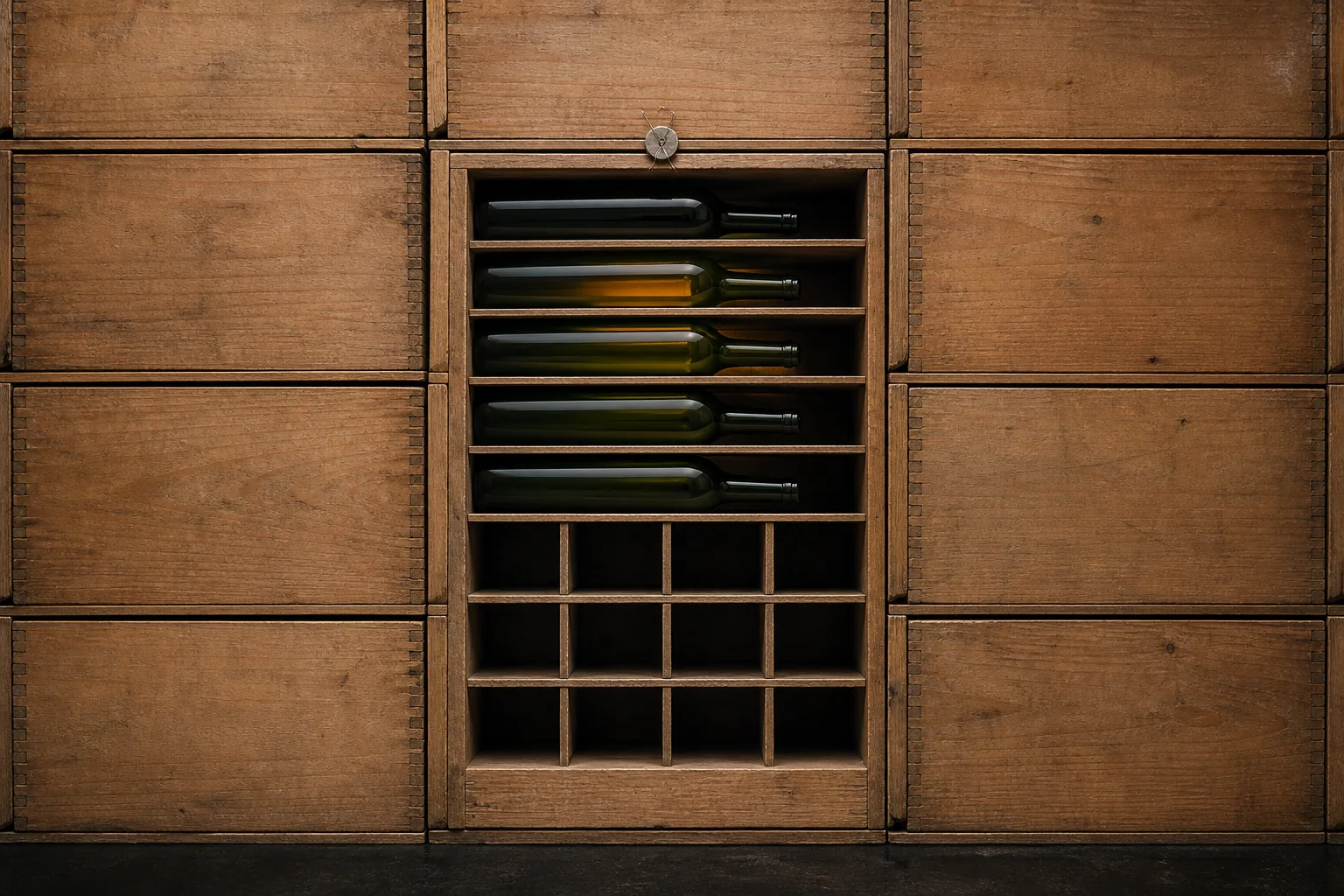
Thomas had found a bottle with an estate name printed in letters large enough to require planning permission.
The shelf tag beneath it was expensive in the discreet, unapologetic manner of a legal letter.
“There,” he said. “That explains it.”
Clara looked at the tag.
“What does?”
“The name.”
It was a very famous name.
Thomas said this with the relief of a man who had located the final answer at the beginning of the exam.
“How did it get here?” Clara asked.
Thomas looked from the bottle to the shelf, which isn’t ordinarily considered a transport document.
“It arrived?”
“Probably.”
And that gap is where most of the price is sitting.
Why Does a Famous Producer Cost So Much?
The producer name in front of you can carry real work inside it.
Close vineyard control. A recognizable house style. Repeated independent reviews. A long reserve program. Reliable distribution. Demand that outruns the release.
It can also tell you that generations of buyers have learned to enjoy saying it.
Those are not the same fact, even when the label uses one very good typeface to suggest that they are.
Start with the producer model, because it decides who controls what you are buying.
An estate-heavy producer may farm closely and still bottle elsewhere. A négociant may own no vines and control grape specifications, pressing, blending and release.
A cooperative may leave the land with grower-members while the members collectively direct the winery.
What you want to know is where control over land, fruit, cellar decisions, stock, bottling and brand actually sits.
“Estate” is an organizational description. It isn’t a small gold medal.
Where the word is regulated, it is regulated tightly.
A U.S. estate-bottled claim requires the whole wine to come from winery-owned or winery-controlled land, in the labeled area, with the named production steps continuous on the premises.
That’s meaningful provenance.
It doesn’t mean every bottle carrying the claim is the best buy in the shop, or that a wine without it lacks serious farming agreements and cellar control.
Thomas tapped the producer name.
“So it means something.”
“It might,” said Clara. “It does not mean everything.”
The reputation you are paying for needs four separate drawers, which is an annoying way to treat a word that would rather lounge about in one upholstered room.
Is the wine known to anyone but you? Is it consistently evaluated well? Can you verify what it is?
Does the producer correct a claim credibly when it fails?
A famous producer can be erratic on you. An obscure one can be meticulous.
A historic brand can have different ownership and different practices from the version people remember.
Even “small” is not a perfume, whatever your nose is telling you.
Regulators define it with an actual production threshold across a stated number of years.
That’s a defined regulatory line, not a worldwide certificate of handmade virtue.
A stated release of three thousand bottles establishes scarcity only if it’s dated and attached to a named wine. It cannot establish pleasure.
This remains a humiliating limitation of arithmetic.
Scale also changes when the unit changes.
Fifty hectares will not automatically make you more wine than twenty. Yield, purchased wine, bottle size and retained stock all intervene.
A magnum contains the same volume of wine as two standard bottles, and it is not the same package count, the same stock line, or necessarily the same market offer.
The name stays still. Almost everything you need in order to price the bottle moves around it.
How Allocation Changes Wine Price
Clara lifted a case from the display beneath the shelf.
“This,” she said, “explains more than the calligraphy.”
A standard twelve-bottle case is nine liters of wine. Not romantic, which is precisely why it’s useful.
A producer and an importer agree the exact wine identity, vintage, format, intended market, price basis, delivery term and forecast, and that case becomes a domestic stock plan.
Your bottle doesn’t enter the market as a mood. It enters as a finite record.
An allocation may reserve sixty cases for a city and ten for a restaurant group.
Those numbers are commitments about stock, not about you. They are not measurements of excellence.
The wine can be excellent and plentiful. It can be mediocre and awkwardly scarce.
It can be excellent, scarce, and offered to the one account whose buyer hasn’t answered an email.
Commerce is capable of several distinct tragedies.
The identity you are comparing has to survive the journey intact.
A 2023 standard bottling and a 2022 magnum are separate saleable lines, even though the estate name is identical and both labels appear to be wearing the same little crest.
Invoice, carton mark, bottle label, product sheet and warehouse SKU all have to distinguish them.
A price comparison that slides between those lines has not compared wine. It has compared a surname.
“But they only made a little,” Thomas said.
“A little of which vintage, in which format, for which market?”
This struck him as pedantry. It was inventory.
At the warehouse, one case out of place matters, because it can later look like a short shipment, a loss or an unrecorded sample.
A retailer’s order is accepted only when the available quantity, the account terms, the territory and the promised delivery all agree.
A restaurant buying six bottles has to decide whether it can manage them by the bottle or by the glass.
Each of those decisions narrows the route from a celebrated producer to one physical bottle on one shelf.
Reorder speed narrows your options again.
If a hundred cases were meant to last ten months and sell in four, an importer cannot manufacture more of that vintage by looking encouragingly at the spreadsheet.
Remaining stock can be reassigned, a substitute offered, or the market can wait for another release.
Which is why an allocation premium may describe a real access problem. It isn’t, by itself, a verdict from the gods of extraction.
What Importers and Distributors Add
Thomas frowned at the back label.
“So the importer gets paid for paperwork.”
“For making the wine saleable here,” Clara said.
Paperwork has suffered from poor public relations, and you have inherited the prejudice.
It has the unfortunate habit of preventing the wrong bottle, the wrong importer or the wrong claim from becoming somebody else’s expensive afternoon.
Before a foreign lot can enter, the importer checks its permit, label, certificates, commercial role and records, then books cargo, insurance and customs representation.
Imported wine above a low alcohol threshold needs label approval before it can be commercially removed from customs custody.
That approval is a gate for compliant labeling. It is not a critic in a little federal hat.
Compliance costs effort because your bottle has to be identifiable to more than its admirers.
A different importer can’t simply borrow another importer’s approval, either.
Each one obtains approval under its own permit, and the approval identifier is what connects later certification back to the label.
That isn’t a tasting note. It’s better than one.
It tells an inspector which regulated domestic party has to stand behind the package in front of them.
“And the sample?” Thomas asked. “That is stock.”
“No.”
Trade-show and order-soliciting samples run on their own waiver route. A sample may help a distributor sell the wine. It is not retail inventory.
Nor is a ship at the port a local product.
Customs release, receiving, damage checks, a domestic SKU and a saleable quantity are five separate events. Less glamorous than a cellar door.
Also the part that stops a shop selling you a bottle that exists only optimistically.
The familiar “three-tier” phrase is a route, not one nationwide license.
Supplier, wholesaler, retailer. State rules then shape who may sell, ship, distribute or retail in any given transaction.
A permitted direct sale can remove the wholesaler from one route. An importer may be owned by a producer in another.
The useful question isn’t whether somebody has invoked the sacred number three. It’s which actor is allowed to do what, where, with this wine.
Clara put the case back.
Thomas watched it disappear beneath the shelf as though the price had acquired several extra rooms while he was not looking.
How to Compare Producer Reputation With Value
The name is still useful to you. It tells you where to begin checking.
It cannot perform the checking for you.
A producer record should separate the legal entity, the trading name, the owner, vineyard control, supply relationship, bottling role, brand, and the named wine.
A company registration number identifies a legal unit. It doesn’t identify a vineyard, a brand, or the source of a particular bottle.
One number is not a biography. Mercifully.
So compare like with like.
The exact vintage. The exact format. A similar style. The same market route.
A local price contains tax, import margin, allocation pressure and retailer position as well as the producer’s quality and reputation.
Your sensible test is two similarly styled producers, not one famous estate against an anonymous bottle at the far end of the shelf.
And buy one bottle before you commit to a case.
A case is twelve bottles of confidence, which is a great deal to discover was mostly typography.
Then ask what the producer’s system actually does for you.
A multi-grower négociant can use several sites to absorb a weak harvest and hold a regional style.
A cooperative can pool equipment, expertise and fixed cellar costs on your behalf.
A single-estate wine gives you a tighter site claim and more exposure to frost, disease and replanting.
Grape intake per bottle is operationally consequential. It is not an equation that turns vineyard acreage into a price tag.
Finally, ask what evidence belongs to the wine rather than the brochure.
A photographed label supports the declared origin, alcohol, net content and producer particulars. A warehouse SKU distinguishes the saleable line.
Neither one proves ownership, unseen vineyard area, critic consensus, or the quality of the current release.
A producer’s website states a philosophy. Dated independent reviews, allocations, auction records, restaurant listings, recalls and corrections do different jobs.
The word reputation becomes useful only once it stops being one word.
Thomas took the bottle from the shelf.
“The name gets it into the conversation.”
“Yes.”
“The case, the route and the vintage explain the price.”
Clara considered this.
“They explain why that price can exist.”
It was not quite agreement. But Thomas put the bottle back and reached for one he could describe more fully than “famous.”
A producer name opens the door.
The price is all the furniture inside.
Put it into practice
- Estate, négociant, and cooperative models differ in where they control fruit, cellar work, bottling, and brand rather than in an automatic quality rank.
- A producer's reputation must be separated into whether the wine is known, consistently evaluated well, verifiable, and credibly corrected when claims fail.
- A 12-bottle case of 750 mL bottles contains 9 L, and allocation is a finite stock commitment rather than a quality score.
- Vintage and format create separate saleable lines, so a 2023 750 mL bottling and a 2022 magnum cannot be priced as interchangeable stock.
- Importers make a foreign lot marketable through permits, label approval, records, customs release, and domestic inventory; a COLA is a compliance gate rather than a quality judgment.
- Value comparison requires the same vintage, format, market route, and style rather than a producer name alone.
Asked across the table
- Does an estate name prove that a wine is worth its price?
- No. An estate name can identify a producer with strong vineyard control, a long record, scarce stock, or reliable demand, but it does not settle value by itself. Price and availability are market-specific and can reflect allocation, tax, import margin, retailer position, format, and vintage. The useful comparison identifies the exact wine and follows its route into the local market.
- What is the difference between an estate, a négociant, and a cooperative?
- An estate-heavy producer may control farming closely while using outside bottling. A négociant may own no vines yet control grape specifications, pressing, blending, and release. A cooperative can leave land with grower-members while members collectively control the winery and may sell under the cooperative brand. These structures describe where authority and supply sit; none is an automatic quality ranking.
- What does estate-bottled actually require in the United States?
- U.S. estate-bottled language requires 100% of the wine to come from grapes grown on winery-owned or winery-controlled land. The winery and vineyards must be in the labeled AVA, and the named production steps must be continuous on the premises. A wine without that claim can still have long leases, detailed farming agreements, or close control of a particular cuvée.
- Why is a 12-bottle case more useful than a famous name when price is discussed?
- A 12-bottle case of 750 mL bottles contains 9 L, making it a defined stock and purchasing unit. The importer and distributor can assign that case quantity to a market, account, release date, and price. A producer name does not state how many cases are available, whether they are saleable, or which buyer has already been promised them.
- Can the same producer's magnum and standard bottle be treated as the same stock?
- No. A 2023 750 mL bottling and a 2022 magnum are separate saleable lines even when the estate name is identical. The vintage and format must agree across the invoice, carton marks, bottle label, product sheet, and warehouse SKU. A 1.5-liter magnum and two 750 mL bottles hold the same volume but are different packages and can have different availability and pricing.
- What does an allocation actually mean?
- An allocation is a commercial commitment against finite stock. A producer may reserve 60 cases for a city or 10 cases for a restaurant group, and those reservations do not establish superior quality. An effective allocation record identifies quantity, customer, price, release date, and status so that the same cases are not promised twice while documents, transit, customs release, or damage still affect availability.
- Does a COLA mean an imported wine is good?
- No. For imported wine of 7% ABV or more, a Certificate of Label Approval is needed before commercial removal from U.S. customs custody. The COLA establishes a package that meets applicable labeling requirements; it is not a quality review or a recommendation for a restaurant list. Each different importer must obtain approval under its own basic permit.
- Why can a wine be famous but still not be available to buy?
- Fame does not create stock. A producer release can be held by export documents, label approval, customs release, damage checks, allocation, or a distributor's existing account commitments. If 100 cases were expected to last 10 months but sell in 4, the importer cannot create more of that vintage. Remaining cases can only be reassigned, substituted, or held for a later release.
- Does a small production number prove that a wine is better?
- No. A stated release of 3,000 bottles can establish scarcity only when it is dated and tied to the named wine; it does not establish sensory quality. Production figures also require units and scope. The EU small-producer threshold of average output below 1,000 hectoliters per wine year across at least three consecutive wine years is a specific regulatory definition, not a worldwide measure of craftsmanship.
- How can producer reputation be checked instead of assumed?
- Reputation can be checked through dated, wine-specific evidence: independent reviews, merchant and restaurant listings, auction records, competition results with methodology, producer allocations, recall notices, complaints, and correction history. The useful questions are separate: whether the wine is known, consistently evaluated well, identifiable, and credibly corrected when a claim fails. A family surname or one critic score does not answer all four.
- How should a buyer compare value before paying an allocation premium?
- A buyer should compare the exact vintage, format, market route, and style with two similarly styled producers. The comparison should separate producer quality evidence from availability, import cost, allocation, and retailer margin. One bottle provides a better test than a case commitment because a famous name can describe demand and provenance without proving that the specific wine offers the best value in that market.