Know what you’re choosing
Why Organic Is Not a Climate Plan
Organic certification can describe an input regime without settling water, labor, emissions or ripening risk. A vineyard's sustainability claim has to survive the actual site and season.
Asserted
“It says organic, so the bottle has settled the environmental question.”
Corrected
Viticulture's site and canopy decisions meet wine sustainability's limits on certification claims at the point where a vineyard practice changes water, disease and ripening tradeoffs rather than producing a universal ethical result.
What to do
Treat certification as one filter: ask a producer for the site, water and labor practices behind the claim, and compare at least two documented indicators before paying a sustainability premium.
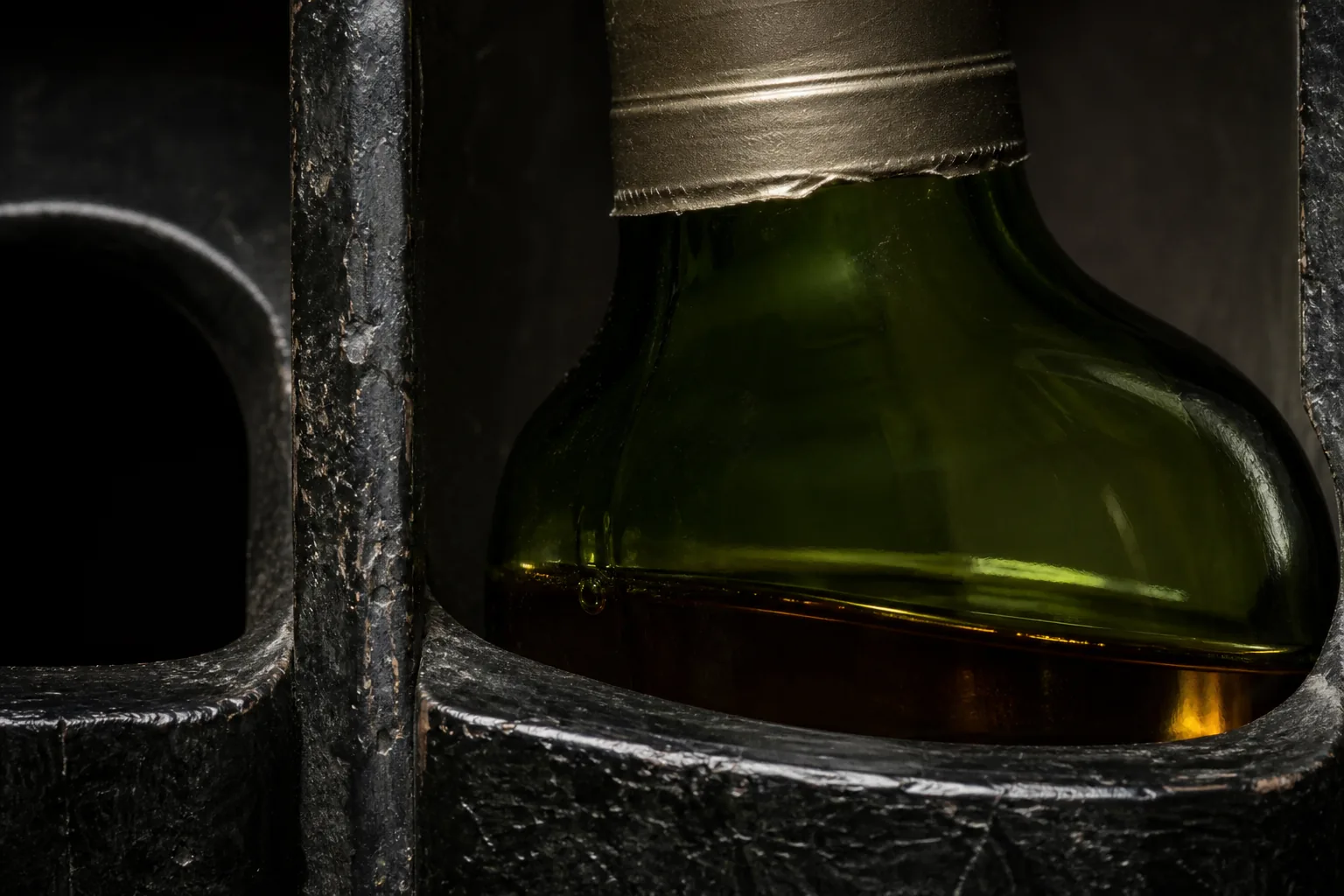
Thomas found the word organic on the back label and relaxed.
It was a handsome relaxation. The bottle was dark. The type was discreet.
A small green device resembling a leaf had been placed where no useful information could disturb it.
“There,” he said. “That answers that.”
“What does it answer?” Clara asked.
“The environmental question.”
Clara looked at the bottle.
“Which one?”
Thomas had not expected the environment to come in several versions. This seemed inefficient.
The word was doing what broad good words often do.
It had arrived without luggage, sat down in a better chair than everyone else, and implied that the bill had been handled.
“Organic,” he said again, more slowly.
“That is a production claim.”
“It is a very green production claim.”
“Those are not different words.”
Nobody has discovered a villain polishing a sprayer in moonlight.
A vineyard can be organic and carefully run. It can be organic and short of water.
It can be organic and make a difficult week for the people pruning it.
The label has told you something. It has not told you everything.
Does Organic Wine Mean Sustainable Wine?
Certification exists because you can’t normally inspect a vineyard, read its pesticide log, or follow its irrigation water back to the source.
The grower knows more than you do. The bottle knows almost nothing, and is unusually calm about this.
Certification narrows that gap for you by verifying a defined set of inputs, procedures, records, inspections and marks.
The European organic framework prohibits GMOs and irradiation and limits artificial fertilizers, herbicides and pesticides. That’s useful.
It means the claim isn’t merely a mood.
But a rule about approved materials is not a complete account of the farm you are buying from.
It doesn’t establish water stewardship, worker conditions, packaging impact, carbon balance or public-health responsibility.
Your label is a boundary. It is not a weather system.
Thomas turned the bottle over.
“It does not say any of that.”
“It does not say it has not rained either.”
This was technically correct, which is an irritating quality in a conversation.
The same restraint applies to biodynamic language, which has acquired a certain ceremonial mist.
A biodynamic wine category requires certified fruit, a certified winery and label approval for each wine.
That is a specific claim, with a specific proof you can go and look at.
It is not a certificate that the vineyard has defeated hydrology, heat, labor law and human appetite in one afternoon.
So the question is not whether the mark is real. It is what the mark covers.
Grapes? Cellar work? The finished bottle? A vintage, a lot, or the larger phrase printed next to it?
A sustainability claim becomes much less impressive when you ask it to identify its noun. That isn’t cruelty. It’s filing.
What Vineyard Practices Actually Change
“So what should I ask?” Thomas said.
“Where it is,” Clara said.
“That is not a practice.”
“It is before the practices.”
Before anything is planted, a serious block brief records slope, frost pockets, water source, access, drainage, drift risk from the neighbors, and what is stopping roots going down. None of that reaches you.
It starts with walking the site in both the growing and the dormant season, and then with digging pits deep enough to see the topsoil, the subsoil, the compaction, the stones, the drainage mottling and the depth the roots can actually use.
The ten acres behind your bottle can hold a shallow knoll, a wet swale and a vigorous alluvial strip.
A label doesn’t make those three places into one place.
Nor does dry farmed prove that the site stores enough water for the vine somebody planted on it. It describes a farming system.
It is not a reservoir.
The physical starting figures are blunt: a workable soil depth, a gentle slope, a long enough frost-free window for cold-tender cultivars.
None of them is a blessing. They are the numbers that force the useful questions. Which cultivar. Which rootstock. Which frost map.
Which water source. Which ripening window.
Thomas frowned at the bottle.
“It has a postcode.”
“A postcode is not a frost map.”
Once the vines are growing, the claim you paid for meets the canopy.
This is where wine vocabulary starts talking about a “wall,” which briefly makes farming sound like municipal planning.
But canopy geometry is real, and it is the part of the farm your wine actually came through.
It controls shade, airflow, fruit exposure, spray access, and how quickly a crew discovers that the shoots have formed an opinion.
Thin the shoots early, before they get long, and hold them to a few per foot of row.
Trim above the top wires and keep the wall narrow enough to work.
Those are inspection references, not commandments carried down from a very small mountain.
They change what the vineyard can actually do. Too many shoots shade the fruit and complicate disease control. Hard early hedging stimulates laterals.
A block that needs three hedging passes to stay narrow is asking you a question about next year’s water, nitrogen, floor cover, spacing or canopy division.
It isn’t asking for another afternoon with blades.
Leaf removal is conditional in exactly the same inconvenient way.
Pulling a few basal leaves per shoot is modest on a full, healthy canopy and much too aggressive on a sparse, water-stressed vine.
Take them shortly after fruit set, usually on the shaded side, and the clusters acclimate.
Expose them suddenly near veraison and you have arranged sunburn.
“So leaves are sustainable until they are not.”
“Leaves are leaves.”
This did not satisfy him. It was nevertheless the answer.
How Climate Changes Harvest Decisions
Climate does not arrive as an annual press release titled Warmer Vintage, Somehow Excellent.
It changes your schedule. Budbreak, flowering, veraison, harvest.
A week’s shift in harvest timing moves your fruit into a different weather window.
That is enough to change the order in which sugar, acid, color, aroma, sunburn, disease, labor and transport become problems.
Harvests have advanced by two or three weeks across most of the world’s wine regions in the past four decades, whatever your label says about tradition.
So a warm season is not one variable with better lighting.
Earlier ripening pushes berries into hotter conditions, while drought, extreme weather and new pest pressure change what a region can reliably grow at all.
Which is why a harvest release can’t be a sugar reading taken in a clean little vacuum.
You divide the vineyard into management zones, sample berries from both sides of the row and from several cluster positions, then measure sugar, pH and acidity while actually tasting berries and looking at skins, seeds, shrivel, disease and uniformity.
A hundred-berry composite is only defensible when the berries came from across the zone.
A sugar reading inside a normal band settles nothing about flavor, phenolic maturity, rot or final alcohol.
Numbers don’t become ethical by acquiring a decimal point. They become useful when somebody else can repeat them.
Thomas examined the glass as though it might provide a report card.
“So the vineyard turns out to have weather.”
“Frequently.”
Water makes the point to you less politely.
A reference evapotranspiration figure estimates the demand the climate is placing on the vine. A flow meter records what you delivered.
Neither one establishes that the source can bear the withdrawal.
A vine’s thirst has never been a water right.
The scale isn’t decorative either.
One millimeter of water across a hectare is ten cubic meters, so a small scheduling change becomes material across a block very quickly.
A mild, well-timed water deficit can manage vigor.
A severe or badly timed one costs you leaf area, fruit set, berry growth, reserves and next year’s crop.
Soil, rootstock, canopy, weather and timing decide which sentence you get.
Then there’s pest control, where “organic” encourages a peculiar kind of amnesia.
A restricted materials list is not proof that nobody has an exposure risk.
You still need the right control, calibrated equipment, weather observation, protection for sensitive areas, records and evaluation.
The safeguards are wonderfully unromantic. Don’t spray in dead-still air or in a stiff wind.
Don’t spray into a temperature inversion, or just before rain, or while driving too fast to keep the pattern.
Exclusion zones and re-entry intervals exist for the people who have to walk back into the block.
Nobody would put a re-entry interval in a tasting note.
That is probably why it matters.
What to Ask Beyond a Certification Claim
“Water,” Thomas said. “Leaves. Wind. Pits.”
“And labor.”
He looked at the bottle again.
It continued to be organic in a perfectly composed way.
Labor is not a sentimental annex to vineyard work.
Pruning, ladders, tractors, repetitive picking, heat, protective equipment, re-entry restrictions, sanitation and emergency transport decide whether a crew can do the work safely and reliably.
The picturesque hand harvest you are paying for is still an operation involving hands.
Water, rest and shade are the baseline, and long tasks need electrolytes as well as water.
Impermeable protective equipment, respirators included, makes heat illness more likely rather than less.
A policy that can’t function for those people on a 35 °C day isn’t a control. It is literature.
You don’t need an audit clipboard or a drone hovering over lunch.
Treat the certification as one filter.
Then ask the producer for the site, the water and the labor practices behind the claim, and compare at least two documented indicators before you pay a sustainability premium.
Each indicator needs a boundary and a unit. Water delivery, or the constraint on its source. Soil depth and drainage observations. A canopy count.
A fruit-sampling record. An application and entry protocol. A heat plan.
A pretty vigor map guides your zone sampling only after somebody has ground-truthed it against soil pits, shoot growth, yield and fruit data.
The attractive image is not the verification. The boring follow-up is.
Thomas set the bottle down between them.
“It is still organic.”
“Yes.”
“It is just not the end of the conversation.”
Clara poured the wine.
The label had not become less true.
It had merely stopped trying to do the work of rain, roots, people and time.
Put it into practice
- Site selection requires records for rooting depth, drainage, frost and water rather than a regional climate average.
- Canopy practices such as shoot thinning, leaf removal and hedging change shade, disease exposure and ripening conditions.
- Organic and biodynamic certifications verify defined restrictions and records rather than every environmental or social outcome.
- Earlier phenology can move ripening into hotter weather, changing sugar, acid, color, aroma and harvest decisions.
- Water supply, worker protection and pesticide exposure remain separate evidence requirements beside a certification mark.
- A sustainability premium should be tested against at least two documented indicators beyond the label claim.
Asked across the table
- Does organic wine mean the vineyard is sustainable?
- No. Organic certification can verify defined restrictions on inputs and practices, records, inspections, and use of a mark. It does not automatically establish water stewardship, worker conditions, packaging impact, carbon balance, or public-health responsibility. Sustainability depends on how permitted practices work at a particular site and season, so the verified category must be stated without turning it into an undefined claim of overall superiority.
- What does the EU organic rule actually restrict?
- The European Union organic framework applies from 1 January 2022 under Regulation (EU) 2018/848. EU organic production prohibits GMOs and ionising radiation and limits artificial fertilisers, herbicides, and pesticides. Those restrictions make a defined production regime auditable, but they do not show whether a vineyard's water source, labor conditions, climate exposure, or total environmental effects are satisfactory.
- Is biodynamic certification a complete sustainability guarantee?
- No. Biodynamic certification overlays a distinct farm-and-processing standard, but it remains a defined verification rather than a full life-cycle result. Demeter's United States Biodynamic Wine category requires 100% certified biodynamic fruit, a certified winery, and label approval for each wine. Those conditions establish the category; they do not by themselves settle water allocation, worker protection, packaging, or alcohol-related harm.
- Why does the vineyard site matter more than a green label?
- A vineyard site determines rooting depth, drainage, frost exposure, water source, row access, and the practical limits on machinery and canopy work. A 10-acre parcel can contain a shallow knoll, a wet swale, and a vigorous alluvial strip, so one blanket recommendation can conceal important differences. A certification mark does not replace a block brief built from those local conditions.
- How does canopy work affect whether a vineyard needs spraying?
- Shoot thinning, leaf removal, shoot positioning, and hedging change the canopy geometry around clusters and the spray corridor. Oregon guidance places shoot thinning before shoots exceed 6 inches and gives 3 to 5 shoots per linear foot as a typical target. The figures are working references, not universal rules; the useful record identifies vine vigor, canopy condition, disease pressure, timing, and the actual work performed.
- Why can leaf removal make a hot year worse?
- Selective basal leaf removal can open the cluster zone and help clusters acclimate when done shortly after fruit set, usually beginning on the shaded side. Suddenly exposing previously shaded berries near softening or véraison raises sunburn risk. The sustainable decision is therefore not simply whether leaves are removed, but which side, how many leaves, when the work occurs, and what the weather and vine condition allow.
- What does climate change do to a vineyard's harvest decision?
- Earlier budbreak, flowering, véraison, and harvest can move berry maturation into hotter weather. That changes the relationship among sugar accumulation, acid loss, color development, aroma, sunburn, disease, and harvest logistics. The latest major review reports harvests advancing 2 to 3 weeks over the past 40 years in most winegrowing regions worldwide, but each block still needs local sampling and a local weather record.
- Why is efficient irrigation not enough to prove water stewardship?
- Efficient delivery does not establish that a withdrawal is sustainable for a watershed, aquifer, community, or downstream ecosystem. Reference evapotranspiration estimates atmospheric water demand, while a flow meter records delivered water; neither alone establishes a sustainable allocation. A water depth of 1 mm over 1 hectare equals 10 m³, so small scheduling changes become material when applied across a block.
- What labor evidence belongs beside a sustainability claim?
- A credible labor record addresses training, work pace, shade, potable water, protective equipment, sanitation, emergency transport, and the ability to report a problem without losing income. OSHA directs employers to provide water, rest, and shade, and advises access to electrolyte-containing fluids as well as water for tasks lasting more than 2 hours. Heat and pesticide restrictions must fit the actual harvest and field schedule.
- What should someone ask before paying extra for a sustainable wine?
- A buyer can treat certification as one filter and ask for at least two documented indicators beyond the mark. Useful indicators include a block water record, soil and drainage observations, canopy and harvest sampling records, pesticide application and entry controls, or labor heat protections. The documents should identify the site, vintage or lot, method, unit, and decision, rather than relying on a broad word such as responsible.