Know what you’re choosing
Why Icewine Is Not Just Sweet Wine Left Outside
Freezing fruit changes the harvest and pressing problem before it changes the sweetness in your glass. Icewine's concentration is not interchangeable with late harvest or botrytis.
Asserted
“It is all sweet wine; the frozen part is just marketing with weather.”
Corrected
Icewine's regulated frozen-grape extraction meets dessert wines' several concentration routes where similar residual sugar can arise from materially different harvest and production evidence.
What to do
Buy by the stated country definition and producer, then serve a 60 to 75 mL pour well chilled; do not treat a generic frozen-wine claim as an icewine substitute.
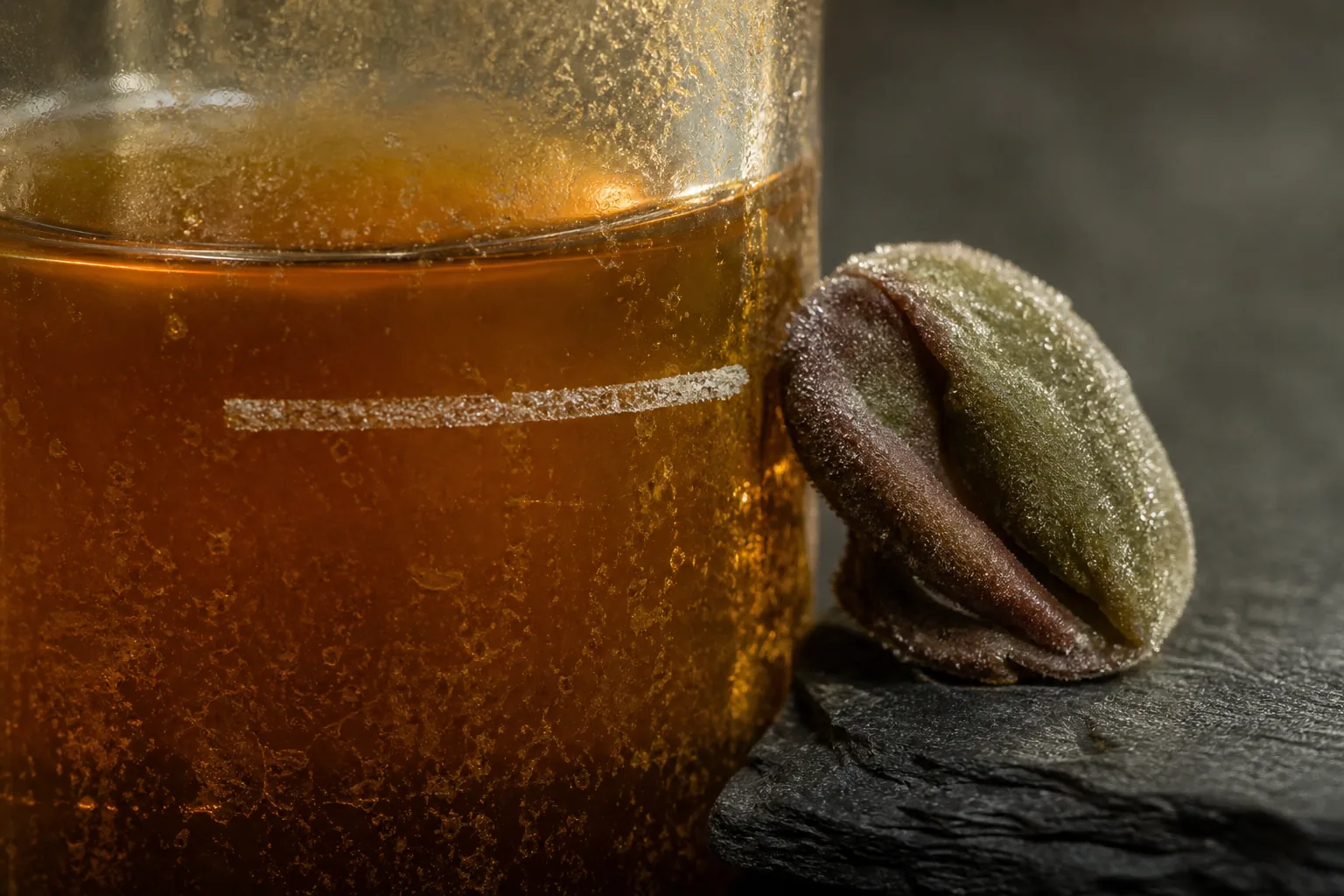
Thomas had called the bottle expensive syrup.
He hadn’t said this aggressively.
He had said it with the weary confidence of a man who believes a small glass cannot possibly contain a serious disagreement.
Clara looked at the label.
“When were the grapes pressed?” she asked.
“At a winery, presumably.”
“Were they frozen?”
Thomas looked at the bottle again. This produced no further information, which was unfair of the bottle.
“It is sweet,” he said. “That is the important part.”
No. It is the visible part.
And the visible part is the last thing that happened.
Because sweetness is what arrives in your glass. Icewine is the chain of things that had to happen before it got there.
Fruit left hanging on the vine. A natural freeze. Harvesting frozen. A cold press. A small, unusually concentrated fraction of juice.
Then a fermentation that yeast does not find especially welcoming.
Calling that “sweet wine left outside” is like calling a lockpick a small piece of bent metal.
It has omitted the only useful bit.
What Makes Icewine Different From Late-Harvest Wine?
Residual sugar is a measurement of the finished wine, and the sweetness thresholds you see on a category sheet are perfectly respectable numbers.
They can’t tell you why the wine is sweet.
The wine in front of you might carry its sugar from late-harvest fruit, from botrytized fruit, from dried fruit, or from some other permitted route to concentration.
A wine made from concentrated grapes may finish drier than all of them.
Sugar records what remained after fermentation.
It is not a witness to the harvest, and you should stop asking it to be.
Ontario makes the distinction with more administrative enthusiasm.
Late Harvest, Select Late Harvest and Special Select Late Harvest are rungs of measured grape sugar at picking.
Icewine is not on that ladder at all: it requires grapes naturally frozen on the vine, harvested below -8 °C, pressed to a juice of at least 35 °Brix.
Those aren’t grades of sweetness. They are different facts about what happened to the fruit.
Late harvest means the grapes stayed attached longer.
That can raise ripeness and sugar, and it accepts weather, birds, rot and acid loss in exchange.
The wine can then be fermented dry or stopped sweet.
Take one batch of high-sugar grapes and you might finish near 13% dry, or near 8% with a great deal of sugar still in your glass.
Harvest sugar doesn’t dictate the result. Yeast, time and a human decision intervene, as they frequently do, not always helpfully.
Botrytis is a different thing again.
Noble rot is a managed encounter with a fungus that changes water loss and aromatic precursors, and the same organism can turn destructive instead.
It generally lowers the wine’s total acidity along the way.
That’s not Icewine with a French-sounding complication. It’s a biological route, with its own risk and its own flavor mechanism.
Thomas considered this.
“So sweet is not a category.”
“It is a result.”
This seemed an annoyingly small distinction to carry so much weight.
But wine holds several such traps.
The word honey will describe a botrytis wine and a Jura vin de paille for you equally well, and the second is dried after harvest with no planned noble rot anywhere near it.
A shared adjective is not a shared biography.
Passito and vin de paille move most of the concentration work to after picking, by drying.
That means weeks in a drying room, then long aging, then space and oxidation risk and capital tied up for years.
It is not a frozen press with worse central heating.
How Frozen Grapes Concentrate the Must
Pure water freezes at 0 °C.
Grape juice is not pure water, a fact that has saved an astonishing number of berries from becoming tiny domestic ice cubes.
Your juice carries dissolved sugar, acids, salts and other compounds, and those solutes lower the freezing point of the liquid around them.
As ice crystals form, they take very little of that dissolved material with them.
What stays liquid gets richer, and then needs a lower temperature still before it will freeze.
No new sugar has appeared. Cold has not performed alchemy.
It has withheld water.
The producer presses the frozen berries intact, before they thaw.
Most of the water stays behind as ice, with the skins and seeds and pulp, in the press cake.
A smaller, syrupy fraction drains away.
The sugar you measure reads higher because the same dissolved material is now divided by much less water.
Pressing happens in a narrow cold band, roughly -7 to -10 °C: cold enough that most of the berry water stays frozen, not so cold that pressing becomes pointlessly difficult and the yield collapses.
Thomas held the glass up to the window.
“So the ice stays behind.”
“Mostly.”
This was the whole trick, and it wasn’t a trick.
The word you want is freeze concentration.
The ice excludes the dissolved material and the liquid portion gets enriched by exclusion rather than by addition.
Your early runnings are the most concentrated.
Later fractions weaken as the pressure rises and the thaw advances, which is why a producer watches must weight throughout the pressing and keeps the cake from warming up.
None of this is quick, whatever the bottle size suggests to you.
Harvest and pressing take hours, often at night, and the juice comes off at a small fraction of a normal table-wine yield.
Netting the vines after autumn isn’t a decorative gesture either. Birds regard hanging grapes as an unsupervised conclusion.
Your fruit also has to stay healthy enough to do the work.
What you want is fully ripe, clean berries with no noble rot, no acetic bacteria and no drift into volatile acidity.
The aim is not maximum decrepitude. It’s a berry that survives the wait, freezes intact, and gives clean, concentrated must.
That must then asks yeast to work under enormous osmotic pressure before any alcohol has accumulated.
That sugar can be hostile enough to stop your fermentation early.
Sweetness may follow, but it isn’t an accident and it isn’t a guaranteed endpoint.
Somebody still has to manage the yeast, the nutrients, the temperature and the stabilization.
Can a Freezer Make Icewine?
Thomas brightened.
“A freezer can do this.”
Clara looked at him for long enough that the domestic freezer entered the discussion and left quickly.
Your freezer can freeze grapes. It may even give you a concentrated juice.
It cannot recreate the production history that the name protects.
The controlled-freezing research is useful precisely because it shows the difference.
Freeze fruit fast in a laboratory and the rate of freezing and the tissue damage change what you extract, and what your wine smells like.
That’s a cryoextraction experiment.
It is not evidence that fruit froze on a vine, and it is not a prescription for a kitchen appliance with a packet of peas in it.
The regulators draw the line in the same place.
In the United States, a wine made from grapes you froze after harvest may not call itself ice wine at all.
It needs qualifying language saying the grapes were frozen post-harvest.
Canada defines Icewine as wine made exclusively from grapes naturally frozen on the vine, with an authority having determined that this was so.
Which is why the weather is not a marketing anecdote. It is evidence.
Germany and Austria tell the same story in their own bureaucratic accents.
Both require the fruit to be frozen at harvest and at pressing, both set a minimum must weight, and both set a minimum finished alcohol.
Nothing is gained by pretending those thresholds are interchangeable. Brix, KMW and Oechsle belong to different systems.
Units should not be made to socialize without supervision.
How to Buy Icewine Without Confusing the Categories
Thomas returned the bottle to the table with slightly more respect than before.
“What should I look for?”
“The country definition. Then the producer.”
That is the useful buying order.
Start with the category claim and the jurisdiction you are buying in. Then look for the producer and the place that can support it for you.
An Ontario VQA Icewine has to say so on the front label, along with its viticultural area. That’s a category-and-place trail.
It isn’t a promise that every bottle tastes the same.
Austria’s protected term carries a longer paper trail: no enrichment, no sweetening, a minimum alcohol, a capped vineyard yield, a quality-wine check number, an intention notice filed the day before harvest, and an official confirmation of must weight.
Paperwork cannot make a wine delicious. It can make a claim inspectable, which is a different and much less sentimental service.
So buy a stated definition, not the frostiest adjective on the shelf.
A post-harvest frozen wine may be well worth your money.
It simply isn’t a substitute where the name rests on naturally frozen fruit and a traceable press day.
Then pour 60 to 75 ml, well chilled.
The small glass is not a punishment.
It gives the sugar, the acidity and the alcohol room to read to you as concentration rather than as furniture.
Thomas took a measured sip.
“It is expensive syrup,” he said.
Clara waited.
“With provenance,” he added.
Ice is only water, until it tells you what had to stay behind.
Put it into practice
- Frozen pressing retains much of the berry water as ice while concentrated liquid drains from the press.
- Residual sugar is a finished-wine measurement and cannot establish whether grapes were frozen, dried, late harvested, or botrytized.
- Ontario VQA Icewine requires grapes naturally frozen on the vine, harvested below -8 °C, and juice of at least 35 °Brix.
- Botrytis, late harvest, passito, and vin de paille concentrate fruit by different biological, on-vine, and post-harvest routes.
- Post-harvest frozen grapes cannot use the U.S. term ice wine without qualifying language, even when their juice is concentrated.
- A small, well-chilled 60 to 75 mL serving manages the concentration and alcohol of Icewine.
Asked across the table
- What actually makes Icewine different from ordinary sweet wine?
- Icewine is defined by a production history, not by sweetness alone. Grapes freeze naturally on the vine and are harvested and pressed while frozen, so much of the berry water remains as ice while concentrated juice leaves the press. A finished wine can be sweet after late harvest, botrytis, or drying, but residual sugar does not prove the frozen-grape route.
- Does freezing grapes make more sugar?
- No. Freezing does not create sugar. Grape juice contains water and dissolved sugars, acids, salts, and other compounds. When frozen grapes are pressed before thawing, ice retains much of the water and the smaller liquid fraction contains dissolved material in less water. The expressed must is therefore more concentrated than ordinary juice from the same grapes.
- What temperatures does Ontario require for Icewine?
- Ontario VQA defines Icewine as wine from grapes naturally frozen on the vine, harvested below -8 °C, with juice of at least 35 °Brix. The temperature is a harvest condition and °Brix is a measure of juice concentration, not a serving temperature or a finished-wine residual-sugar figure. Ontario also requires a VQA Icewine front label to state “100% Icewine” and the viticultural area.
- How is Icewine different from late-harvest wine?
- Late-harvest wine comes from grapes left on the vine longer, which can raise ripeness and sugar without requiring freezing. Ontario sets Late Harvest at 22 °Brix, Select Late Harvest at 26 °Brix, and Special Select Late Harvest at 30 °Brix. Those categories can be sweet, but they do not meet Icewine's naturally frozen-grape requirement merely by reaching a high juice reading.
- Is Icewine the same thing as a botrytis wine?
- No. Icewine concentrates must through selective freezing during pressing. Botrytized wine involves Botrytis cinerea on the fruit; noble rot changes water loss and aromatic precursors, while damaging gray mold degrades fruit quality. Botrytis also generally lowers total acidity through fungal metabolism. Similar honey or apricot descriptions do not establish a shared production method.
- Is dried-grape wine basically the same kind of concentration?
- No. Passito and vin de paille concentrate fruit mainly after harvest through drying, rather than through frozen pressing. That route can give more control over selected bunches and drying conditions, but it requires space, handling, and time and can bring spoilage or oxidation risk. Jura vin de paille requires at least six weeks of drying and a minimum three years from pressing.
- Can a home freezer make Icewine?
- A home freezer can freeze grapes and may produce concentrated juice, but it does not establish Icewine's protected production history. U.S. policy says wine made from grapes frozen after harvest may not use “ice wine” or a variation; any frozen-grape reference must be qualified as post-harvest. Controlled cryoextraction experiments are process studies, not evidence of naturally frozen on-vine fruit.
- Why does pressing have to happen while the grapes are frozen?
- Pressing while grapes remain frozen preserves the separation between retained ice and concentrated liquid. If the press cake warms and melts, retained water enters the must and lowers concentration. Ontario describes harvest and pressing that generally take at least 6 hours, often at night, and estimates Icewine juice at only 15% of expected table-wine yield.
- Does a high residual-sugar number prove a wine is Icewine?
- No. Residual sugar is a finished-wine measurement, usually glucose plus fructose in g/L. The OIV uses at least 45 g/L glucose plus fructose for “sweet,” but that number cannot identify the route by which concentration occurred. A wine at that level can come from late-harvest, botrytized, dried, or another permitted natural-concentration route.
- What should a buyer look for on an Icewine bottle?
- A buyer should identify the country, producer, category name, and any regional assurance rather than rely on a generic frozen-wine claim. In Ontario VQA, the front label states “100% Icewine” and the viticultural area. Canadian federal standards define Icewine as wine made exclusively from grapes naturally frozen on the vine, with provincial authority determining that fact for Canadian wine.
- How much Icewine should be poured?
- A 60 to 75 mL pour served well chilled is a sensible service direction for a concentrated sweet wine. The small serving acknowledges its intensity and alcohol without treating it as an ordinary table-wine portion. A generic frozen-wine claim is not an Icewine substitute, so the bottle's stated country definition and producer should be checked before the wine is served.