Understand the craft
Why Ice Is Not a Serving Temperature for Whisky
Ice is a dilution program with a temperature effect attached. It can be useful, but it cannot be treated as a neutral way to make every whisky more approachable.
Asserted
“Ice opens whisky because it makes the whisky easier.”
Corrected
Whisky's variation in style and bottling proof meets wine service's temperature-and-dilution logic when ice suppresses aroma while meltwater changes concentration over time.
What to do
Taste 20 to 30 mL neat first, then add water in 2 to 5 mL increments; use one large cube only when progressive chilling and dilution are the intended result.
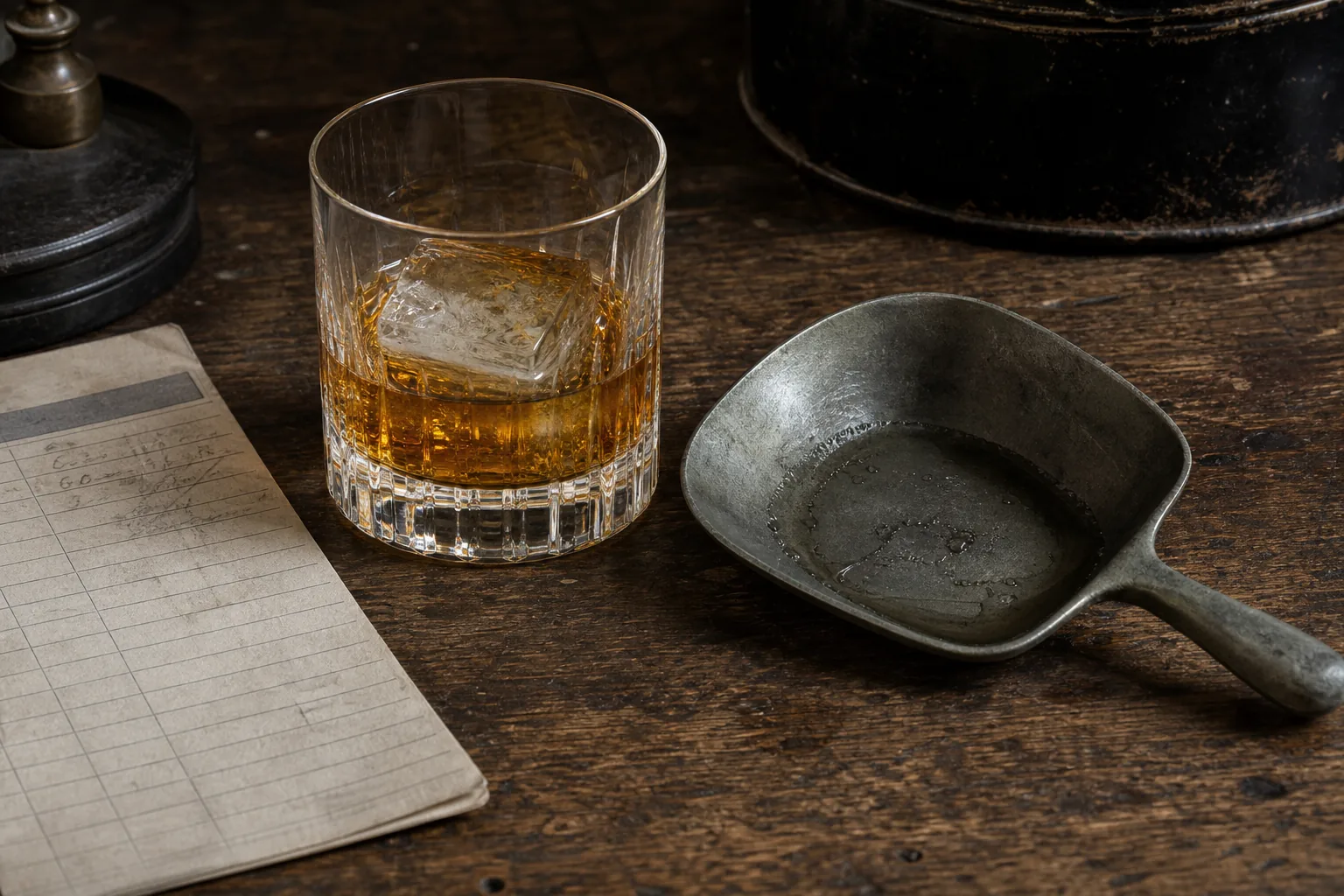
Thomas filled the glass with ice.
Not one cube. The glass was full of it, in the manner of a small excavation project that had accidentally encountered whisky.
Then he poured the whisky over the top.
“It opens it up,” he said.
Clara looked at the ice.
“What are you trying to change?”
“The whisky.”
This was unhelpfully broad.
The bottle was a cask-strength whisky at 58%.
Thomas had tasted it once, decided it was intense, and appointed the freezer to a regulatory role.
“It is a bit much neat,” he said.
“Cold or weaker?”
“Easier.”
This settled nothing, which was the point.
And the two words he skipped past are the whole problem.
Because ice is not a serving temperature. It is a program of two things: chilling now, dilution later.
It can be exactly what your drink needs. It just cannot be called neutral because the glass looks reassuringly occupied.
What Does Ice Do to Whisky?
The first job of ice is temperature. The second is water.
They arrive together, which is why you keep mistaking them for one decision.
Chilling changes how the aroma presents. Dilution changes the concentration.
When someone tells you the ice has “opened” a whisky, they may mean the aroma has gone quieter, or the alcoholic force has softened, or the melt has shifted the balance.
Those are not the same observation wearing a wool coat.
The number that actually matters before you start is the one on the label.
A whisky bottled at the 40% category minimum and a cask-strength bottling at 58% are different concentrations before anyone reaches for a cube.
What each of them wants from water is a different question.
Thomas took a sip through the ice.
“It is less aggressive,” he said.
“It is colder,” said Clara.
This did not strike him as a sufficient accomplishment.
But it is one.
The trouble starts when cold is asked to impersonate every other correction.
A whisky can be perfectly sound at bottling strength and simply less expressive when chilled.
Another benefits from water because its proof has its aroma and texture under pressure. A third was always meant for a long drink.
Category, proof, glass, temperature and purpose all get a vote. Nobody has elected ice chair.
Why Chilling and Dilution Are Different Decisions
Ice starts changing your drink immediately and continues without consulting you.
Your first sip is cold whisky with a little early melt.
Your last is a more diluted version of the pour you began with, at whatever temperature the room has settled on.
The cube has been working in the background like a very quiet colleague with access to the accounts.
Which is why the last sip can’t prove the first one was “opened.” It proves the whisky has traveled.
A neat pour, a watered pour and an iced pour are three serving conditions. They are not three moods.
To compare pours at all, you have to hold the serving volume, the temperature, the glass and the dilution steady.
Once the cube starts melting, dilution is no longer steady.
That’s fine when you meant it. It isn’t fine when you call it a baseline.
Order matters as much as the glass.
Neat first. Then measured water. Then ice.
The neat glass establishes the bottle. The watered glass answers a dilution question.
The iced glass answers whether you want a colder drink that keeps changing.
Start with the iced glass instead and the neat one will seem louder by contrast, which tells you nothing.
Starting neat doesn’t make the pour pure, heroic, or eligible for a small plaque. It gives the other two something to be compared against.
A service sequence is a control, not a personality test.
There’s no need to make the neat pour a test of virtue either.
A high-proof bottle is not asking to be endured. It is offering you a different concentration.
The error isn’t adding water. The error is letting ice make the water decision slowly, invisibly, and while the evidence keeps moving.
Thomas moved one cube from his glass to Clara’s empty tumbler.
“So a large cube?”
“Only if you want the drink to keep changing.”
He considered the cube. It had no visible opinion.
How Whisky Proof Changes the Choice
Proof isn’t a quality ladder. It is a concentration and a use case.
Lower proof can make a blend coherent the moment you pour it.
Higher proof leaves you room for dilution, and changes texture and aroma release along the way.
Neither wins by existing in a more emphatic bottle.
Read the label before the folklore starts.
An age statement is cask time after distillation and before bottling, not time the bottle spent on a shelf, and it names the youngest component in there.
So a twelve-year bottle gives you a lower bound.
It does not tell you whether the whisky wants to be cold, watered or left alone.
Nor does a category name predict a flavor for you.
What the bottle’s strength, its cask history and one neat sample tell you is worth more than the phrase “on the rocks,” which has the intellectual ambition of a weather report.
Thomas looked at the label again.
“So 58% is not a serving instruction.”
“No.”
“It is quite insistent.”
“That is a different thing.”
There is a practical way to test this without turning a weekday into a laboratory, although the laboratory has already put on a good shirt.
How to Add Water Without Losing the Glass
Begin with 20 to 30 ml neat. Smell it. Taste it.
That establishes the whisky before a serving decision has been made on its behalf.
Then add water in 2 to 5 ml increments, tasting after each one.
The increments aren’t a route to some ordained final answer. They keep the change legible.
If a pour improves, ask what improved. Is it clearer, rounder, or just less loud? Those are separate achievements.
This matters most with cask strength, because “more approachable” can hide several different requests.
Thomas may want less alcoholic force. He may want a wider aroma. He may want less wood.
Or he may want something cold after walking home in August.
The first three are questions for a neat sample and measured water.
The fourth is an excellent reason for ice, and it has the advantage of not pretending to be analysis.
Some arithmetic helps here, if only to embarrass the word splash.
Taking 30 ml at 60% down toward 45% needs roughly 10 ml of water, before you allow for the fact that mixing water and alcohol loses a little volume.
That is an approximation, not a magic proportion.
It does show why “a splash” is a charming expression with poor laboratory manners.
Use the same glass throughout, and keep the starting pours equal.
Clean, odor-free glassware isn’t fussiness.
Residue and smell belong to the serving condition too, and a bowl is chosen for headspace and aroma rather than decorative acreage.
If the glass changes at the same time as the water, your whisky has acquired an alibi.
One large cube belongs after that decision, not before it.
It’s useful when progressive chilling and dilution are what you want: a hot afternoon, a long drink, a whisky deliberately being taken in that direction.
It is not a gentle way of avoiding the question of what the neat pour needs.
It is a different pour with a clock in it.
Clara poured 25 ml into three matching glasses.
One stayed neat. One took measured water. One received the cube Thomas had rescued from his own glass.
They tasted the neat pour first. Then the watered one. Then the iced one, and waited.
The first glass was forceful, but specific. The second had widened without going quiet.
The third was cool, agreeable, and progressively less like either of the others.
Thomas took the final sip from the iced glass.
“That is not the first whisky,” he said.
“No.”
“The cube has been editing it.”
Clara nodded.
The cube had done its work beautifully.
This was not the same as leaving the whisky alone.
Put it into practice
- Bottled strength and an age statement describe different things and should not be collapsed into a single smoothness claim.
- Chilling and dilution are separate serving decisions because a colder pour releases aroma differently while added water changes concentration.
- Ice changes a whisky progressively, so the last sip cannot be assumed to represent the first sip.
- A neat, watered and iced comparison needs equal starting pours, the same glassware, and a stated sequence.
- Water should be added in measured increments and assessed after each addition rather than used as an automatic correction.
- A large cube is a choice to accept continuing chilling and dilution, not a neutral way to make a whisky easier.
Asked across the table
- Does ice actually open up whisky?
- Ice can make a whisky seem less forceful by chilling it and then adding meltwater, but those are two separate changes rather than a neutral opening process. Chilling changes the aromatic presentation, while meltwater lowers concentration over time. The first sip and the last sip therefore do not present the same whisky, even when the original pour is unchanged.
- What is the best way to taste a whisky before adding water?
- A practical supplied sequence begins with a 20 to 30 mL neat pour in a clean, odor-free glass, followed by a smell and taste before any adjustment. A controlled whisky comparison holds serving volume, temperature, glassware, and dilution practice constant. That separates a change in the liquid from a change in the setup and makes the water decision easier to interpret.
- How much water should go into whisky?
- The supplied working method adds water in 2 to 5 mL increments after the neat pour is assessed. Each increment is tasted before another is added, because dilution changes concentration and can change texture and aroma release. Whisky comparison guidance gives a 30 mL pour at 60% ABV reduced toward 45% ABV as an example requiring about 10 mL water before volume contraction.
- Why does the last sip over ice taste different?
- A drink served over ice changes while it sits. The ice chills the liquid and meltwater gradually lowers its concentration, so the final sip is not a repeat of the first. A large cube may slow the change relative to smaller pieces, but it still establishes a progressive chilling-and-dilution service rather than a fixed condition.
- Is a higher-proof whisky supposed to be drunk neat?
- No. Higher proof signals greater concentration and leaves more room for measured dilution; it does not prove that water is required or that the whisky is better. Scotch and qualifying Japanese whisky have a 40% ABV bottling minimum, while a 58% cask-strength bottling is a different starting condition. The useful comparison begins at each bottle's intended strength, then tests water deliberately.
- What does the age statement on a whisky bottle mean?
- An age statement records time in cask after distillation and before bottling, not time spent in the bottle. In U.S. and Irish guidance, it identifies the youngest relevant whisky component. A 12-year statement therefore provides a lower-bound comparison point, but it does not reveal the whole cask mix, warehouse conditions, grain bill, or bottling proof.
- Does bourbon or rye tell a drinker how the whisky will taste with ice?
- No. Bourbon requires at least 51% corn and rye at least 51% rye, but the remaining grains, cask treatment, bottling strength, and serving method still vary. Bourbon and rye also require charred new oak, whereas Scotch can mature in qualifying used oak. Category names establish production constraints; they do not predict one universal response to chilling or dilution.
- Does a wine-cask finish tell a drinker that whisky needs ice?
- No. A wine-cask claim needs a chronology before it supports a serving conclusion. A 6-month finish and a 12-year full-term ex-wine maturation are different cask histories, even though both may be described with wine-cask language. The bottle's ABV and the actual neat tasting provide more useful evidence for deciding whether to add measured water or accept ice.
- How should neat, watered and iced whisky be compared?
- The comparison starts with equal pours in the same clean, odor-free glassware and a stated serving sequence. A 25 mL controlled-comparison volume is a useful whisky example. One pour remains neat, another receives measured water, and the iced pour is observed again as it changes. Holding the other conditions still prevents glassware, temperature, volume, and dilution from becoming one indistinguishable experiment.
- Why does the glass matter when serving whisky?
- Glassware affects what a taster can smell and how a serving changes while it waits. Wine-service guidance begins with clean, odor-free glassware and uses temperature, portion, headspace, and time as separate controls. A whisky comparison is more interpretable when the same glass is used for neat and watered pours, because a change in glass then cannot be mistaken for a change caused by water.
- When is one large cube a sensible choice for whisky?
- One large cube is sensible when gradual chilling and dilution are the intended experience and the drinker accepts that the pour will not remain fixed. It is not a neutral substitute for deciding whether a whisky needs water. A neat taste first identifies the bottle's starting condition; measured water can then test dilution separately before ice is chosen as the longer, changing service.