Master the details
Why a Great Vintage Is Not a Drinking Window
A celebrated year can describe growing conditions without telling you whether this bottle is ready tonight. Vintage quality and aging trajectory meet only through the wine in question.
Asserted
“It was a great vintage, so it must be ready and worth saving.”
Corrected
Vintages' growing-season account meets wine aging's chemical development where a year's broad conditions influence a bottle's potential but do not set one universal opening date.
What to do
For an unfamiliar mature bottle, open one 750 mL bottle before buying more; record the producer, storage and tasting result, then set a revisit interval of 6 to 12 months if it is still developing.
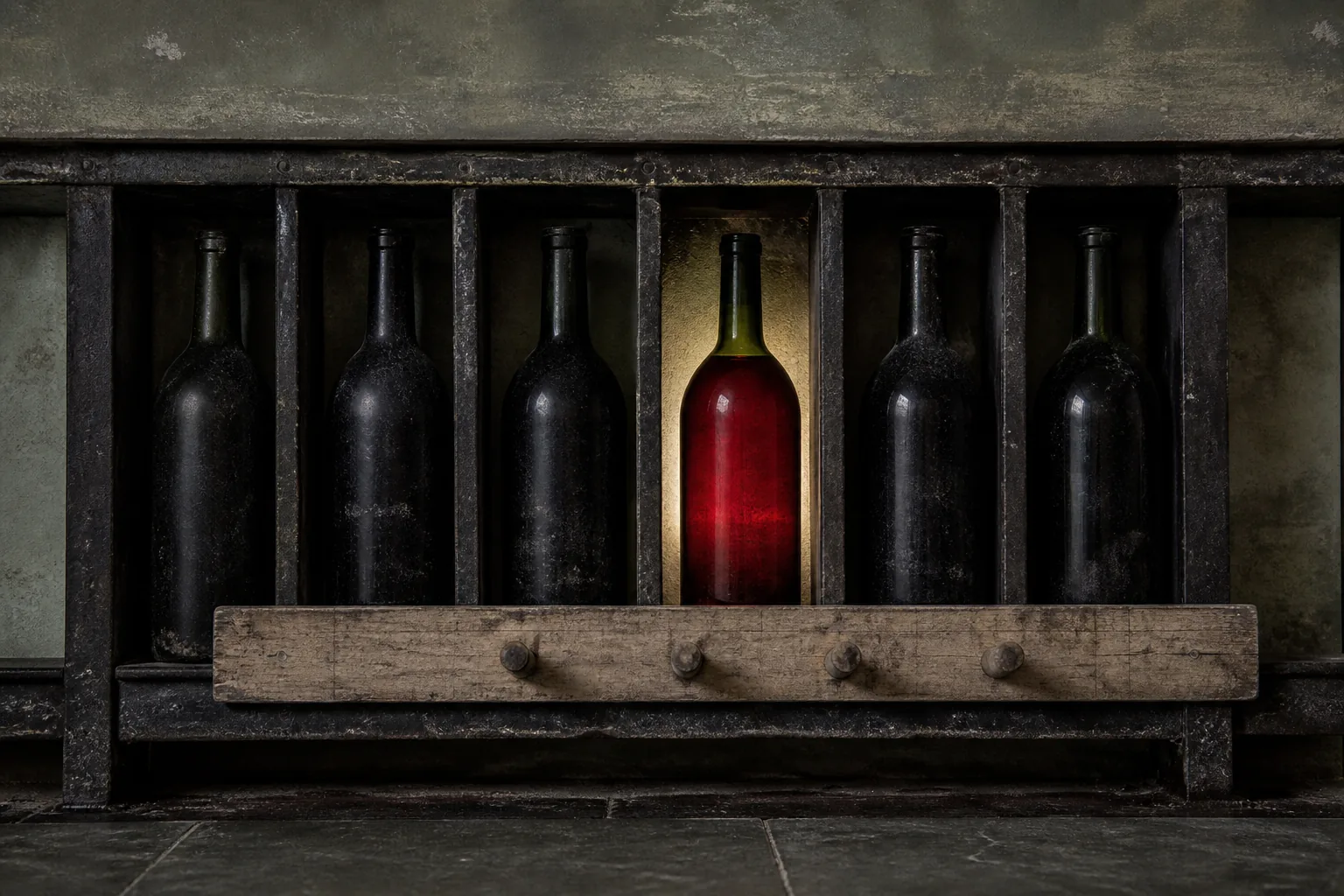
Thomas brought a vintage chart to the table.
It had several columns, a row of stars, and the dry authority of a document that had never been asked to open a bottle.
“It was a great year,” he said. “So this is ready. Or worth saving. Possibly both.”
Clara looked at the chart.
“What wine does it think it is?”
Thomas looked at the bottle. The chart had not said.
The cork came out before the argument did. The chart remained dry and untroubled.
The distinction begins there.
Because a great vintage is an account of conditions. A drinking window is an account of a bottle over time.
They meet, certainly. They do not merge into one administrative body and issue you dinner instructions.
Does a Great Vintage Mean a Wine Is Ready?
No.
Your vintage begins in the vineyard, where weather arrives at inconveniently specific moments.
Budbreak, flowering, fruit set, veraison and ripening aren’t one long weather event wearing different hats. What matters to you is what happened, and when.
Heat at flowering can cut your fruit set.
Severe heat during ripening slows photosynthesis and sugar accumulation, and burns off acidity at the same time.
So “warm year, ripe wine” is the kind of sentence that sounds decisive while leaving every useful part out in the corridor.
Thomas held the bottle by its neck.
“The chart says excellent.”
“The chart has not met the cork,” Clara said.
A year shapes the material your producer had to work with. Berry condition. Acidity. Crop size. Harvest urgency.
The range of styles that are even possible.
It doesn’t tell you whether this producer picked one parcel before the rain, sorted another after the heat, extracted hard, blended broadly, or gave this bottle a closure with its own oxygen pathway.
Even a thermometer has a limited social circle, and it was not standing where your grapes were.
During one Oregon heat event, the air read one temperature, the shaded clusters read a couple of degrees higher, and the exposed clusters ran fifteen degrees hotter than the air.
Row orientation, canopy density, slope and which side of the row a bunch hung on all had opinions.
A regional rating gives you a useful broad report. It is not a surveillance program covering every grape.
Cold is equally rude to any generalization you might want.
Midwinter bud hardiness varies by cultivar and shifts through dormancy, and buds, canes and trunks don’t share a single threshold.
A hard winter can cut your potential crop without leaving any obvious signature in the fruit that survived.
Which is why a great year can produce a wine that is interesting, plentiful, scarce, concentrated, fragile, graceful, or merely expensive.
Those outcomes are not synonyms. Wine people do sometimes use them as though they were. They also say tension while sitting down.
The distinction is real.
What Vintage Charts Can Actually Tell You
A chart can summarize regional weather and a broad historical pattern for you.
What it can’t do is send a verdict down through region, site, producer, cuvée, bottle and mouth without changing shape on the way.
Take a year where a national report records wine-grape production well down on the year before, and in the same document reports exceptional grape quality in several regions.
Lower volume and higher quality hadn’t formed an alliance. They were simply in the same report.
Thomas put the chart beside the opened bottle, as if giving it a chance to improve its answer.
“So a small crop is not good?”
“It is small,” Clara said.
Harvest dates record somebody’s decisions too, not an objective medal ceremony held for you.
Champagne runs a monitoring system across hundreds of control plots, sampling clusters twice a week from veraison for color change, cluster weight, estimated sugar and acidity, before setting dates by municipality and variety.
That is considerably more work than writing “superb” in a column. It is also less convenient at a restaurant table.
Weather gets read in intervals for the same reason, and none of those intervals is your vintage chart.
Agroclimate reporting stacks precipitation windows of a week, a fortnight, a month, two months and three, alongside heat accumulations at several different base temperatures.
A vine responds to sequences, to stored water, to evaporation, and to what stage it had reached.
It has not agreed to be summarized by an annual mean.
Nor does a label always promise you one year’s evidence.
Earlier harvests can make up as much as half of a non-vintage Champagne blend. A single-vintage wine and a multi-year wine answer different questions.
One shows you selected fruit from a harvest. The other shows you how a producer designed continuity.
Calling either one more authentic is usually a way of avoiding the useful noun, which is blend.
The chart remained dry and untroubled. It had done its job.
Thomas had assigned it another one.
How Wine Changes With Age
Your bottle does not sit in the cellar patiently becoming a better version of its former self.
That is a very flattering story to tell a bottle.
Inside are acids, phenolics, anthocyanins, volatile aroma compounds, sulfur compounds, metals, sugar where there is any, oxygen and sulfur dioxide.
Time gives them opportunities. It doesn’t give them a shared ambition.
Acid alone will not answer it for you either.
Tartaric and malic acid sit at very different levels in most wines, and pH measures free proton activity rather than total titratable acid.
“High acid makes wine age” confuses at least two measurements before it even starts behaving like advice.
“But it is Cabernet,” Thomas said.
“So were the bottles in the trial,” Clara said.
In a controlled two-year trial on a single Cabernet vintage, wines held at different pH values separated within six months and were clearly different by two years.
Tannin fell. Pigmented tannin rose. Color density dropped and the hue moved.
That supports a pathway in that defined wine. It doesn’t appoint every Cabernet to the same future.
This is chemistry, which has a reputation for sounding to you like a minor betrayal of romance. But what it describes is happening in the bottle.
Anthocyanins react with tannins. Some pigment leaves solution. Esters hydrolyze. Oxygen leaves aldehydes behind it. Sulfur compounds form, vanish, or emerge from behind other aromas.
Your red lightens toward garnet, then brick, then orange-brown. Its grip recedes. The fruit becomes less conspicuous.
None of that is automatically an improvement, a defect, or a reason to summon a man in a waistcoat.
Oxygen and the closure set the pace.
Your oxygen is in the headspace, dissolved at bottling, or diffusing through the closure. Screw caps run very low and very consistent.
Technical corks vary less than natural cork. Synthetics tend to sit moderate to high.
At the low extreme, wines can show reductive character. At the high end, oxidation hurries along.
That isn’t cork against screw cap. It’s a U-shaped problem, in which both certainty and despair can be overpoured.
Free sulfur dioxide is a protective reserve. It is not your scorecard.
Some of it is lost at packaging, and how much depends on how well the wine was protected from oxygen.
The molecule is busy long before anyone receives an invitation to dinner.
Thomas tasted the wine.
“It is not old,” he said.
“It is not young,” Clara said.
This was more information than the chart had managed.
How to Set a Drinking Window
A drinking window isn’t a date that arrives on a bottle and takes possession.
It’s a provisional zone. An observed stage, a preferred stage, and the standing possibility that the next bottle has had a different life.
Peak is useful only if you let it be a zone, rather than a tiny laboratory bell that rings once for an entire appellation.
For an unfamiliar mature wine, the practical move is refreshingly unceremonious.
Open one bottle before you buy any more. Write down the producer, the storage history and what you found.
If it is still developing, set yourself a revisit interval of six to twelve months.
The second bottle then answers a question about the wine, rather than about your faith in charts.
Say what changed, specifically.
Is the fruit still primary, or moving toward dried, floral, savory, honeyed, nutty or earthy?
Is the astringency still firm, or has it stopped abrading?
Is the color lighter but sound, or lighter alongside stale fruit and a bruised note?
Color alone doesn’t convict a wine of oxidation. One aroma word doesn’t establish a mechanism.
A bottle is not a witness who becomes more reliable when you interrogate it with adjectives.
Put the storage in your note, because heat history, fill level, a failing seal and starting condition can all explain uneven development inside a single case.
Closure can guide a hypothesis. It can’t prove the cause of one disappointing bottle.
Your first tasting is evidence. The second one makes it a trajectory.
Thomas folded the vintage chart and put it away.
“So it was a great vintage,” he said.
“Possibly.”
“And the wine is ready.”
“Tonight, it is open.”
This seemed annoyingly exact. It was also dinner.
A year can arrange the weather.
It cannot arrange the bottle.
Put it into practice
- Growing-season events affect vines differently at budbreak, flowering, fruit set, véraison and ripening.
- Vintage charts summarize broad regional conditions and cannot predict every site, producer or bottle.
- Bottle aging changes color, tannin behaviour, aroma and sulfur-dioxide reserve through several interacting chemical pathways.
- Starting composition, closure, oxygen exposure and storage history can make bottles from the same vintage develop differently.
- A mature bottle supplies evidence for a drinking window only when its producer, storage and tasting result are recorded and revisited.
Asked across the table
- Does a great vintage mean the wine is ready now?
- No. A great vintage can describe favorable or distinctive growing conditions, but readiness depends on the particular wine's starting composition, producer decisions, closure, oxygen exposure and storage history. Bottle aging is not a regional calendar. A wine from a celebrated year can be youthful, developed, fading or variable across bottles, so a chart cannot replace tasting the bottle in question.
- What can a vintage chart actually tell me?
- A vintage chart can summarize broad growing-season conditions for a region and suggest a starting hypothesis about crop conditions or style. It cannot state what happened in every vineyard, what a producer selected or blended, or how an individual bottle has aged. Its strongest use is as a regional context that is checked against producer information, bottle provenance and tasting evidence.
- Why can two wines from the same vintage age differently?
- Two wines from the same vintage can begin bottle life with different pH, titratable acidity, anthocyanin-to-tannin balance, sulfur dioxide, sugar, closure and oxygen exposure. Different sites, harvest decisions and cellar choices also alter the starting wine. Time acts on that actual reaction inventory, so the shared label year does not create a shared chemical trajectory or a common peak.
- Does a hot year always make a riper wine?
- No. Temperatures above 100°F at bloom can reduce fruit set, while severe heat above 105°F during ripening can reduce photosynthesis and slow sugar accumulation. Heat can also increase malic-acid respiration, reduce acidity and dehydrate berries. The result depends on timing, water status, fruit exposure and vineyard management, not on the annual adjective hot.
- Can a regional temperature reading explain a whole vintage?
- No. During one Oregon heat event, 102°F air temperature coincided with shaded clusters at 104.2°F and exposed clusters at 117.3°F around 1 p.m. Row orientation, canopy, slope and cluster position modify the fruit's immediate conditions. A regional reading establishes shared weather context, but it does not measure every vineyard block or every bottle made from it.
- Does a non-vintage wine tell the same story as a vintage wine?
- No. A vintage Champagne is made solely from one harvest, while a non-vintage Champagne is a multi-year cuvée designed to perpetuate a producer's style. Earlier harvests may contribute as much as 50% of a non-vintage blend. The first category is a more direct lens on selected fruit from one year; the second shows active blend design across years.
- What actually changes inside a wine as it ages?
- Aging involves concurrent oxidation, reduction, esterification, hydrolysis, Strecker reaction and polymerization pathways. Anthocyanins and tannins can form pigmented polymers, some aroma compounds can fall below sensory relevance, and sulfur dioxide can be consumed or bound. The visible and sensory result can include changed color, texture and aroma, but the direction depends on the starting wine and package.
- Do old red wines always get softer?
- No. Bottle age can reduce total tannin concentration and redistribute the relationship between fruit, acidity, bitterness and astringency, so some young firm reds become less abrasive. But tannin structure, seed and skin contribution, alcohol, polysaccharides, residual extract and oxidation differ among wines. An older red can become softer, remain drying, or lose concentration and become thin.
- Can color prove that an old wine is oxidized?
- No. In red wine, declining color density and a shift toward garnet, brick or orange-brown can occur during ordinary phenolic evolution. White wine can deepen toward yellow or amber under development or oxidation. Color must be interpreted with aroma, palate, fill level and provenance. A lighter red or deeper white is evidence to investigate, not a stand-alone diagnosis.
- Does the closure change the drinking window?
- Yes, it can change the development trajectory. Screw caps tend toward very low to low oxygen transmission rates with high consistency; technical corks generally vary less than natural cork; synthetics often occupy moderate to high ranges. Closure is not a quality hierarchy, because very low oxygen exposure can permit reductive attributes and higher exposure can accelerate oxidative development.
- How should an unfamiliar mature bottle be used to set a drinking window?
- One 750 mL bottle is opened before more bottles are bought. The producer, storage history and tasting result are recorded because those facts identify what was actually tested. If the wine is still developing, a revisit interval of 6 to 12 months creates a second observation of the same wine. That procedure turns a chart's broad suggestion into bottle-specific evidence.