Know what you’re choosing
Why an Appellation Is Not a Tasting Note
An appellation can guarantee defined origin and practice without guaranteeing that every bottle tastes like the brochure. Place explains some variation; rules explain a different part of it.
Asserted
“It says the famous place on the label, so I already know how it will taste.”
Corrected
Appellation rules make a protected origin and production claim enforceable, while terroir evaluates the conditional pathways by which site, season, plant material and production can create wine differences.
What to do
Use an appellation as a first filter, then check producer, vintage and style; buy one bottle before committing to a case when the claimed place is doing most of the persuasion.
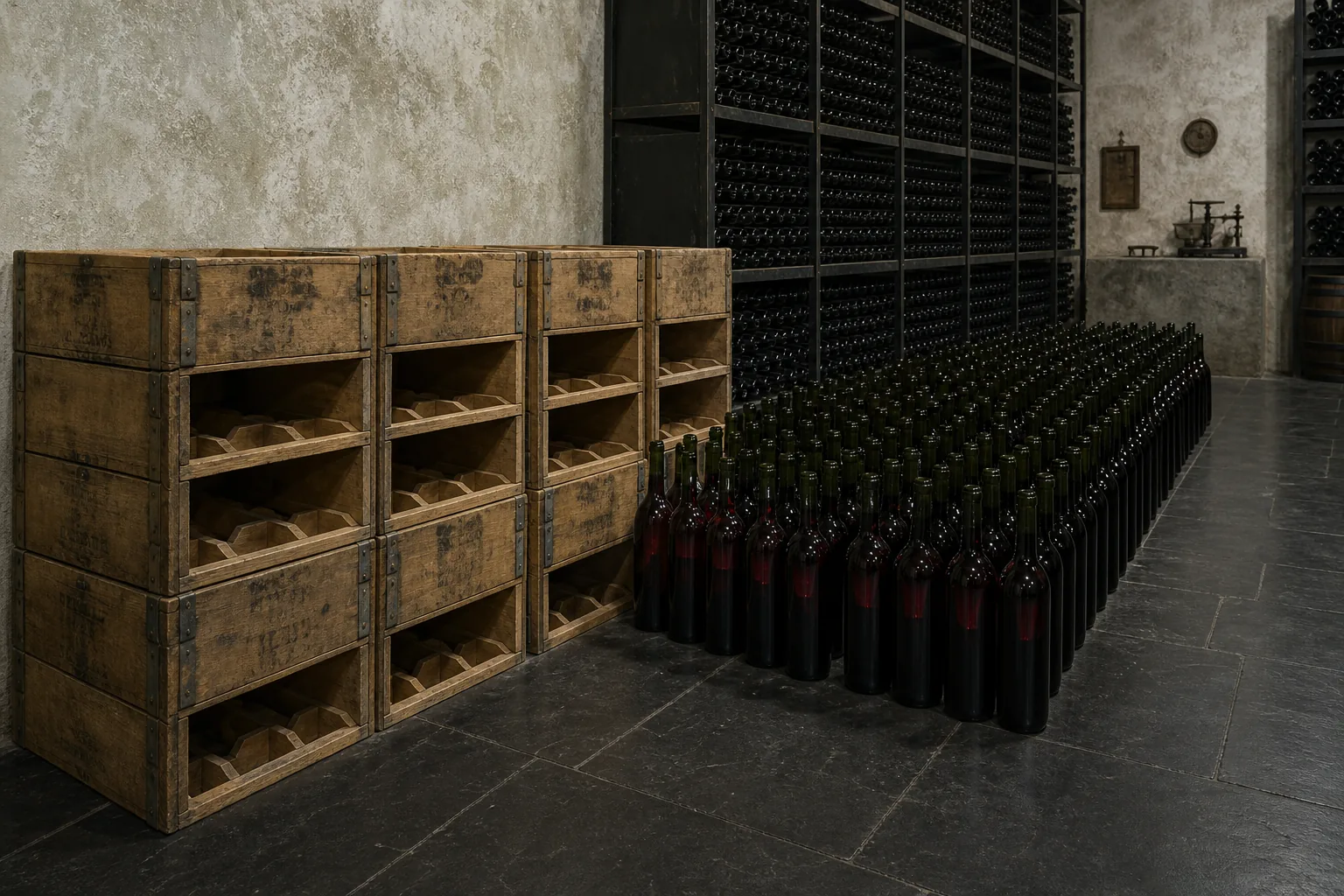
Thomas had chosen the bottle by reading the place name aloud.
He did this in the way people read a verdict.
The name was long, accented, and printed in a typeface that had clearly been through something.
“There,” he said. “That tells us what it will be like.”
Clara looked at the label.
“Which rule do you think you’ve just tasted?”
Thomas looked again, as though the answer might have appeared in smaller type while he was speaking.
The bottle sat on the kitchen table beside the glasses and a loaf of bread that had been cut with alarming confidence.
Nothing about the room had become more Tuscan, Burgundian, Californian or Ontarian. This was inconvenient, but legally unsurprising.
“It is from there,” Thomas said.
“Possibly. Continue.”
And “possibly” is the entire distance between a rule and a mouthful.
Because an appellation is a rule for making a place claim.
A tasting note is a prediction about what will happen in your mouth.
They travel together very successfully. They are not the same object wearing different hats.
What Does an Appellation Actually Guarantee?
The useful question isn’t whether the AOC, DOC, DO, AVA or VQA name is impressive.
It’s what that name obliges a producer to prove.
Under European protected-origin rules, a producer may use a PDO or PGI name only when the wine conforms to that name’s specification.
The protection reaches misuse, imitation, evocation, translation, and even helpful little phrases like “style,” “type” and “imitation.”
A qualified new cellar may sell you the name. An old cellar doesn’t own it merely by having spent a decade becoming associated with it.
That’s a legal claim, not a coronation.
DOC and DOCG wording, official seals and control marks mean the wine has entered a regulated system.
They do not mean you are required to enjoy it.
Civilization retains this small liberty.
The specification behind a name can be enormous.
It can cover the product name and category, the analytical and sensory characteristics, the geographic area, the production rules, packaging, storage, presentation, declarations, records, checks, and who is authorized to run the checks.
France asks for three linked elements: the natural factors, the product characteristics, and the causal relationship between them.
So a name can govern location, varieties, yields, harvesting, processing, aging, bottling and label terms, where its own specification says so.
What it can’t do is make every European bottle a small machine that prints the same fruit, the same texture and the same mood.
The rulebook isn’t a palate.
Thomas tapped the label.
“So it has rules.”
“It has a claim.”
This seemed less glamorous. A claim, after all, is something you can check. It has none of the soft furnishings of a sense of place.
There are real checks behind it. Verification is annual, and it includes analytical and sensory testing alongside everything else the specification demands.
A laboratory can measure your wine’s alcohol, sugars, acids, sulfur dioxide and pressure. A panel can examine the appearance, the smell and the taste for you.
None of that proves origin.
A laboratory can report an acid. It cannot watch a grape leave a field.
The origin you care about belongs to source records, lot identity, inspection, declarations and material balance: qualifying grapes in, qualifying wine out, losses and stock accounted for.
Wine is many things. It is also paperwork with consequences.
The Spanish Txakoli system makes it unusually visible.
Every lot seeking the DO is controlled, an anonymous sample is analyzed and tasted by a trained committee, and a qualifying lot gets numbered back labels.
The panel examines what you will drink. The records connect it to the place. Those are two different jobs.
Why Appellation Does Not Guarantee Flavor
Thomas brightened.
“But an appellation tells me what grapes it uses.”
“Sometimes,” Clara said.
This small word did a great deal of work, which is generally a sign that somebody has paid for it.
An American Viticultural Area is a useful counterweight to the grand European impression.
For a named AVA, at least 85% of the wine by volume must come from grapes grown in that area, and the wine must be fully finished in the state or states where the AVA sits.
What it doesn’t give you is a list of permitted grapes, a maximum yield, a training rule or a taste panel.
That isn’t thin information. It’s origin information, and origin matters. It is simply not a recipe for flavor.
The other American place claims work the same way, at different resolutions. A state claim gets you at least 75% from that state.
A multi-county claim needs all of it from the named counties, with the percentages shown.
The word place has several legal meanings before the cork even leaves the bottle.
Ontario VQA takes another route again.
Every VQA wine starts at 100% Ontario-grown grapes.
A regional claim like Niagara Peninsula runs on more than 85% regional fruit with the balance from Ontario, and a sub-appellation is entirely from its sub-area.
VQA also regulates names and boundaries, permitted varieties and ripeness, composition, winemaking technique, labeling, and the finished wine’s sensory and chemical criteria.
And yet Ontario wineries may grow permitted varieties anywhere in the province and make a very wide range of styles inside all of that.
A vintage-dated VQA wine needs at least 85% of its grapes from the stated year, and the front label has to say where they grew.
Vintage, origin and style are three pieces of information. They have not agreed to merge for your convenience.
“So the label remains useful,” he said.
“Yes.”
This was a significant concession. The label hadn’t been exposed as a fraud.
It had merely been demoted from oracle to evidence.
The consequence is practical.
Your place name tells you a stated geographic and production claim has been met.
It cannot tell you whether this producer picked earlier, used a different rootstock, chose a different fermentation, blended differently, or made a style that flatly disagrees with the brochure’s best posture.
What Terroir Can and Cannot Explain
“Then what is terroir for?” Thomas asked.
“Explanation,” Clara said. “Sometimes.”
The vintage entered the room and declined to be ignored.
Terroir isn’t the corrective fantasy in which the rocks finally explain everything.
Its defensible form is a chain. Site conditions change what your vine experiences. Vine physiology changes the fruit composition.
Fruit composition and production choices change the wine. Repeated patterns become a candidate expression of place.
Every arrow in that chain needs evidence.
A soil map helps you with the first arrow, at the scale it actually supports.
A tasting result can show you a difference at the far end. Neither one, on its own, proves why the difference happened.
In between sit variety, clone, rootstock, vine age, row orientation, water status, yield, harvest date, fermentation, maceration, blending, filtration, maturation, and the rather stubborn fact that weather keeps happening.
Soil is consequential, and you should know how. Its strongest pathway is not minerals crawling into your glass in tiny waistcoats.
The physical properties matter most, and they matter mostly through water.
They govern aeration, rooting volume, root-zone temperature and sometimes nutrient supply, and those govern water status, canopy growth, yield and ripening.
Direct links from soil chemistry to sensory character are comparatively weak.
Scale matters just as much. Geology gets mapped coarsely. Soil gets mapped finely.
A map’s scale has to travel with its claim, or the claim is borrowing authority it hasn’t earned.
A weather station some distance away describes a regional season perfectly well.
It can’t pronounce on the frost, wind or humidity in every folded slope nearby.
Push the temperature high enough and the vine’s photosynthesis falls away and the anthocyanins suffer.
A seasonal average, standing on its own, has missed the plot.
Thomas poured the wine.
“The soil is not in it.”
“Not as a flavor word.”
This was, perhaps, the worst possible news for certain restaurant lists. Water, roots, vigor and ripening are not less real for making poorer wallpaper.
The cellar stays in the story too.
A small analytical difference in the fruit can be perfectly real and then vanish in the bottle after acid adjustment or blending.
A measurable difference in an aroma compound may be real without being perceptible at all.
Terroir is a mechanism for you to investigate. It’s not a shortcut around investigating.
How to Use a Place Name When Buying Wine
The most useful version of Thomas’s original idea is much smaller.
Use the place name first.
It narrows your origin, tells you what kind of regulated claim you’re looking at, and suggests the questions worth asking.
Then go looking for the producer, the vintage and the stated style, plus whatever production choices the label or the merchant actually discloses.
An appellation is a filter. It is not a mouthfeel in formal dress.
Vintage matters because spatial pattern and seasonal variation both exist at once.
Blind work across contrasting vintages in one famous zone found real differences in color and aroma between sub-units, and found that those differences were not stable in every year, and were least pronounced in the wettest one.
A place can be coherent without being identical to itself whenever you ask.
None of which is a reason to abandon the appellation for a bottle with a cartoon animal on it.
That would be theatrical and, more importantly, unrelated.
It is a reason to stop asking the appellation to do the producer, season and style work it never promised you.
When the place name is doing most of the persuading, buy one bottle before you buy a case. Taste the vintage you’re actually buying.
If the claim matters to you, see whether the producer explains the site through heat, water, roots, ripening and fruit composition, and whether the evidence fits the size of the assertion.
“The vineyard tastes of its wind” is evocative. “Cooler ripening was associated with a different precursor profile” is a claim with somewhere to go.
Thomas tasted the wine again.
“What does the appellation tell me it tastes like?”
Clara considered the bottle.
“That it may call itself that.”
He looked mildly offended by the brochure, which was an improvement on being persuaded by it.
The label had not become less useful.
It had simply stopped pretending to be the glass.
Put it into practice
- AOC/AOP and many DO/DOC systems use product specifications, while a U.S. AVA principally substantiates grape origin and finishing location.
- A wine using a named AVA needs at least 85% of its volume from grapes grown there and must be fully finished in the relevant state or states.
- Ontario VQA wine starts with 100% Ontario-grown grapes, but regional, sub-appellation and vintage claims have separate thresholds.
- Appellation compliance can govern origin, varieties, yields, processing, aging, records, testing and label wording without guaranteeing a universal flavor profile.
- Terroir claims require an evidence chain from site through vine response and fruit to wine, with production choices and vintage kept in view.
- Soil matters chiefly through water availability, roots and vigor rather than as a direct tasting-note lookup table.
- Vintage and producer choices can materially vary wines from the same named place, so an appellation works best as a buying filter rather than a sensory promise.
Asked across the table
- What does an appellation actually guarantee?
- An appellation guarantees that a wine may use a protected place name because it meets that system's applicable conditions. Depending on the denomination, those conditions can cover origin, grapes, yields, harvesting, processing, aging, records, testing and label wording. The guarantee is compliance with a defined claim, not a promise that every compliant bottle has the same quality or flavor.
- What does an AVA on an American wine bottle mean?
- A named American Viticultural Area means at least 85% by volume of the wine derives from grapes grown in that AVA, and the wine is fully finished in the state or states in which the AVA lies. Federal AVA rules do not themselves prescribe permitted grapes, maximum yields, training systems or a taste panel. State law may add further requirements.
- Are AOC, DOC, DO, AVA and VQA the same thing?
- No. AOC/AOP and many DO/DOC systems use a product specification that can regulate production and presentation in detail. An AVA principally substantiates a geographic grape-source percentage and finishing location. Ontario VQA regulates origin, permitted varieties, ripeness, composition, winemaking techniques, label requirements, and finished-wine sensory and chemical criteria. Each term must be read under its own rules.
- What does Ontario VQA tell a buyer?
- Ontario VQA wine begins with 100% Ontario-grown grapes and complies with the program's standards for origin, composition, production, labeling, and finished wine. A regional appellation such as Niagara Peninsula may use more than 85% regional grapes with the balance from Ontario, while a sub-appellation is 100% from that sub-area. VQA does not prescribe one universal regional flavor.
- Does a vintage date prove where the grapes came from?
- No. Vintage and origin are separate label claims. A vintage-dated Ontario VQA wine requires at least 85% of its grapes from the stated vintage, while its geographic claim must independently meet the relevant origin rule. A wine can be correctly dated and still make an inaccurate narrower origin claim, so one label element does not verify the other.
- Does passing a tasting panel prove that a wine came from the named place?
- No. Analytical and organoleptic testing assess characteristics such as alcohol, sugars, acids, appearance, odor and taste, but neither test alone proves vineyard origin. Traceability records, source documents, inspections and material balance establish the geographic claim. For an EU designation of origin, annual verification combines analytical and organoleptic testing with checks of other specification conditions.
- What happens if a wine fails an appellation rule?
- A wine that fails a protected designation's conditions can remain commercially sound, but it may lose the right to use that protected name. EU rules allow a product that fails PDO or PGI conditions to be marketed without that designation when other legal requirements are met. In one Spanish DO example, an unqualified lot must be kept separately, marked, and removed from the winery by 31 July of the relevant wine year.
- Can soil tell a drinker exactly what a wine will taste like?
- No. Soil physical properties most often matter through water availability, aeration, rooting volume, root-zone temperature and vigor. These can alter vine water status, berry development and ripening, then become wine differences subject to production choices. Simple links from soil chemistry or a rock type to a sensory descriptor are comparatively weak unless a measured pathway has been demonstrated.
- What evidence makes a terroir claim convincing?
- A convincing terroir claim follows a measured chain from site conditions to vine response, fruit composition and wine difference. It records possible confounders such as variety, clone, rootstock, vine age, harvest timing and cellar treatment. Matched production, blind analysis and repeated observations across seasons provide stronger evidence than a memorable commercial tasting or a map presented without a mechanism.
- Why can two vintages from the same appellation taste very different?
- Seasonal timing can change a wine's expression even when the named place remains the same. Frost, flowering rain, heat during color development, water availability and cool ripening periods alter vine response and fruit. In a Chianti Classico study across three contrasting vintages, differences among units were less pronounced in the humid 2014 vintage and were not stable across all years.
- How should a place name be used when buying wine?
- A place name works best as a first filter for origin and the production claim that the relevant system regulates. Producer, vintage, variety, stated style and price remain separate decisions because site effects interact with season, plant material and winemaking. When the place name supplies most of the persuasion, one bottle is a more informative commitment than a case.